Arizona Senate passes SB 1106 to conform state tax code to federal changes amid partisan rift
Loading...
Summary
The Arizona Senate passed SB 1106 on Jan. 14 by a 17-12-1 vote to align state tax law with federal HR 1 provisions; supporters said the measure provides certainty and benefits businesses, while opponents warned of large multi-year revenue losses and limited help for families on child-care waitlists.
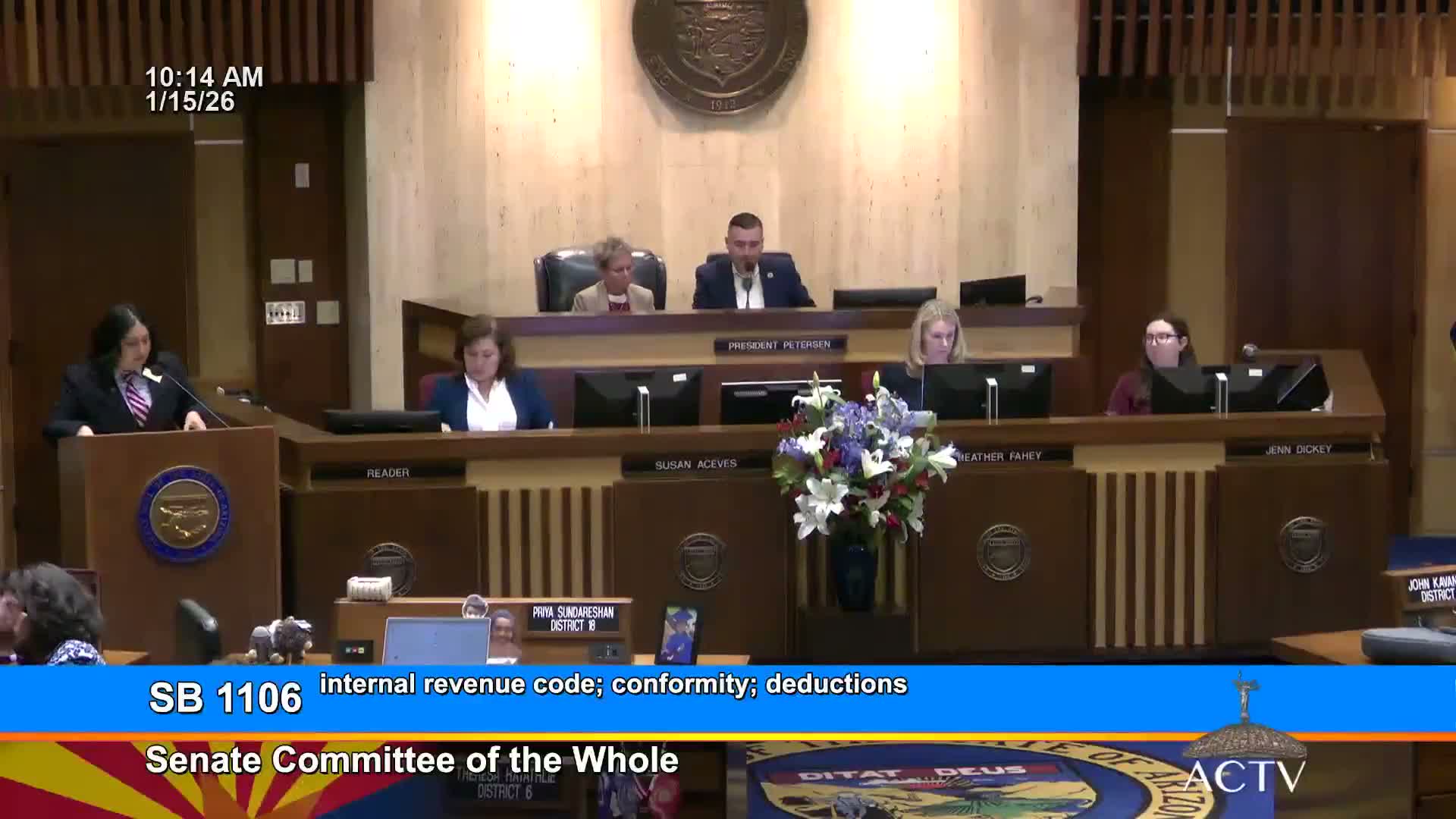
The Arizona Senate on Jan. 14 approved SB 1106, a bill to conform the state's tax code to federal changes, after several hours of debate and a final roll-call of 17 ayes, 12 nays and 1 not voting.
Supporters said the bill provides certainty for taxpayers and businesses and preserves tax reductions they described as pro-growth. "Businesses are not the enemy," Sen. Percy said in explaining his vote, urging colleagues to support the "full package" of individual and business tax relief. Proponents argued conformity would simplify filings for many taxpayers and encourage economic activity.
Opponents said the bill would sharply reduce state revenue and disproportionately benefit higher-income Arizonans. "We have seen one of the biggest transfers of wealth, from the lower class to the upper class in United States history," Sen. Ortiz said during floor debate. Sen. Sundarachian called the measure "irresponsible," citing cost estimates he described as forecasting a first-year loss of "$440,000,000" and total losses that "will cost our state over $1,000,000,000 in revenue." Sen. Epstein likewise warned the bill could cut "$1,200,000,000 over the course of 3 years," and criticized the expansion of tax-credit and voucher-like programs tied to the federal provisions.
Several Democrats also said the bill does little to help families currently on child-care assistance wait lists. "As of January 9, there are 10,762 children on the DES wait list," Sen. Diaz said, adding that the bill's deductions or credits would not aid families who cannot afford child care now.
On procedure: the Senate resolved into the Committee of the Whole and a committee motion to report SB 1106 "do pass" was moved by Sen. Meznard and later adopted on the floor after a committee voice vote. Sen. Angus moved the committee report be adopted on the floor. After third reading, the clerk opened the electronic voting system and senators explained their votes before the final tally.
The clerk was instructed to record the vote and transmit the bill as required. The journal records both that the secretary was instructed to transmit the bill to the House following passage and, later in the session, a message noting SB 1106 was transmitted to the governor.
What happens next: with passage in the Senate, the measure will follow the normal legislative process for the House and executive consideration; the journal shows transmission steps were initiated during the same session.
The session then recessed after a separate proclamation in support of law enforcement was read by Sen. Shauna Bullock.