Get Full Government Meeting Transcripts, Videos, & Alerts Forever!
Get email alerts on the Professional Licensure Military Spouses topic
No spam. Unsubscribe anytime.
Senate panel advances bill to expedite professional licensure for service members and military spouses
Summary
The Senate Transportation, Highways & Military Affairs Committee advanced Senate File 119, which would require licensing boards to issue a license or temporary permit within 30 days to qualifying service members and military spouses and to adopt online application procedures; the committee approved a technical correction and sent the bill forward.
Senate File 119, a bill to speed professional licensure for active-duty service members, recently separated veterans and military spouses, passed the Senate Transportation, Highways & Military Affairs Committee after testimony from military representatives, local officials and military spouses.
The measure would require a professional or occupational licensing board to issue a license or a temporary practice permit within 30 days of receiving an application from a qualifying applicant who holds a substantially equivalent out‑of‑state license. The bill defines eligible applicants to include active duty service members, spouses and people honorably discharged within two years. It also requires boards to adopt rules and to offer online applications; the bill sets a July 1, 2025, effective date.
Supporters say the change responds to delays that keep military spouses from working when families relocate for military orders. Sponsor Senator Bonar told the committee he drafted the bill after hearing that “it may take up to six months or even longer to get a license through some of these licensing boards,” a delay that can prevent families from finding work during short tours. He said the bill aligns state statute with recent federal requirements that states provide expedited licensure when applicants already hold a license in another jurisdiction.
Lieutenant Colonel Karen Hinkle, senior legal counsel for the Wyoming National Guard, described the bill’s temporary permit as “the intent so that [spouses] can begin the work and then go through the longer process of establishing that full license.” Hinkle cautioned that the committee’s proposed requirement that applicants provide a copy of military orders showing service “in this state” might unintentionally exclude returning residents who receive PCS or retirement orders differently; she offered to work with the sponsor on revised language.
Cheyenne Mayor Patrick Collins said the change matters locally because of the city’s large military presence. “Thirty percent of Cheyenne’s economy is made up by our military presence,” Collins told the committee, adding that spouses “keep hearing stories of military spouses who struggle to get a license to work in our state.”
Military spouse Katie Brown described multiple moves and licensing delays she experienced. Brown said other states, particularly Florida, have streamlined online military‑spouse licensing; in her example Florida issued a license within 10 days. “Wyoming has been a struggle,” she said, citing higher fees and a lack of a distinct online pathway for military spouses.
The bill requires applicants to provide proof of eligibility, which the draft lists as a military ID, a spouse’s ID or marriage license and a copy of military orders. It also directs rulemaking to implement the federal standard, recognizes military training as part of education or training credits where appropriate, and directs licensing boards to adopt online application processes.
Committee members asked how boards would meet the 30‑day timeline when some boards meet infrequently. Senator Bonar and other members said rulemaking could allow staff to grant permits when applications clearly meet the criteria, rather than waiting for a board meeting. The military department and municipal witnesses urged clear rules and online pathways so applicants can apply before arriving in Wyoming.
Committee members also approved a technical amendment changing a statutory cross‑reference on page 5 (committee record: two “26” references changed to “36”). The amendment was adopted by voice vote.
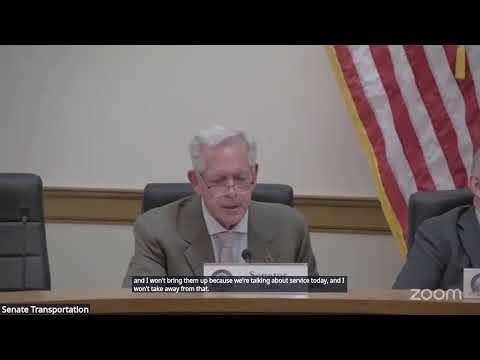
Motion and vote: The committee moved the bill on a motion by Senator Anderson and a second by Senator Cooper. In a roll‑call vote the committee recorded five ayes and no nays; the chairman announced, “That bill has passed the Senate Transportation.”
The bill will proceed to the next legislative step with committee direction to work with the military department on the language about orders and to finalize rulemaking details and online application requirements.