Get Full Government Meeting Transcripts, Videos, & Alerts Forever!
Get email alerts on the Affordable Housing topic
No spam. Unsubscribe anytime.
Quorum Court reassigns $1 million in ARPA funds to emergency operations center after debate over Accelerate housing project
Summary
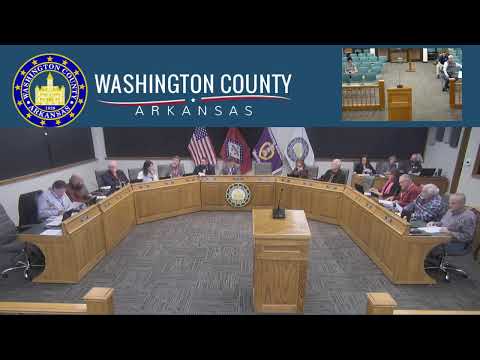
After an extensive presentation from Accelerate Foundation about a proposed Mercy Housing development in Springdale, the Quorum Court voted to request an ordinance allocating $1,000,000 of county ARPA funds to the county Emergency Operations Center rather than hold the money for the Mercy project.
The Washington County Quorum Court voted to ask counsel to draft an ordinance allocating $1,000,000 in county federal recovery funds to the county Emergency Operations Center, after a lengthy discussion about whether the money should instead remain available to an Accelerate Foundation‑backed affordable housing project.
The committee considered a presentation from Accelerate Foundation chief executive Webster, who outlined an affordable housing proposal in Springdale in partnership with Mercy Housing: a proposed 150‑unit development, structured as a 4% low‑income housing tax credit (LIHTC) deal with an estimated total project cost of roughly $45 million. Webster said the county had earlier received $1.4 million in ERA‑2 funds and $300,000 for nonprofit stabilization, and that an additional $1 million in fiscal recovery funds (FRF) originally set aside for two technical‑education buildings remained unspent and could be paired with the ERA‑2 dollars to leverage the larger Mercy project.
Webster described the Mercy proposal as a coordinated financing package that depends on commitments from multiple sources — including ADFA, the Walton family philanthropic support and other grants — and said the $1.4 million already awarded would be a final piece only if the rest of the capital stack could be secured. He said Mercy’s project would include units set at 50% and 60% area median income (AMI) and long‑term compliance to keep rents affordable.
Justices raised timing and feasibility concerns. Multiple members said the FRF $1,000,000 (previously appropriated for capacity expansions at local education and training providers) had a narrow commitment and expenditure window and that the Mercy project’s larger financing commitments might not be firm until late summer next year. County attorney Counsel Lester advised that the funds, as originally granted to Accelerate, carried grant strings; if Accelerate cannot meet the project milestones those dollars revert to the county and the quorum court would have to reallocate them.
Justice Lyons moved that the court request an ordinance allocating the $1,000,000 to the Emergency Operations Center; an amendment to leave the money with Accelerate failed on a roll‑call vote. On a subsequent roll call the court approved the request to draft an ordinance moving the $1,000,000 to the Emergency Operations Center; the chair said the motion carries.
Accelerate and Mercy officials said the Mercy project remains their preferred use of the funds and that the ERA‑2 dollars already awarded to Mercy would only be disbursed if the full financing package is secured. Accelerate also proposed an off‑ramp: if the larger Mercy deal cannot obtain state and private commitments, a smaller CDC‑led, shovel‑ready 24–25 unit project could receive the funds and begin construction more quickly.
The committee’s decision returns the unspent $1,000,000 to the quorum court to reallocate; a formal ordinance will be prepared for the full court. Accelerate said it will continue to pursue Mercy’s commitments and that any county dollars would be distributed only if all funding sources are confirmed.
Votes at a glance: after defeating an amendment to keep the $1,000,000 with Accelerate, the quorum court approved a motion requesting council draft an ordinance to reallocate the $1,000,000 to the Emergency Operations Center (committee roll call; chair announced motion carries).