Get Full Government Meeting Transcripts, Videos, & Alerts Forever!
Get email alerts on the Live Music Fund topic
No spam. Unsubscribe anytime.
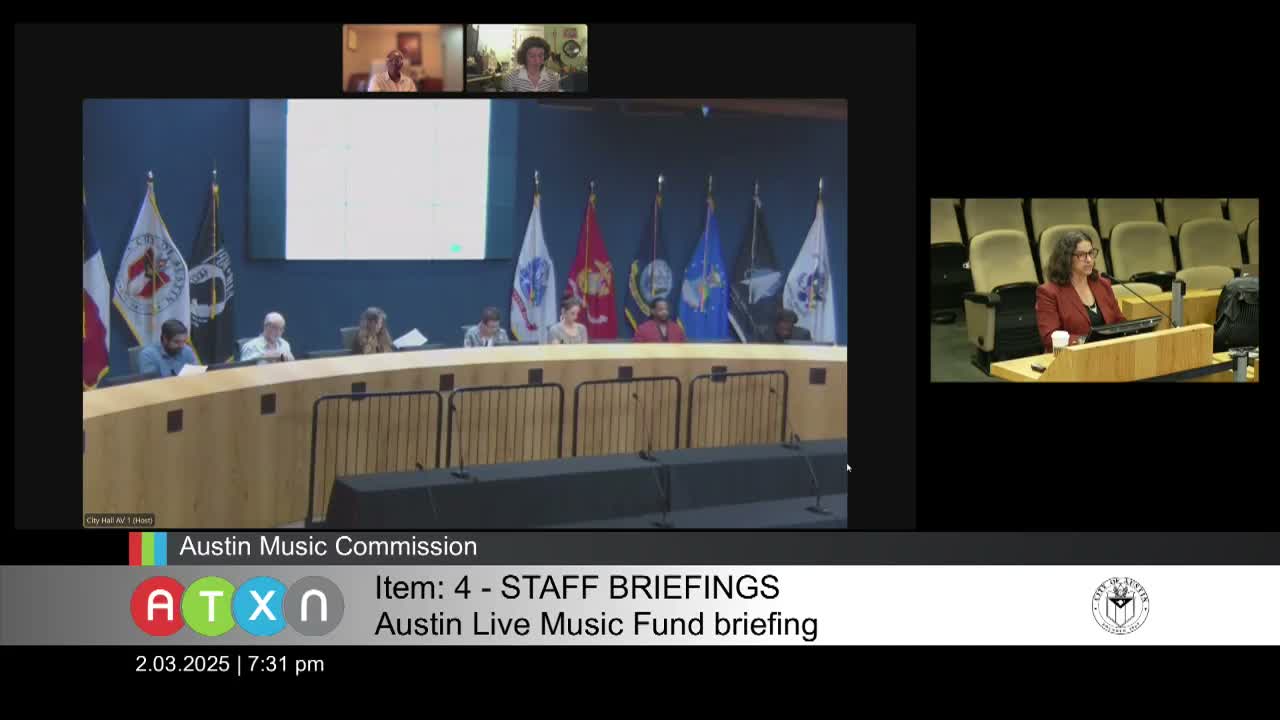
Austin Music Commission approves revised Live Music Fund criteria to expand awards to musicians and promoters
Summary
The commission voted to adopt new eligibility and scoring rules for the Austin Live Music Fund, splitting awards into $5,000 (one-year) and $20,000 (two-year) categories for musicians and promoters, and retaining $30K/$60K venue awards. The changes prioritize musician career accomplishments and local economic impact and direct staff to continue the
The Austin Music Commission approved recommendations to revise the Austin Live Music Fund for the 2025 rollout, changing award categories, eligibility and how applications are scored.
Under the approved proposal, musician and independent-promoter awards will be offered at two main levels: $5,000 awards that run for a single year and $20,000 awards that span two years. Venue awards remain at $30,000 for venues with operating budgets under $100,000 and $60,000 for venues with operating budgets above $100,000. The commission directed staff to use the new scoring weights and to continue administration through existing city processes.
Commissioners and community presenters said the revisions are intended to enable wider distribution of funds while preserving higher-dollar awards for larger or more established projects. The adopted scoring rubric places primary emphasis on an applicant’s career accomplishments (50 percent), local economic impact (25 percent), and a combined measure of past and future marketing plans (20 percent); accessibility features were included as a lower-weight criterion (5 percent). The recommendations preserve allowable uses listed under hotel-occupancy-tax (HOT) rules, including live performance, production (studio and video), event operations and marketing expenses, but emphasize public exhibition outcomes.
Community organizations and musicians who testified during the meeting and in working-group sessions supported clearer scoring, more transparency and outreach. Austin Musicians (ATXM) representatives and others urged improved communication on application scoring and suggested smaller award tiers to reach more working musicians; venue stakeholders urged a definition that prioritizes businesses for which live music is the primary function.
Debate at the meeting surfaced two tensions: (1) concerns from Commissioner Strickland and others that some prior awards had been spent in ways that reduced the number of awards available for other musicians, and (2) staff and community arguments that administrability and auditability require clear final-reporting and verification steps. Commissioners asked staff to ensure final-report checks are complete before applicants receive subsequent awards; staff indicated final reports and budget reconciliation are required for award closure.
The commission passed the recommendation in a recorded motion; a commissioner seconded the motion and the chair announced the motion was approved. Commissioners also asked staff to broaden outreach and application assistance and to share clearer examples of acceptable project budgets and final-report formats before the next application opening.
What changed from 2024: the 2025 recommendations split musician/promoter awards into two fixed tiers ($5K and $20K with the $20K award administered over two years), raise the emphasis on musician career accomplishments to 50 percent of score weight, explicitly require review of both past and future marketing plans, and keep venue definition and award levels aligned with the 2024 pilot but prioritize venues that list live music as their principal business function.
Commissioners, staff and community presenters said the directives aim to distribute funding more widely across working musicians while keeping targeted larger awards for projects with greater scope and financial need. Staff and the Long Center — the third-party administrator used in 2024 — will continue grant administration and final-report auditing under city procurement rules.
The commission also asked the working group and staff to return to the commission with any legal or procedural clarifications (for example accessibility scoring and any state law implications) well ahead of the next application cycle.