Get Full Government Meeting Transcripts, Videos, & Alerts Forever!
Get email alerts on the Legislation Briefing topic
No spam. Unsubscribe anytime.
City briefing flags firearms, DEI and utility bills as state priorities that could affect Austin music events and programs
Summary
City intergovernmental-relations staff briefed the music commission on the 89th Texas legislative session and bills tracked as relevant to city operations and the music industry, including proposed laws on firearms at events on government property, DEI restrictions, data sharing on homelessness, and bills that could limit city debt tools.
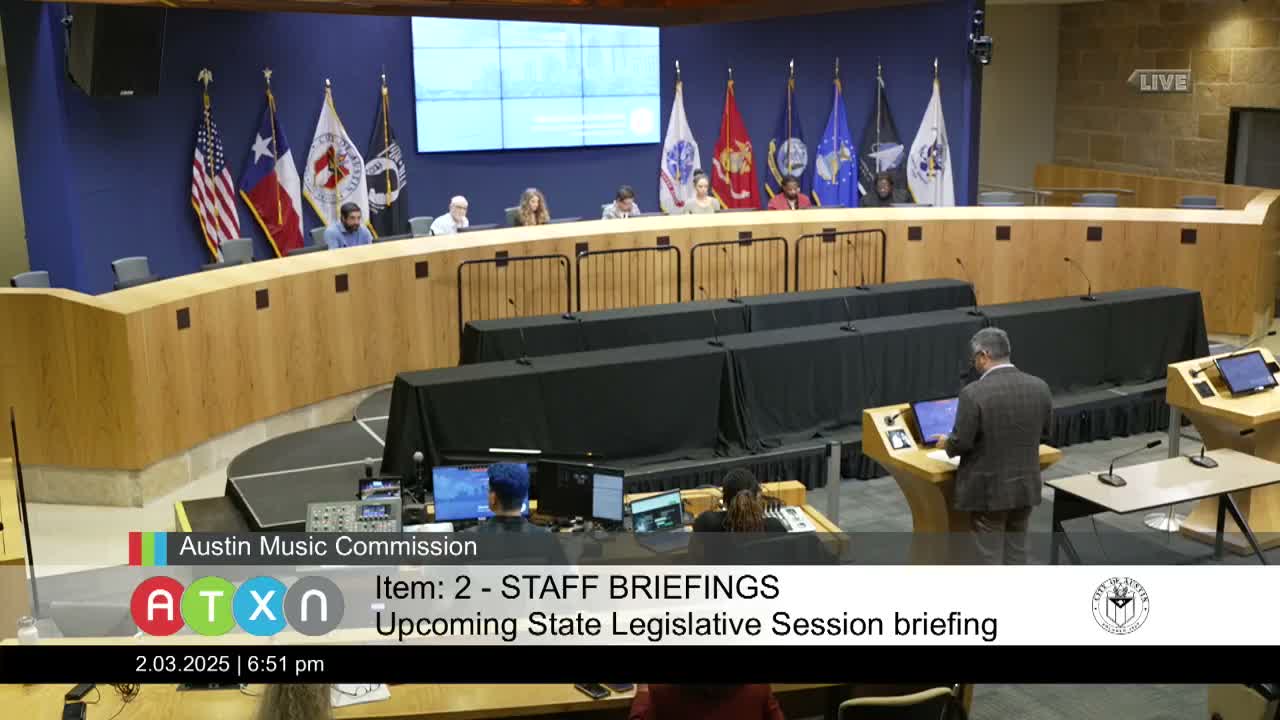
Rick Ramirez, deputy intergovernmental relations officer for the City of Austin, briefed the commission on the city’s 2025 legislative priorities and several bills the city is tracking that could affect music events, grant programs and city services.
Ramirez said the city’s legislative agenda focuses on preserving local authority, opposing unfunded mandates and supporting healthcare, public safety and protections for vulnerable populations. He flagged several bills of particular relevance to the commission: a measure (HB 1715, cited in the briefing) that would limit event organizers’ ability to prohibit firearms at events held on government property; several proposed bills restricting or banning municipal DEI programs (e.g., HB 167, HB 1521) and restricting the use of certain DEI terminology; proposals affecting certificates of obligation and municipal debt (HB 1453, SB 470); an AI-related bill (HB 1709); and bills that would help people experiencing homelessness obtain birth certificates or provide for data sharing (HB 505, HB 636, HB1042 were cited as examples). Ramirez said the city is reviewing impacts on cultural grants and festival planning, including insurance and safety costs for large events such as South by Southwest.
Commissioners asked how the firearms bill would apply to private clubs and to events on public property. Ramirez said the bill as drafted would prevent event organizers from prohibiting firearms at events held on government or university property, and that could dissuade out-of-state event organizers from bringing events to Texas. Commissioners also asked about the DEI proposals and their implications for grant language. Ramirez said city departments and the city attorney’s office are reviewing draft bills to determine what language would be permissible; he recommended that commissioners consult city legal counsel before changing program language.
Ramirez summarized other procedural matters for the session: the new Texas House speaker and committee rule changes, the unusually large number of bills filed, the 140-day legislative session timetable and that bills do not become law until enacted and signed by the governor. Ramirez said the intergovernmental relations office will keep departments and commissions informed and will work with departments if effective dates create unrealistic compliance timetables.
Commissioners requested follow-up information about the governor’s executive orders and potential impacts on cultural programs funded with local HOT revenues; Ramirez agreed to provide documents and guidance through the intergovernmental-relations office.