Get Full Government Meeting Transcripts, Videos, & Alerts Forever!
Get email alerts on the Property Tax Rate topic
No spam. Unsubscribe anytime.
Richmond council debates 4-cent property tax cut as CAO warns of $17M shortfall
Summary
At an informal Richmond City Council meeting, the mayor and the city’s CAO advised caution on a proposed four-cent real-estate tax-rate reduction, with the CAO projecting roughly $17.2–$17.3 million in recurring revenue loss and potential reductions to services and capital projects; council members requested more data before any formal vote.
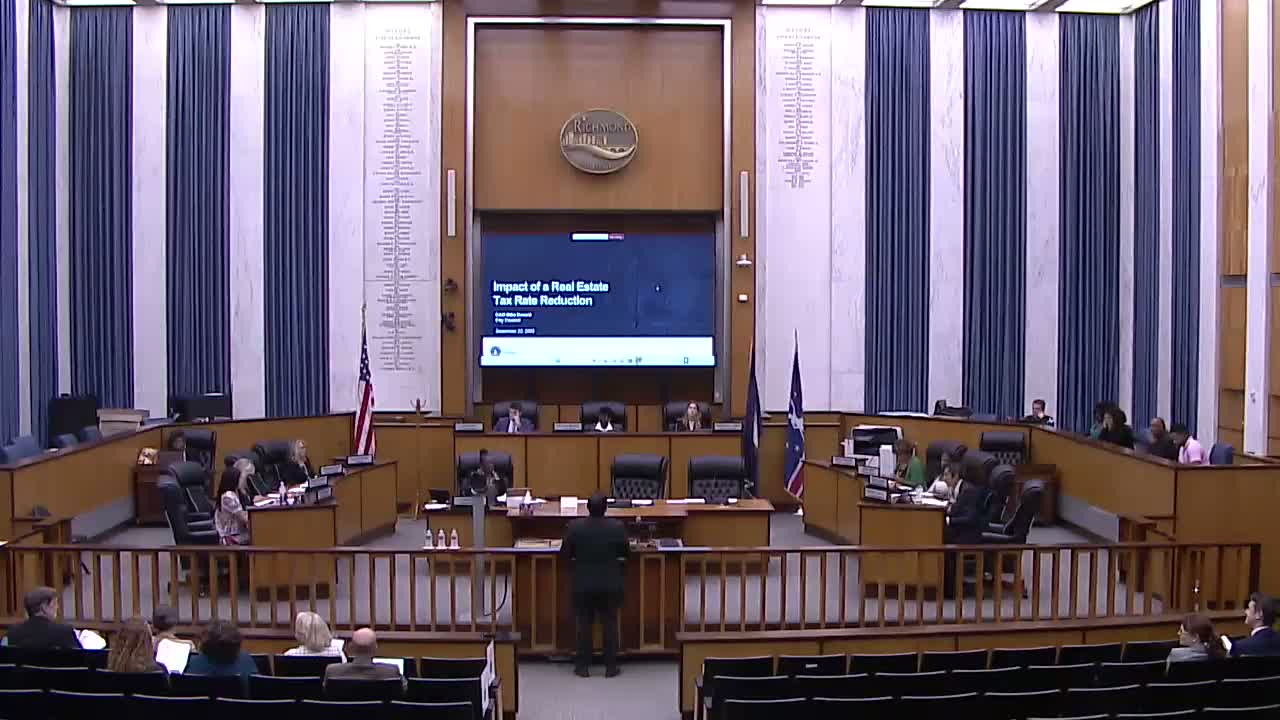
Richmond — Richmond’s informal City Council meeting focused on a proposed four-cent reduction in the real-estate tax rate, a measure proponents say would provide relief to homeowners and opponents say would endanger services and school funding.
Mayor Thor, who co‑patroned the ordinance with the council president, told colleagues he understands constituent concerns about tax burdens but that "this is not the year" to enact a broad rate cut. He said the proposed reduction would fall disproportionately on homeowners — roughly 44% of residents would see some direct savings while the majority of residents, renters, would not. "It’s a $17 million hit," the mayor said, and "it means potentially 150 or so staff" cuts or "a 13% reduction in our operating budget," if the revenue gap were not otherwise closed.
The city’s chief administrative officer, Mr. Donald, presented the administration’s fiscal analysis and framed the numbers as projections. He said general property taxes account for about 57% of the city’s revenue and that each penny of the tax rate represents about $4.3 million in annual revenue. "So for every penny, we'll call it about $4.3 million in revenue," Mr. Donald said, and estimated the proposed four‑cent rollback would reduce recurring revenues by about $17.2–$17.3 million and remove roughly $50 million in capital‑project support.
Mr. Donald warned that those reductions would ripple across the budget. He pointed to rising recurring obligations — projecting an initial collective‑bargaining cost increase of roughly $27–$29 million that compounds in subsequent years — and flagged long‑term liabilities and projects including a roughly $300 million estimate for the John Marshall Court Building, more than $100 million for bridge replacements, about $64 million for the main library renovation and about $40 million for flood‑wall and dam work. He cautioned the council could face a credit‑rating downgrade if revenues fell significantly.
Council members pressed for additional documentation. Councilwoman Gibson asked the administration to show the specific math used in the current fiscal‑year budget (which was developed using assessment projections) and to reconcile budgeted assessment growth with actual assessments, noting the council needs that analysis before making a rate decision. "I want to make sure I'm clear on the amount the assessment is based on," she said, asking for the projection vs. actual figures behind the adopted budget.
Several council members urged more time and public outreach. Councilmember Abubakar called the conversation a civic duty and argued the body must be mindful of state budget norms and public input; he warned that adopting the higher rate in the face of rising assessments amounts to "a tax increase." Councilmember Trammell and others asked for full documentation of projected collective‑bargaining costs, the status of rent‑relief program applications and the city’s surplus and contingency balances.
The city attorney summarized the legal timeline: notice of a new rate must be sent 45 days before the rate’s effective date (Jan. 1), and a new rate would need formal adoption by the Nov. 10 meeting to take effect for the next tax year. The attorney also noted the default if council takes no action is the statutory rollback rate (stated in this session as $1.14). The council did not vote on a new rate during the informal meeting.
On process, the mayor and CAO referenced recommendations from a recently convened budget task force and the Finance committee’s review; the mayor said that body had recommended against a mid‑cycle "side‑by‑side" rate cut and urged additional runway for administrative improvements before changing the rate.
Procedurally, the council agreed by consensus to move Resolution 2025 R035 to the consent agenda after staff confirmed the sponsoring entity had complied with CAR recommendations. The informal meeting was then adjourned; councilmembers said the tax‑rate proposal will return for formal debate and an eventual vote only after the administration provides the additional analyses requested.
What’s next: the administration agreed to supply the assessment math, projections and related documents to the council ahead of formal consideration; the city attorney said Nov. 10 is the last council meeting for a new rate to be adopted in time to take effect Jan. 1. No formal change in the tax rate was adopted at this meeting.