Get Full Government Meeting Transcripts, Videos, & Alerts Forever!
Get email alerts on the Death Penalty topic
No spam. Unsubscribe anytime.
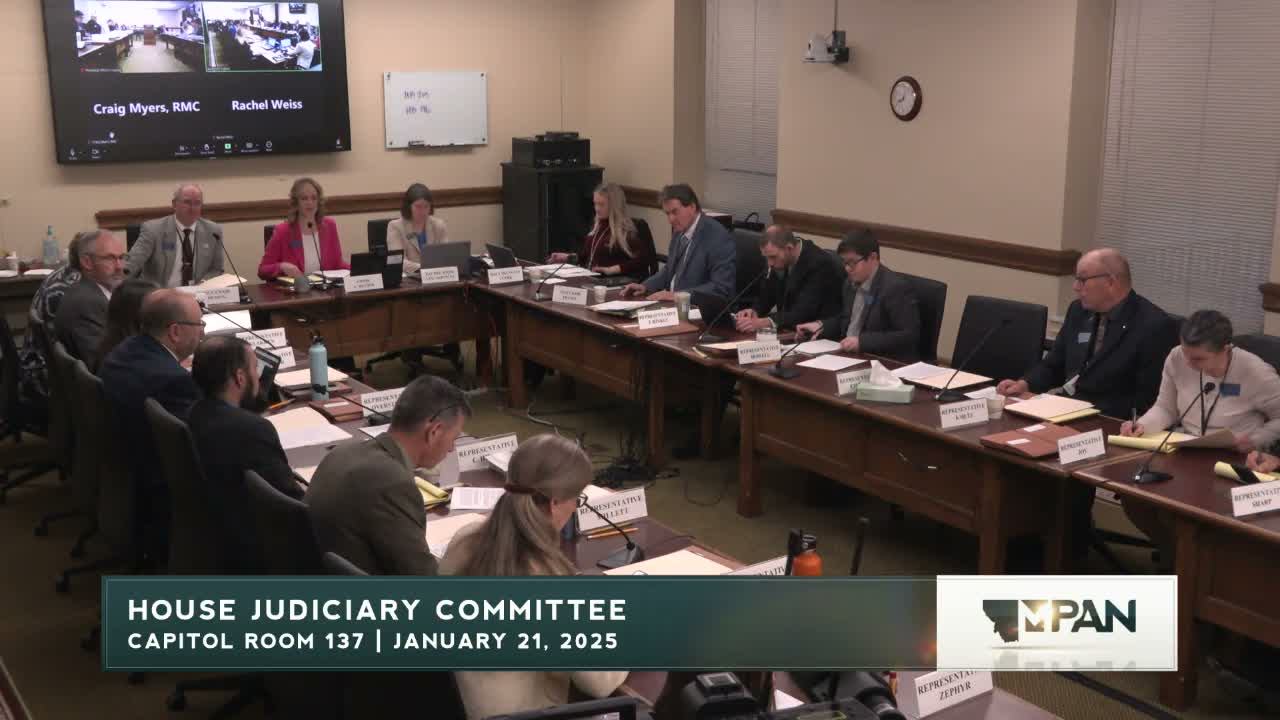
Montana House Judiciary Hears Bill to Broaden Lethal-injection Language
Summary
House Bill 205 would replace a statutory requirement that executions use an "ultra fast-acting barbiturate" with a broader phrase allowing "a substance or substances sufficient to cause death," a change supporters say would restore the state's ability to carry out executions and opponents say would invite constitutional challenges and risk cruel methods.
Representative Shannon Maness, sponsor of House Bill 205, told the House Judiciary Committee the measure is intended to address a practical barrier to carrying out executions: "We're looking at House Bill 205, an act revising laws related to the death penalty," Maness said, arguing that courts and drug shortages have left Montana unable to follow the statute as written.
The bill would remove a statutory requirement that an "ultra fast-acting barbiturate" be used in lethal injection and replace it with language allowing "a substance or substances sufficient to cause death," a change Maness said would let the Department of Corrections use whatever medically appropriate drugs are available. "This is not a bill on the death penalty. This is a bill on the administration of that death penalty," Maness said in closing.
Opponents ranged from civil-rights groups to faith leaders and innocence advocates. Alex Rate, deputy director and legal director for the ACLU of Montana, told the committee HB205 runs afoul of the Montana Constitution’s protections against cruel and unusual punishment and the state dignity provision. Rate warned the statutory breadth could allow dangerous alternatives and said, "Administering antifreeze or rat poison or cyanide in a sufficient quantity to cause death is the definition of cruel and unusual punishment." Several witnesses—the Montana Innocence Project and others—also emphasized the risk of wrongful conviction and the finality of execution.
Outside experts and agency officials provided operational context. Robin Maher of the Death Penalty Information Center told lawmakers "there is really no evidence to support the use of the death penalty as a deterrent" and described national difficulties states face obtaining pentobarbital and related drugs, including rising costs and manufacturer and export restrictions. Eric Strauss, deputy director for the Montana Department of Corrections, said the department has not developed a new drug cocktail since a 2015 court ruling and "we haven't contemplated what type of drug would be appropriate in this scenario." He said DOC's protocol requires contracting with a "qualified medical professional" to develop any lethal cocktail but that DOC has not researched which substances might be used if the statute changes.
Committee members pressed several topics in questioning: whether the bill should include statutory guardrails to limit unnecessary pain or suffering, who would select and administer any drugs and what medical qualifications they must have, and the likely fiscal and litigation costs of resuming executions. The sponsor argued constitutional prohibitions on cruel and unusual punishment make duplicative statutory language unnecessary; opponents and experts warned that the broader statutory language would likely prompt litigation and could permit unacceptable methods.
No committee vote was taken on HB205 during the hearing. Representative Maness recommended the bill "do pass" at the close of testimony. The committee scheduled executive action days later to consider items in members' folders, but HB205 remained under discussion at the end of the hearing.