Get Full Government Meeting Transcripts, Videos, & Alerts Forever!
Get email alerts on the Snow And Ice Operations topic
No spam. Unsubscribe anytime.
Public works committee presses DPW on December snow response, asks staff to study feasibility of refunding snow-and-ice fee
Summary
Milwaukee Common Council Public Works Committee questioned Department of Public Works leaders about communication, staffing, vehicle reliability and service levels after late‑December snow. The committee asked the comptroller, budget office and DPW to study whether it is legally and practically feasible to refund or alter the snow-and-ice fee.
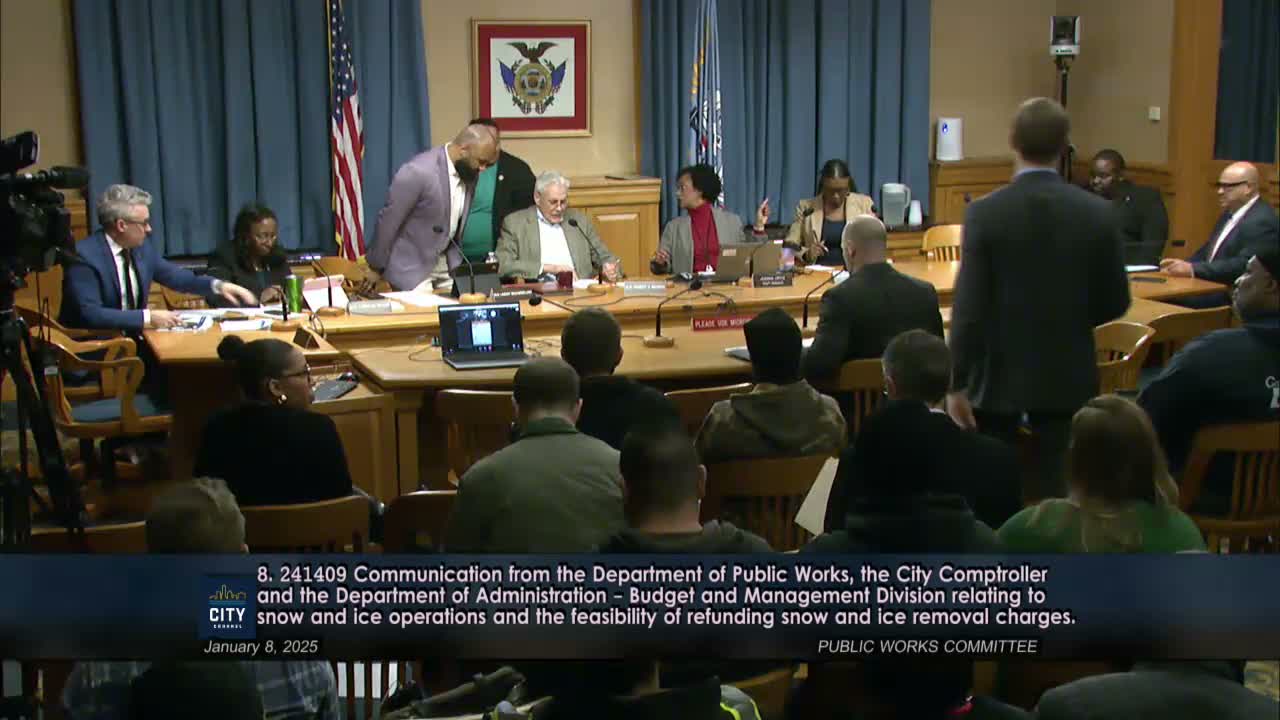
The Milwaukee Common Council Public Works Committee on Jan. 8 pressed Department of Public Works (DPW) leaders for details about the department's response to the late‑December 2024 snow event and requested staff study options for changing or refunding the city’s snow‑and‑ice fee.
The committee's discussion focused on three interrelated concerns identified by Alderman James Westmoreland: parking enforcement, leaf collection and the snow‑plowing operation itself. Alderman Westmoreland said he was not criticizing line crews but faulted leadership for “a lack of communication” and for not responding to constituent emails. DPW Director of Operations Danielle Rodriguez and Public Works Commissioner Joe Kruschick described how complaints should be entered into the city's 286‑CITY call center or the ClickForAction app so they can be dispatched, and acknowledged gaps in direct email responses during the operation.
Why it matters: committee members said residents pay an annual snow‑and‑ice fee (assessed by frontage) and expect a reliable service. Members pressed DPW for data on staffing, vehicle reliability, salt use, service standards and whether the fee can be adjusted or refunded midyear without creating budget shortfalls.
DPW officials described the operational timeline for the storm: pre‑treatment, salting of mains, then moving into residential districts as conditions allowed. Danielle Rodriguez said crews pretreated residential routes at 500 pounds per lane mile in anticipation of the storm, shifted to mains at 400 pounds per lane mile when accumulation increased, then returned to districts as conditions permitted. Commissioner Joe Kruschick added that during an active storm crews often must run repeated salt passes on mains while residential streets may only receive a center‑lane pass at first to keep arterial traffic moving.
Committee members pushed for concrete data. DPW said it would provide after‑action materials and operational summaries on request. Key figures discussed in committee testimony and DPW comments included: about 233 citizen calls logged to DPW during the event (DPW reported responding to those calls), an estimated 107 truck breakdowns that required shop work over the two‑day operation, and a reported average downtime per breakdown of about 1.5 hours. DPW staff also described a multi‑year effort to reduce total salt use citywide (from roughly 57,000 tons historically to about 37,000 tons in recent years) because of environmental concerns; council members contrasted that with year‑to‑year usage figures DPW reported (26,000 tons in 2023 and 32,000 tons in 2024) and budgeted salt purchases.
On service standards, DPW provided its response targets: a center‑lane pass on residential streets is expected within about 18–24 hours after snow stops; full curb‑to‑curb clearance can take up to 48 hours. DPW managers said those service levels reflect tradeoffs between cost, equipment and environmental impacts (salt reduction) and emphasized that residential service expectations differ from arterial streets.
Budget and fees: the committee discussed the snow‑and‑ice fee, which is assessed by linear frontage. DPW staff said the fee generates roughly $11.3 million in anticipated revenue in the 2025 budget and that the city counts that revenue when planning departmental expenditures. City Comptroller Bill Christianson advised that, under normal rules for charges for service, a fee must be tied to a current and direct service provided to a property; he said he was not aware of an existing city process that refunds the snow fee when residents claim poor quality of service.
Next steps and formal actions: the committee did not order an immediate refund. Instead it asked the comptroller, the budget office (Budget Management Division) and DPW to study the legal and operational feasibility of altering or refunding the snow‑and‑ice fee and to return findings to the committee. Committee members also directed DPW to share its internal post‑storm debrief documents and operational timeline with council offices and to accelerate planned technology pilots (vehicle GPS/camera telematics) and other improvements intended to improve accountability and data collection.
Quotes: Danielle Rodriguez, DPW director of operations, said, "For residents, the appropriate way to enter a complaint is through the call center, or through the app for the city of Milwaukee." Commissioner Joe Kruschick said the department will tell aldermen when a complaint has been entered into the call center and that "if that's not responded to in a timely fashion ... that's where it becomes a concern for the department." City Comptroller Bill Christianson summarized a legal point: "In order for a charge for service to be charged to a property, there must be a current and direct service provided to that property."
Ending: After extended questioning and cross‑examination by aldermen, the committee voted to hold file 241409 (the communication about snow and ice operations) and file 191930 (status of current and future DPW operations) to the call of the chair, and to receive and place on file file 241416 (Alderman Westmoreland's communication regarding the late‑December snow event). The committee asked the requested offices to return with a legal and fiscal feasibility analysis and with DPW operational summaries and data.