Get Full Government Meeting Transcripts, Videos, & Alerts Forever!
Get email alerts on the Capital Improvements topic
No spam. Unsubscribe anytime.
Planning Commission recommends five-year CIP, highlights municipal building and pedestrian priorities
Summary
After a presentation on the five-year Capital Improvement Program, the commission voted to recommend the CIP as presented; discussion focused on a proposed $24 million municipal building renovation, funding sources (bonds), sidewalks, the Bluestone Trail and project prioritization.
The Harrisonburg Planning Commission reviewed the city's five-year Capital Improvement Program (CIP) on Jan. 14 and voted to recommend the document as presented to City Council.
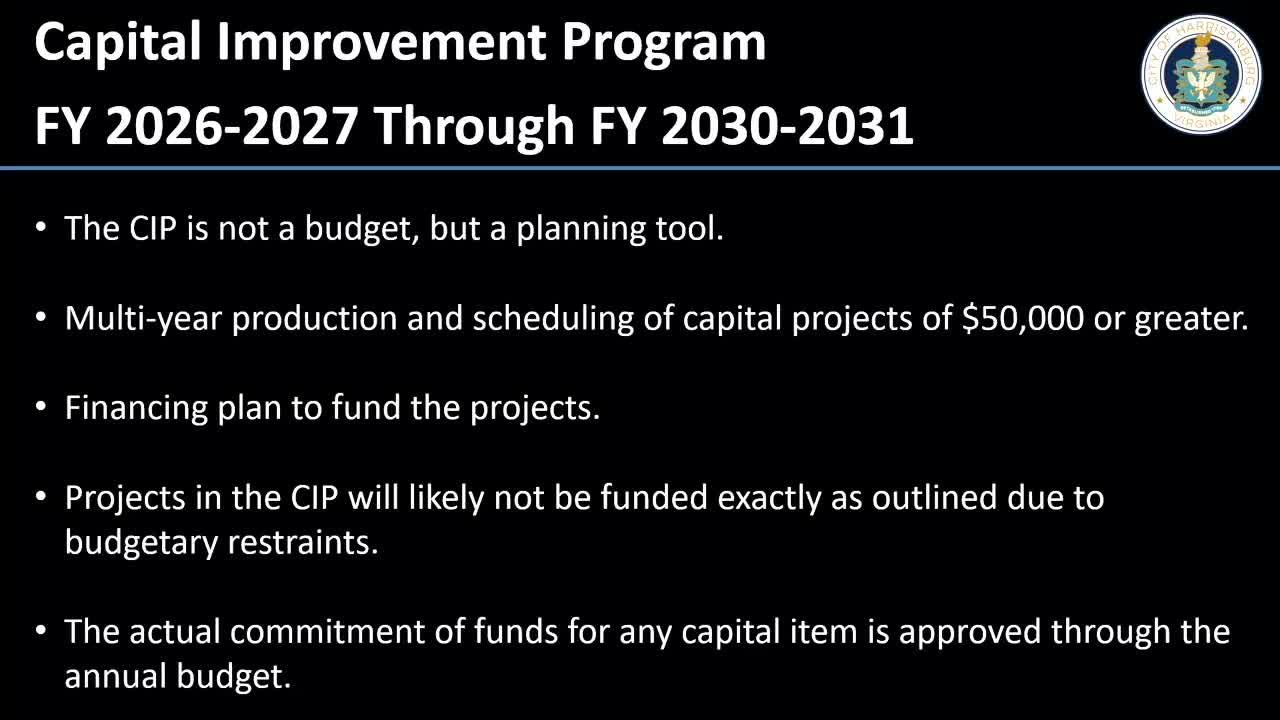
Adam Fletcher, director of community development, told the commission the CIP is a planning tool (not a budget) that lists capital needs of $50,000 or greater and outlines potential financing. Fletcher highlighted a proposed combined municipal building/City Hall complex renovation with a $24,000,000 cost estimate and explained that funding for major projects is often contemplated via bonding.
Commissioners asked about prioritization, alternatives and specific projects. Several commissioners pushed for clearer prioritization among the many priority-2 projects and raised safety-related project needs, including sidewalks near Rocktown High School and completion of the Bluestone Trail Phase 2. Commissioners also discussed fire-station timing, the planned renovation of parking decks at a later horizon, and the role City Council and the city manager's office play in ultimately allocating funds.
After debate, a motion to accept the CIP as currently presented passed on a roll-call vote. Commissioners noted the CIP identifies priorities and that further budgeting decisions will be made during the annual budget process and by council.
Staff encouraged commissioners and the public to review project sheets online and to engage in the process if they wish to influence prioritization.