Get Full Government Meeting Transcripts, Videos, & Alerts Forever!
Get email alerts on the Public Works Snow topic
No spam. Unsubscribe anytime.
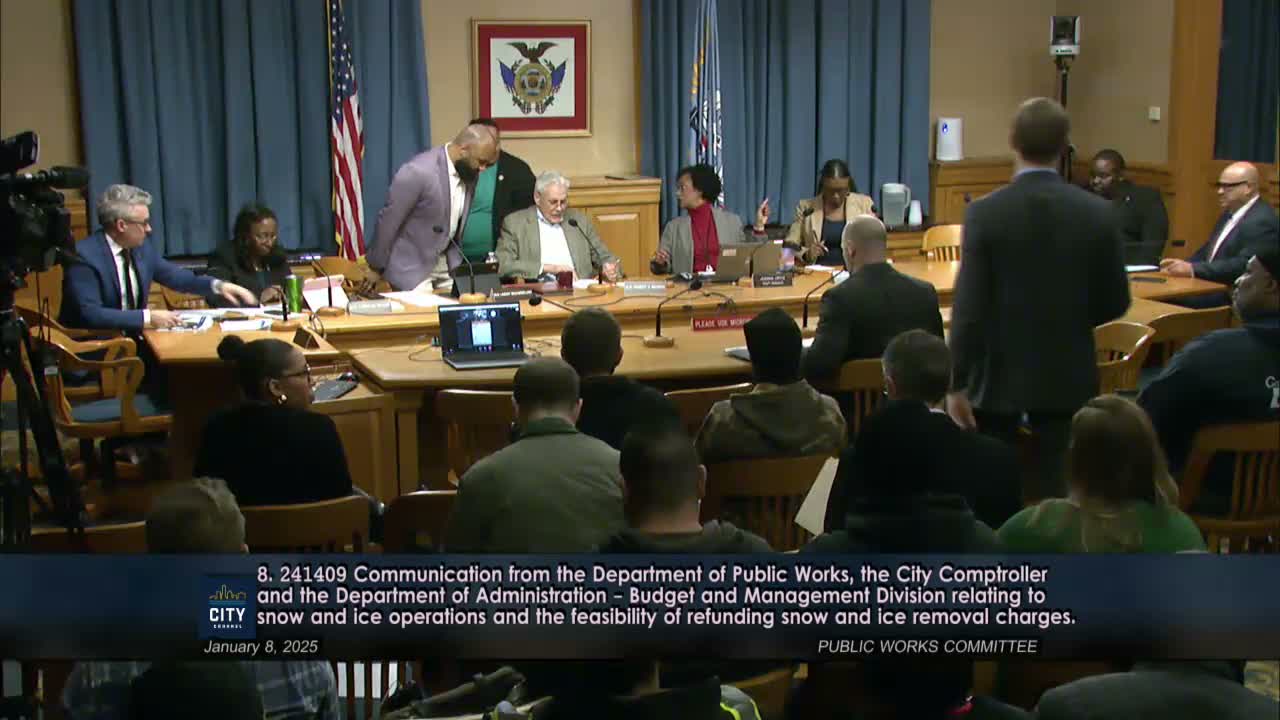
Public works committee presses DPW on December snow response, pauses snow‑fee decision
Summary
At a Jan. 8 Public Works Committee meeting, aldermen pressed Department of Public Works officials about communications, staffing, equipment breakdowns and service levels during a Dec. 19–20 snow event; the committee held further action on a proposed snow‑fee refund and asked staff and budget offices to study feasibility.
MILWAUKEE — The City of Milwaukee Public Works Committee spent the bulk of its Jan. 8 meeting examining how the Department of Public Works handled a late‑December snow event, and paused formal action on a proposal to refund or otherwise alter the municipal snow‑and‑ice fee.
Aldermen criticized lapses in communication with elected officials, uneven service across districts and a handful of operational breakdowns that they said left neighborhoods unplowed for longer than residents expected. Committee Chair Alderman Baumann and Vice Chair Alderman Westmoreland led questioning of DPW leadership, and the panel agreed to hold the file on refunding snow charges to the call of the chair while staff and budget offices study feasibility.
Why it matters: The city's snow‑and‑ice fee is an ongoing municipal revenue source used to fund snow operations; city budget documents included in the discussion list an anticipated $11.3 million from the fee for 2025. Committee members said residents equate the fee with an expectation of timely, reliable clearing, and they asked whether the city is delivering that level of service.
Alderman Westmoreland opened the discussion by telling DPW employees present that the meeting was not aimed at rank‑and‑file workers but at the “lack of communication from DPW leadership” and apparent gaps in quality control. Westmoreland said he had sent multiple emails after the Dec. 19–20 storm and had not received timely replies; he said residents expect aldermen to respond and hold officials accountable. “When it’s 2, 3 days after the fact and I’m forwarding those complaints and I’m not getting a response,” he said, “I’m sick and tired of taking the heat from my constituents.”
Danielle Rodriguez, DPW director of operations, said she received several of the forwarded emails but had been out for a medical procedure when the messages arrived and that she intended to respond once she caught up. Rodriguez and DPW commissioner Joe Kruschick stressed that the department relies on the city’s 286‑City call center and the Click‑for‑Action app to register and dispatch complaints because entries there populate the database managers use to schedule crews. Kruschick said that automatic complaints routed to dispatch are “instantaneous” and that if aldermen want staff to enter items into the call system when they forward emails, he will do so moving forward.
Operational details provided by DPW during the meeting:
- Staff and routes: DPW described roughly 102 frontline trucks per 12‑hour shift assigned to salt and plow operations, supported by mechanics, field support staff and managers. DPW said it maintains a small number of additional trucks to fill holes when routes are broken or vehicles are down.
- Salt and brine: DPW said the city’s annual salt use has fallen from earlier decades (the department cited historical use near 57,000 tons) to roughly 37,000 tons in recent years, a reduction planners attribute to environmental concerns for Lake Michigan. The department said a standard salting application for many conditions ranges from about 200–300 pounds per lane mile; crews increase to 400–500 pounds per lane mile in heavier storms. DPW also uses brine as a pretreatment on some routes.
- Equipment reliability: DPW reported fleet downtime during the two‑day operation. Department staff said there were roughly 107 vehicle breakdown events that required return to a shop during that period; department managers said average downtime for disabled equipment in this event was about 90 minutes. DPW staff said 12–18 months are typical for procurement of new plow trucks and that some vehicles budgeted in prior years were still in the procurement pipeline.
- Service levels and timing: DPW described a tiered service approach: arterial and high‑traffic streets receive priority and often reach near bare pavement; residential streets may have packed snow and a single center pass for 12–24 hours after snow ends, with curb‑to‑curb clearing assigned later (DPW cited up to 48 hours for curb‑to‑curb in some conditions). Rodriguez said the operation’s timing and the need to balance mains against districts require frequent pivots during the event.
Committee members raised several recurring concerns: inconsistent responses to constituent emails and phone calls from aldermanic offices; click‑for‑action or 286‑City reports that were difficult for some residents to use; a perception of uneven enforcement of parking rules that hampered plow access in parts of the city; and the age and availability of vehicles.
Alderman Rublelis questioned procurement timelines and how long recently budgeted new trucks would take to arrive; DPW said it expected some newly purchased trucks to be delivered within roughly 12–18 months and that planned purchases would incrementally reduce the proportion of older trucks in the fleet. Several aldermen requested post‑storm operational reports: DPW confirmed it prepares internal after‑action summaries and said it would share those reports with the committee.
On the snow‑fee file: Committee members asked whether it was feasible to refund or cancel the snow‑and‑ice charge for 2025. City budget staff said reducing the fee mid‑budget year would create a shortfall in an already balanced budget and the administration did not recommend a midyear refund; staff described a legal and procedural path that could allow the council to alter fee policy for a future budget year but urged caution before reversing budgeted revenue in 2025. The committee did not vote to refund the fee; members voted to hold the file to the call of the chair and asked the comptroller and budget office to provide additional legal and fiscal analysis on the feasibility and consequences of a refund.
What’s next: The committee agreed to hold the snow‑fee file (file 241409) to the call of the chair so that DPW, the comptroller and the budget office can return with a clearer legal and fiscal analysis. DPW also offered to host a training for aldermen’s aides to explain how the call center and complaint intake process work, and staff said they will share after‑action reports and fleet/downtime statistics requested by aldermen.
Quotes in context: “This is not about you guys at all,” Alderman Westmoreland told rank‑and‑file DPW workers in the room. “This is about the lack of communication from DPW leadership.” Danielle Rodriguez apologized for communication gaps and said she would ensure future messages from her office note when complaints have been entered into the call system. Commissioner Joe Kruschick said automatic complaints routed through the call center are the most efficient way to dispatch resources and that he will confirm when forwarded emails have been entered.
Ending: The committee’s action to hold the refund file and request more analysis stops any immediate refund of the snow‑and‑ice fee. Members said they will press DPW for clearer communications with elected offices, faster post‑storm reporting and faster adoption of vehicle camera and GPS pilots DPW said it plans to expand before next winter.