Get Full Government Meeting Transcripts, Videos, & Alerts Forever!
Get email alerts on the Zoning Code Amendments topic
No spam. Unsubscribe anytime.
Kearney amends unified land development ordinance: clarifications to definitions and conditional use permit rules
Summary
The City Council adopted code amendments to Chapters 12, 13, 14 and 59 of Kearney’s Unified Land Development Ordinances to clarify definitions (including townhouse, dwelling unit and conditional use permit), remove an obsolete two-family residential designation, and revise how conditional use permits are applied and transferred.
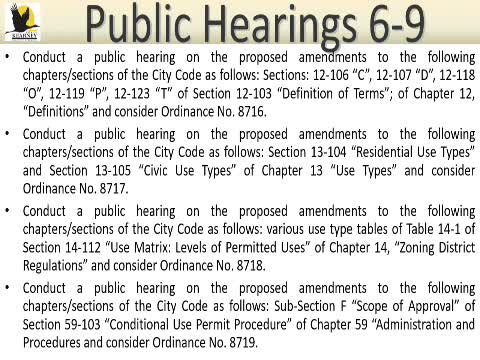
The Kearney City Council adopted a package of amendments to the Unified Land Development Ordinance (ULDO) that revise definitions, remove outdated use categories and clarify processes for conditional use permits (CUPs). The ordinances (Nos. 8716–8719) passed on unanimous votes.
City Planner Melissa Dorotheo Harris briefed the council on the changes, saying the amendments tidy definitions in Chapter 12 (adding a definition for “outlots,” clarifying “dwelling unit” to note a separate entrance, harmonizing the townhouse definition with Chapter 13 and clarifying conditional use permit language). Under Chapter 13 the staff proposal removes the obsolete “two‑family residential” label used prior to the 2002 code update. Chapter 14 changes reclassify some uses to be governed by conditional use permits instead of planned developments where appropriate; Chapter 59 also received targeted amendments.
Harris explained the practical difference: a conditional use permit is “a public hearing process. We notify the neighbors,” she said, and allows the city to attach conditions addressing potential neighborhood impacts that then run with the land. She added that the CUP process includes requirements for transfer notification so the city knows the new operator and can communicate any existing conditions.
Council members asked about one Planning Commission dissent on Chapter 14; Harris said one commissioner opposed the change because of concerns that CUPs might be viewed as temporary or create perceived business risk, and staff clarified that CUPs generally continue with the land so long as the conditions are met. The council approved Ordinance Nos. 8716 (Chapter 12), 8717 (Chapter 13), 8718 (Chapter 14) and 8719 (Chapter 59) and directed staff to publish the ordinances as provided by law.
What’s next: The code updates become effective as published and will be used in future permit reviews and Planning Commission applications.