Get Full Government Meeting Transcripts, Videos, & Alerts Forever!
Get email alerts on the Education Funding topic
No spam. Unsubscribe anytime.
Senate panel advances bill to send more district funds directly to charter schools, districts warn of shortfalls
Summary
The Senate Education Committee voted to advance Senate File 73, which would allocate a proportional share of certain district-level funding to charter schools. Supporters called the change an equity fix; district officials and the Wyoming School Boards Association warned it could underfund district services and create short-term budget gaps.
The Senate Education Committee on Jan. 22 advanced Senate File 73, a bill to change how certain district-level funding is allocated to public charter schools, voting to send the measure to the full Senate.
Supporters said the bill corrects an existing funding inequity by directing a proportional share of specified personnel and nonpersonnel components of the school funding model to the charter school that generates them. Opponents, including district finance officials and the Wyoming School Boards Association, said the change could shift hundreds of thousands of dollars away from districts that currently provide central services to district-authorized charter schools and leave districts with shortfalls until contracts are renegotiated.
The bill would calculate a charter school's share based on average daily membership (ADM) and flow the proportional amount to the school rather than retaining the funds at the district level, according to testimony from charter advocates. The measure does not alter other parts of the funding model that remain with districts, supporters said.
Tristan Green, chief financial officer for Albany County School District, told the committee he supports the bill but warned the outcome must not come "at the expense of the districts." He said districts are already facing rising costs, including for special education, and asked lawmakers to ensure funding changes do not reduce services for district K–12 students. "I do ask for your favorable consideration in this bill but not at the expense of the districts," Green said.
Carrie Klein, executive director of the Wyoming Public Charter School Association, told the committee the bill "really addresses an important, funding inequity that's currently existing for public charter schools" and that it would direct to the school the state dollars the school generates in the district's foundational model. Klein and other charter advocates said district- and state-authorized charter schools are different and that mutual agreements between authorizers and charter schools can (and should) govern how services are purchased when districts continue to provide administrative functions.
Several witnesses urged care in implementation. Brian Farmer, executive director of the Wyoming School Boards Association, argued that the state's prototypical funding model is built around school- and system-level resource blocks and that slicing central-office funding by ADM risks creating inconsistent funding across districts. "We end up with inequity. We end up with a disparity in the way that we are funding entities that is not uniform," Farmer said, urging the committee to consider alternative approaches for state-authorized charters.
Committee members and witnesses discussed practical effects on negotiated contracts for district-authorized charter schools. Senators and witnesses noted a potential near-term shortfall in districts that have five-year contracts tied to the current funding baseline; witnesses said those contracts would need renegotiation if the bill became law. Albany County's testimony estimated the bill could shift roughly $300,000 between two local charter schools if enacted.
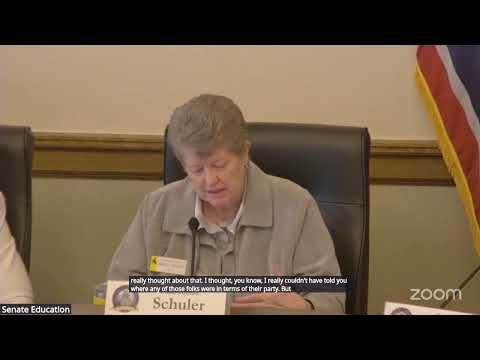
The committee voted to advance the bill. Recorded committee votes were: Senator Bridal—aye; Senator Olson—aye; Senator Rothfuss—aye; Senator Scott—aye; Chairwoman Schueller—aye. The committee chair said the measure will be taken up next on the Senate floor.
Committee discussion indicated support for the bill as a step toward equity, and several senators and witnesses recommended an interim study or recalibration of the funding model to examine long-term fixes and the possibility of creating shared back-office structures for charter schools.
The bill moves forward with directions from committee members to staff and interested parties to clarify implementation details, gather precise special-education cost data, and examine how district contracts should be treated during the transition period.