Get Full Government Meeting Transcripts, Videos, & Alerts Forever!
Get email alerts on the Honorary Signs topic
No spam. Unsubscribe anytime.
Council staff summarize survey on honorary street signs; DPW urges dedicated budget and event support
Summary
Staff reported survey results showing council interest in an outside review body, residency and living‑person eligibility, and limits on nominations; Public Works recommended a dedicated budget (about $700 per sign) and suggested contractors manage ceremonial installs to reduce burden on city crews.
Council legislative staff on Jan. 13 presented the results of a survey of council members about standardizing Richmond’s process for honorary street signs, and the Department of Public Works urged clearer budgeting and a reduced operational burden.
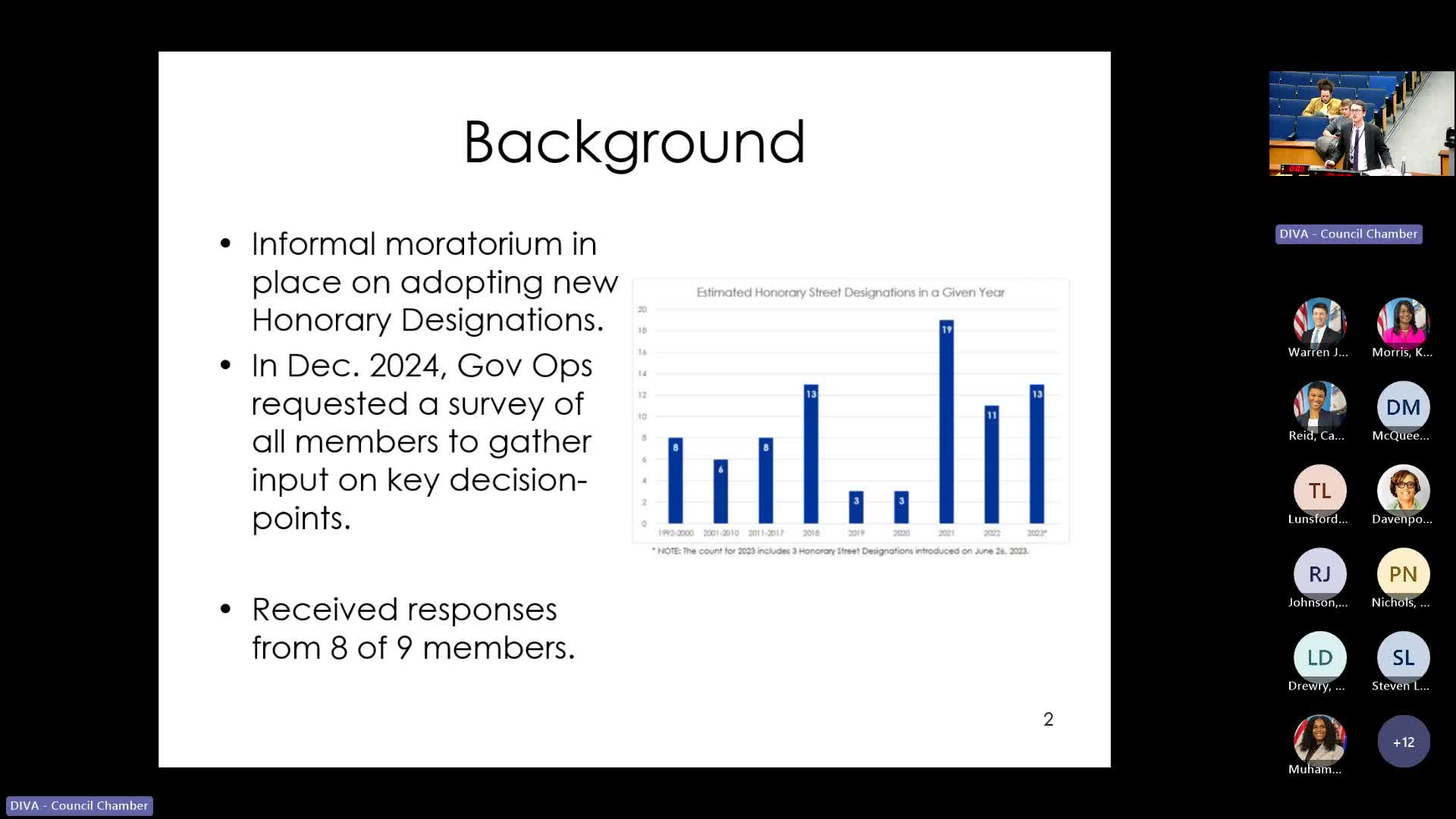
Senior legislative services manager Will Perkins told the Governmental Operations Standing Committee that eight of nine council members responded to the survey. A majority of respondents favored an outside body reviewing nominations before council consideration, most supported an annual limit on nominations by council members (though no single limit size reached consensus), and most favored eligibility for individual persons — including living people — with some Richmond residency requirement.
Perkins said respondents did not agree on which body should review nominations; two of the respondents suggested the History and Culture Commission but there was no clear majority. On frequency, there was no consensus whether council should act monthly as nominations arrive, quarterly or on another schedule.
Public Works Director Bobby Vincent told the committee the material cost to manufacture a single honorary street sign is roughly $700, but that the larger operational cost comes from the installation ceremony and related coordination. “When we're installing a street name sign that's dedicated to a family member, they actually become event coordinators,” Vincent said, noting that coordinating weekend ceremonies and family reveals is time‑consuming and not core public‑works work.
Vincent suggested either budgeting for a contractor to manage ceremonial reveals or creating a dedicated budget line so Public Works can plan staffing and logistics. He also noted transportation‑engineering concerns about multiple names on the same roadway and suggested alternatives such as mid‑block plaques to honor individuals while avoiding wayfinding confusion.
Council members asked staff to refine a proposal and suggested working offline with Perkins and administration to produce draft rules of procedure or an ordinance that clarifies roles (council, DPW, administration) and identifies funding and limits. Perkins recommended moving the topic through the rules‑of‑procedure amendment process and asked council members to identify a patron for the legislation.
No formal vote was taken; staff will circulate a draft recommendation for committee review.