Arizona Department of Revenue warns retroactive tax changes could trigger millions of amended returns and major staffing needs
Loading...
Summary
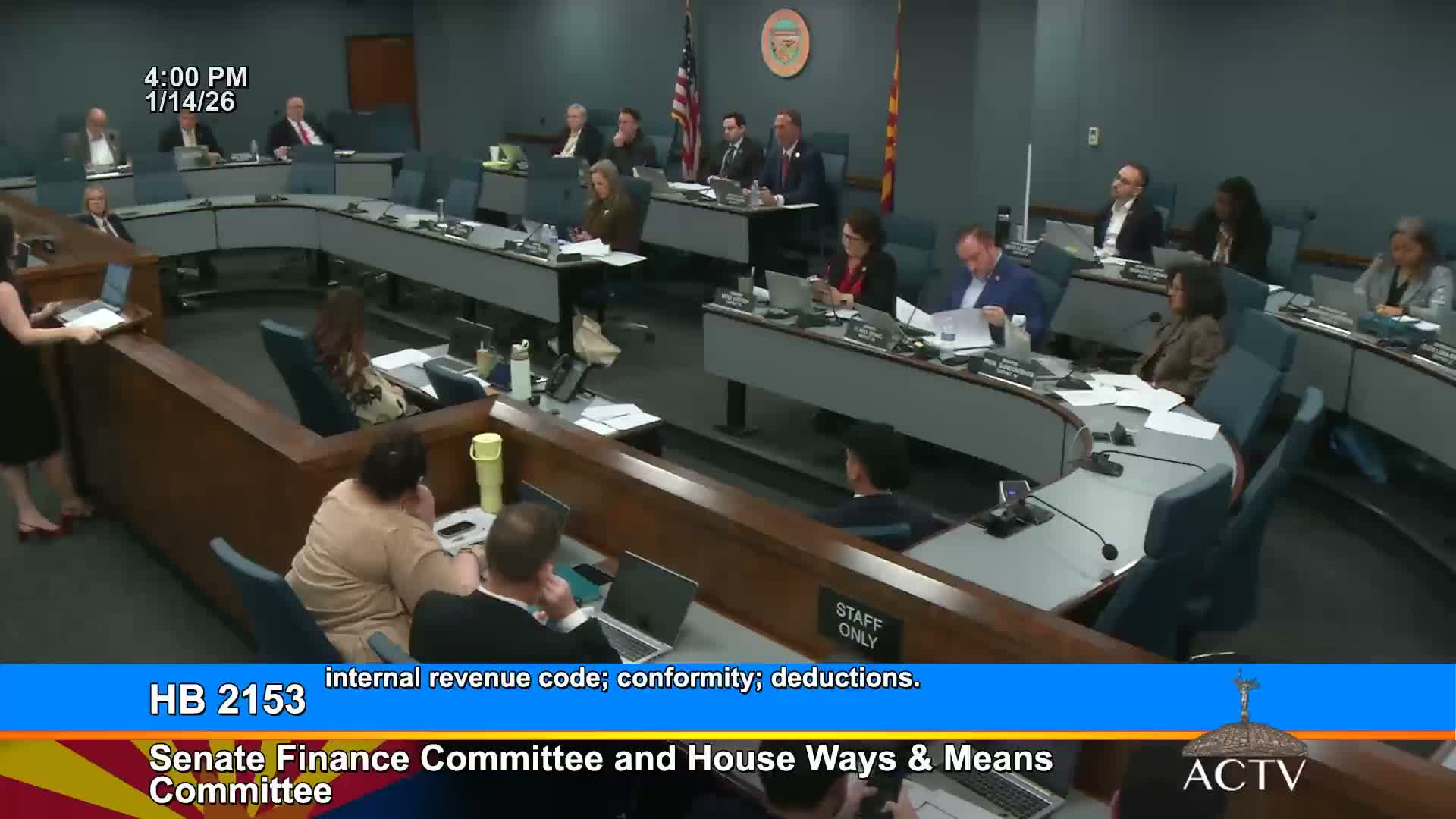
Molly Murphy of the Arizona Department of Revenue told joint committees that retroactive conformity items could create a surge of amended returns — potentially nearly 1,000,000 — and estimated DOR would need about $20 million and 200 temporary FTEs to maintain operations while processing additional filings.
Department of Revenue testimony at the joint Ways and Means and Senate Finance hearing focused on operational feasibility if the legislature enacts retroactive conformity provisions after the department and tax-software vendors have published forms.
Molly Murphy, speaking for the Arizona Department of Revenue, said the department is neutral on the policy but concerned about timing. "If passed and signed into law, we would expect to see nearly 1,000,000 amended returns coming in, which would bring the department's operations to a halt," she told the committee. Murphy added that absorbing that workload while continuing normal processing would likely require "at least $20,000,000 in [funding] and 200 FTE."
Rory Wilson, DOR’s subject-matter expert on forms, explained that vendors and the department coordinate on forms starting in November and that many software vendors have not yet completed testing to support electronic amended returns. "Paper is very labor intensive, and that's one of the operational concerns with late changes after forms have already been issued," he told lawmakers.
Wilson and Murphy said past years in which Arizona decoupled from some federal items did not require the same scale of retroactive administrative work because many decouplings were timing adjustments that applied to later years. For the current package, DOR identified specific provisions (for example, changes to itemized SALT treatment and retroactive dependent-credit/deduction items) that could materially increase amendment volumes.
Committees asked DOR for further counts and vendor-readiness data; members also discussed options for reducing disruption by passing a conformity measure quickly or staging statutory changes so they do not require retroactive corrections. DOR said full conformity (without additional below-the-line adjustments) would be the easiest option for vendors and the department because the forms as issued already assume full conformity for federal-adjusted-gross-income items.
The committee recorded motions to return the bills with due-pass recommendations and instructed staff and DOR to continue coordination on implementation contingencies.