Arizona House passes tax-conformity bill, making federal changes retroactive to 2025
Loading...
Summary
The Arizona House voted 31-27 to pass Senate Bill 1106 (substituted for House Bill 2,153), aligning state law with recent federal tax changes, adding a $6,000 retirement-income subtraction for many seniors, a 25% increase to the child tax credit and a new state childcare deduction, and making the changes retroactive to Jan. 1, 2025.
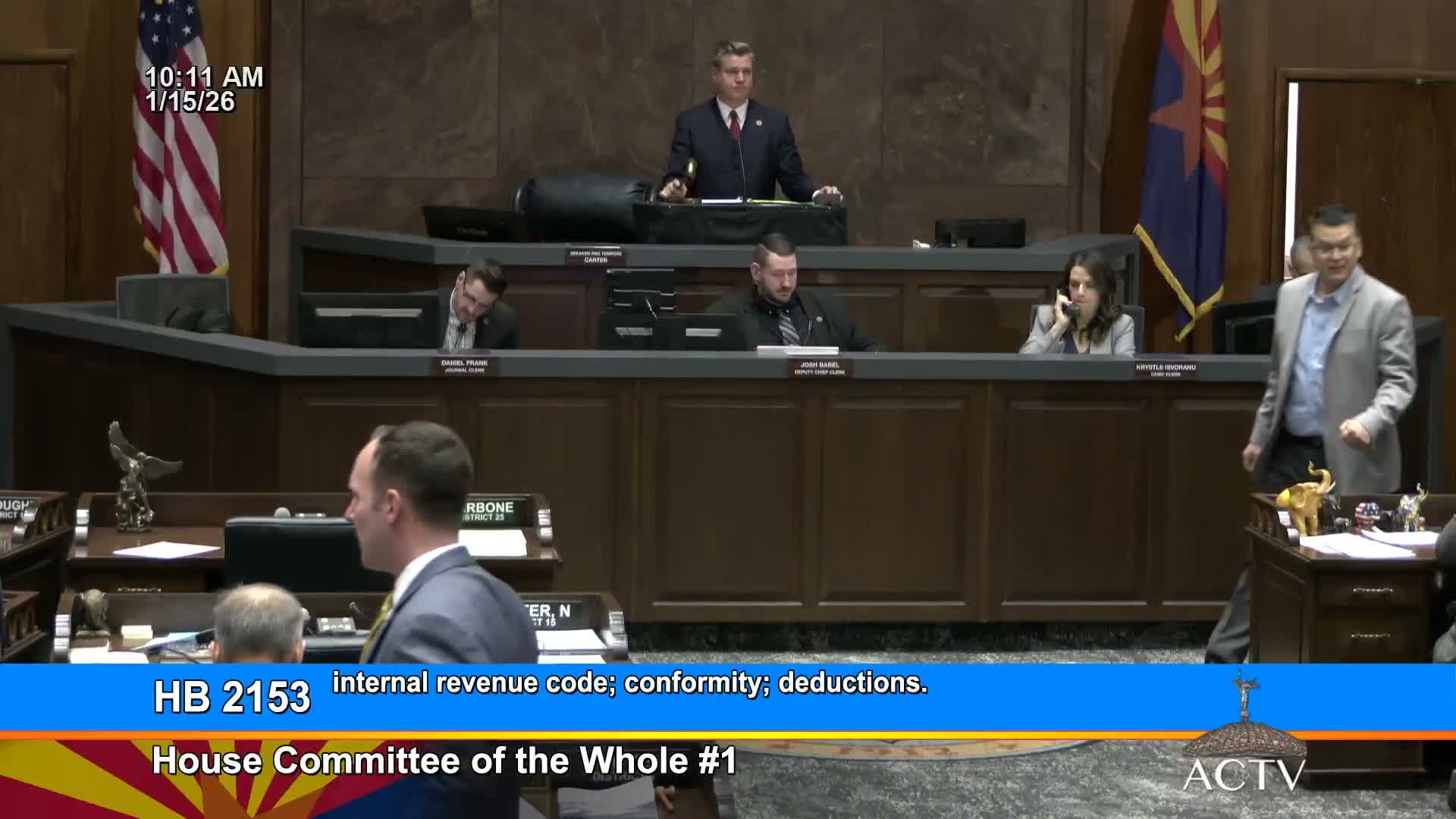
PHOENIX — The Arizona House passed a package to align state tax law with recent federal changes on a 31-27 vote on the floor Monday, sending Senate Bill 1106 (substituted for House Bill 2,153) to the Senate for enrollment after roughly 30 minutes of debate.
Representative Olson, the bill sponsor, told members the measure is the annual tax-conformity bill and said it would apply recent federal changes to Arizona and "save Arizona taxpayers over $440,000,000 annually." Olson said the Arizona Department of Revenue had already issued forms and tax-software providers coded filings on the assumption the state would conform, and warned that failing to act quickly would force many taxpayers to file amended returns.
"We can have no tax on tips. We can have no tax on overtime. We can provide seniors with tax relief by not taxing their retirement income," Olson said in closing remarks, summarizing the package and urging prompt action.
Supporters described several specific changes: the bill increases the child tax credit by 25% (from $100 to $125 per child), creates a state deduction for child and dependent care expenses for the first time, and allows up to $6,000 of retirement income to be excluded from state income tax for eligible filers. Chairman Livingston said the bill would be retroactive to Jan. 1, 2025, which he called critical for taxpayers beginning to file returns.
Representative Gress said the legislation provides "real relief" to working families, seniors and small businesses and framed the measure as necessary to provide consistency and avoid taxpayer confusion while filing.
Opponents argued the package disproportionately benefits wealthier taxpayers and large businesses and questioned how the state would make up hundreds of millions in lost revenue. Representative Blattman said it was "not normal to pass hundreds of millions of dollars of tax cuts for large corporations" so early in the session and warned of a potential $1.2 billion cost. Representative Sandoval added that the cuts would take money away from public schools, health care and housing.
Several members who opposed the bill highlighted specific coverage concerns. Representative Cruz and others said some seniors who rely only on Social Security but do not have retirement-account income may be left out under the bill's structure. Representative Sandoval and others pressed for clearer plans to replace lost revenue for existing obligations.
Members offered standard explanations of vote on the floor. Supporters argued conformity reduces paperwork and protects taxpayers from filing mistakes; opponents urged caution because of the fiscal trade-offs. After a committee-of-the-whole recommendation and standing count earlier, the final House tally was recorded as 31 ayes and 27 nays. The clerk reported the bill passed and instructed transmission to the Senate.
What happens next: The House sent the enacted substitute (Senate Bill 1106) to the Senate for enrollment/engrossing. The bill sponsor and supporters urged the governor to sign the measure into law to provide certainty to taxpayers and tax preparers before the filing season progresses.
Votes and formal actions taken: The Committee of the Whole gave HB 2,153 a "due pass" recommendation (committee count reported at 31–26). On final passage of the Senate substitute (SB 1106, for HB 2,153) the House recorded 31 ayes and 27 nays and transmitted the bill to the Senate.