Get Full Government Meeting Transcripts, Videos, & Alerts Forever!
Get email alerts on the Code Amendments topic
No spam. Unsubscribe anytime.
Redmond staff previews narrow code amendments on alleys, townhome setbacks, open space, evacuation routes and planter strips
Summary
Planning director Kyle Roberts briefed the commission on a focused package of development code amendments the council directed staff to pursue this fall, touching on alley widths (16 ft current standard), townhouse rear setbacks constrained by House Bill 2001, usable open‑space sizing, fire evacuation access, and prohibiting turf in planter strips; work session set for Oct. 29 and public hearing for Nov. 19.
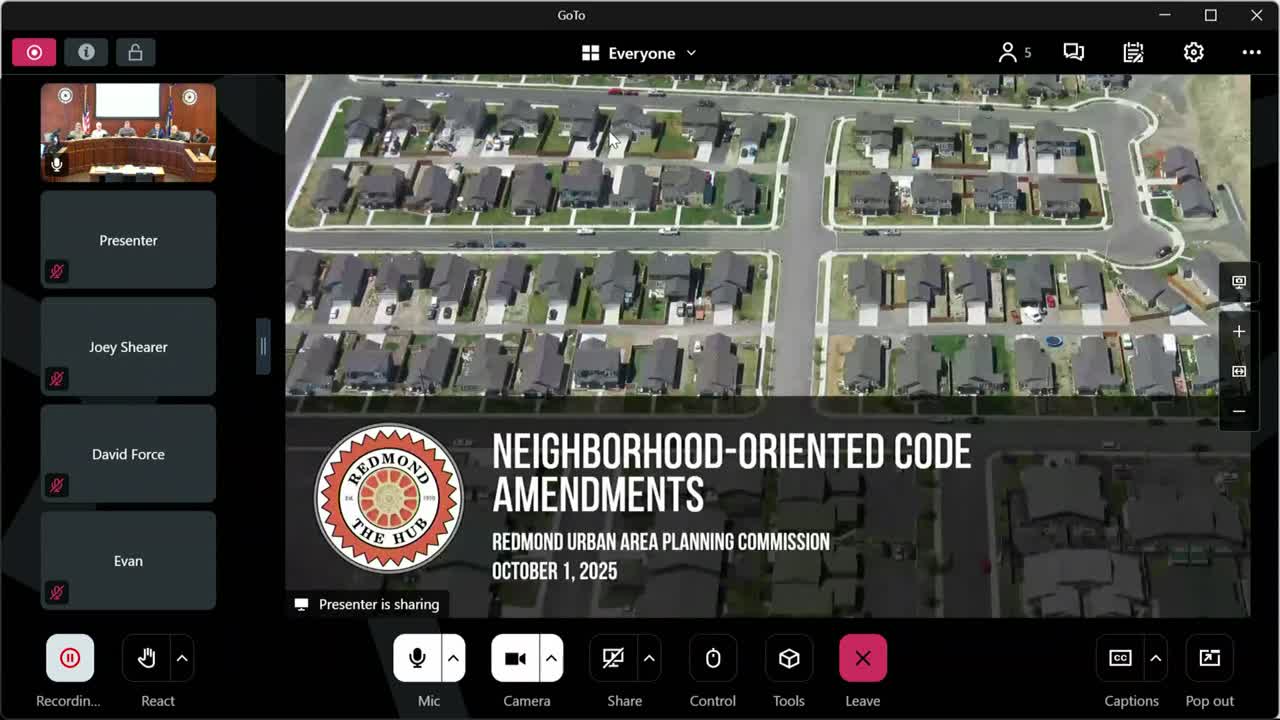
City of Redmond planning staff on Oct. 1 outlined a narrowly scoped package of proposed development code amendments intended to address recurring concerns raised on recent master development plans.
Planning Director Kyle Roberts told commissioners the package is meant to be a short, focused set of revisions (not the larger, 18‑month neighborhood design effort) and aims for adoption before the end of the calendar year. He listed five primary topics: alley standards, townhouse rear setbacks, usable open green space, fire evacuation routes and planter‑strip landscaping.
On alleys, Roberts said the city’s current pavement standard is 16 feet and council has expressed interest in increasing width to improve emergency access and off‑street parking maneuverability. “Our standard, specification for alley width is 16 feet in pavement width,” Roberts said.
On townhouses, staff flagged the common five‑foot rear setback for garages that face alleys and explained constraints from state law. Roberts cited House Bill 2001 and related Oregon administrative rules that limit how the city may change minimum parking and middle‑housing standards; staff noted the city can increase setbacks only within limits that do not make townhouse setbacks more restrictive than single‑family standards in the same zone.
On usable open space, Roberts summarized the city’s ‘‘great neighborhood’’ standard requiring 3,000 square feet of open space per 25 units in medium‑ and high‑density zones and said staff have seen applicants fragment required open space into multiple small tracts that are not functionally useful. Commissioners discussed whether the code should require larger contiguous tracts or different sizing to ensure recreational utility.
Staff also raised wildfire and evacuation concerns. The code currently requires at least two points of access for subdivisions; Roberts said staff will consider scalable requirements (for example, three access points for very large subdivisions) to improve evacuation and emergency response for some projects.
Finally, staff proposed changes to public‑right‑of‑way landscaping standards that would discourage turf in planter strips and encourage xeriscaping to reduce irrigation and water waste.
Commissioners agreed to form two small subcommittees (three commissioners each) to work with staff on recommendations. Tom Kuhn and Heather DeWolf volunteered for the group addressing alleys and townhouse setbacks; staff will work with commissioners to finalize membership and schedule one‑off meetings before a planning commission work session on Oct. 29. A planning commission public hearing is scheduled for Nov. 19; if the commission recommends adoption, council will consider the ordinance later in November with an anticipated 30‑day effective period after adoption (staff said revisions could take effect in January if adopted this fall).
Roberts said the focused package is intended to address recurring, practical design problems (alley width, parking access, usable open space and water use in planter strips) without delaying the larger, comprehensive neighborhood design effort staff expects to begin next year.