Get Full Government Meeting Transcripts, Videos, & Alerts Forever!
Get email alerts on the Regional Jails And Programs topic
No spam. Unsubscribe anytime.
Regional jails report capacity pressures but show treatment successes; association survey finds 30% population increase since 2021
Summary
Lake Region Correctional Facility reported a 93.4% completion rate for its substance use disorder program and described how it partners with DOCR; the North Dakota Association of Counties presented survey data showing a roughly 30% increase in local jail population from 2021 to 2025 and noted funding constraints from the 3% property tax cap.
Representatives from Lake Region Correctional Facility and the North Dakota Association of Counties briefed the subcommittee on how regional jails are handling rising populations and providing treatment programming.
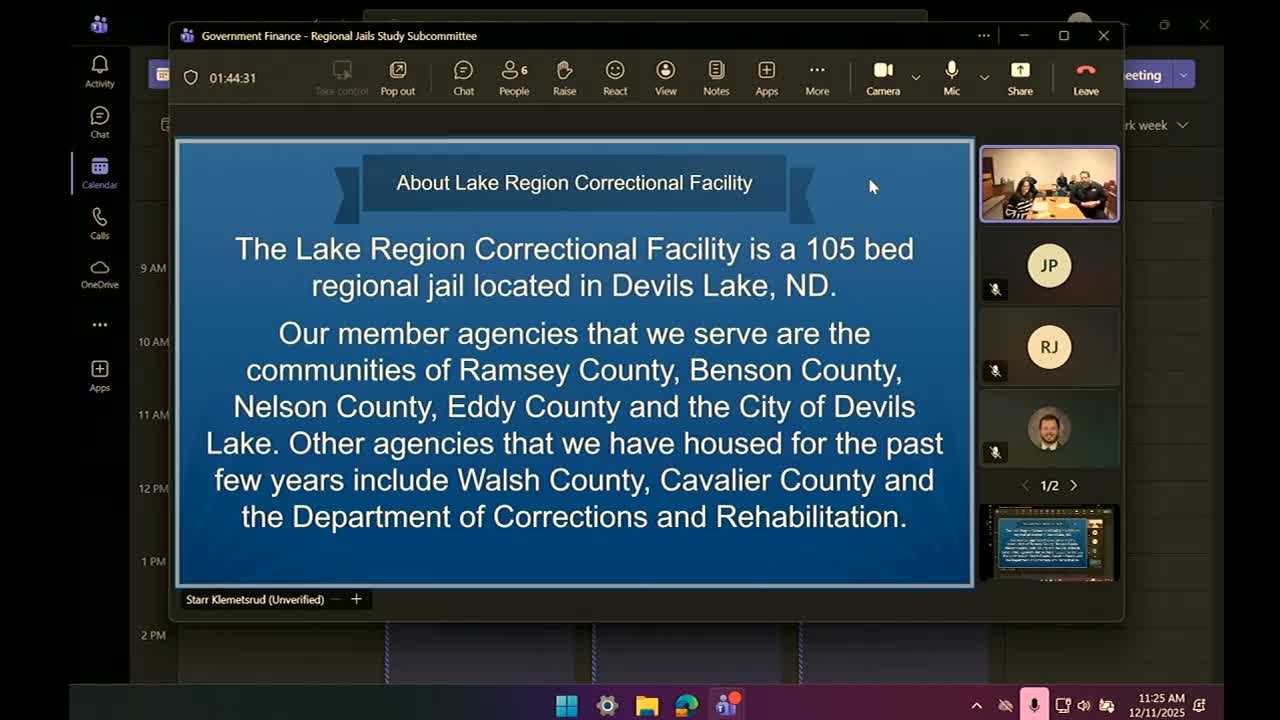
Lake Region Captain Dan Craft and jail administrator Star said their 105‑bed facility serves multiple counties, partners with DOCR on a substance use disorder program and has graduated 43 of 46 participants from the DOCR program — a 93.4% completion count the facility described as a strong early result. They said the facility generally has only a few DOCR inmates awaiting acceptance at any given time and that programing is constrained by building design (a linear layout), laundry and kitchen limitations.
Danelle Presky of the North Dakota Association of Counties reported results from a statewide survey of all 19 jails: a roughly 30% increase in population from 2021 to 2025; 16 of 19 jails have DOCR housing agreements; 12 have federal agreements; and two jails reported they do not operate mental/behavioral health services onsite. She noted recent expansions — Grand Forks added 82 beds and Cass added 200 beds in 2025 — and emphasized counties’ concerns about the 3% property‑tax cap limiting future corrections budgets.
Committee members asked whether some counties that have beds do not have DOCR agreements and whether beds are effectively usable given staffing and gender‑separation constraints. Presky and Lake Region staff said capacity is not only about physical beds but also staffing, female housing requirements and program infrastructure.
The subcommittee thanked presenters and said the presentations and survey materials would be shared with members for follow‑up consideration.