Get Full Government Meeting Transcripts, Videos, & Alerts Forever!
Get email alerts on the Minot Transit topic
No spam. Unsubscribe anytime.
Minot transit superintendent urges state help after reclassification cut federal funding and flags aging fleet
Summary
Minot City Transit told legislators federal reclassification reduced stable formula funding, creating a volatile dependence on performance 'stick' metrics and local-match pressures; Minot detailed an aging fleet, rising maintenance costs, and a plan to buy a refurbished bus to shorten lead time and lower replacement cost.
Minot City Transit told a legislative subcommittee that federal reclassification from rural to urban funding has reduced consistent federal formula dollars, leaving the agency more dependent on volatile performance-based "stick" payments and limited local-match options.
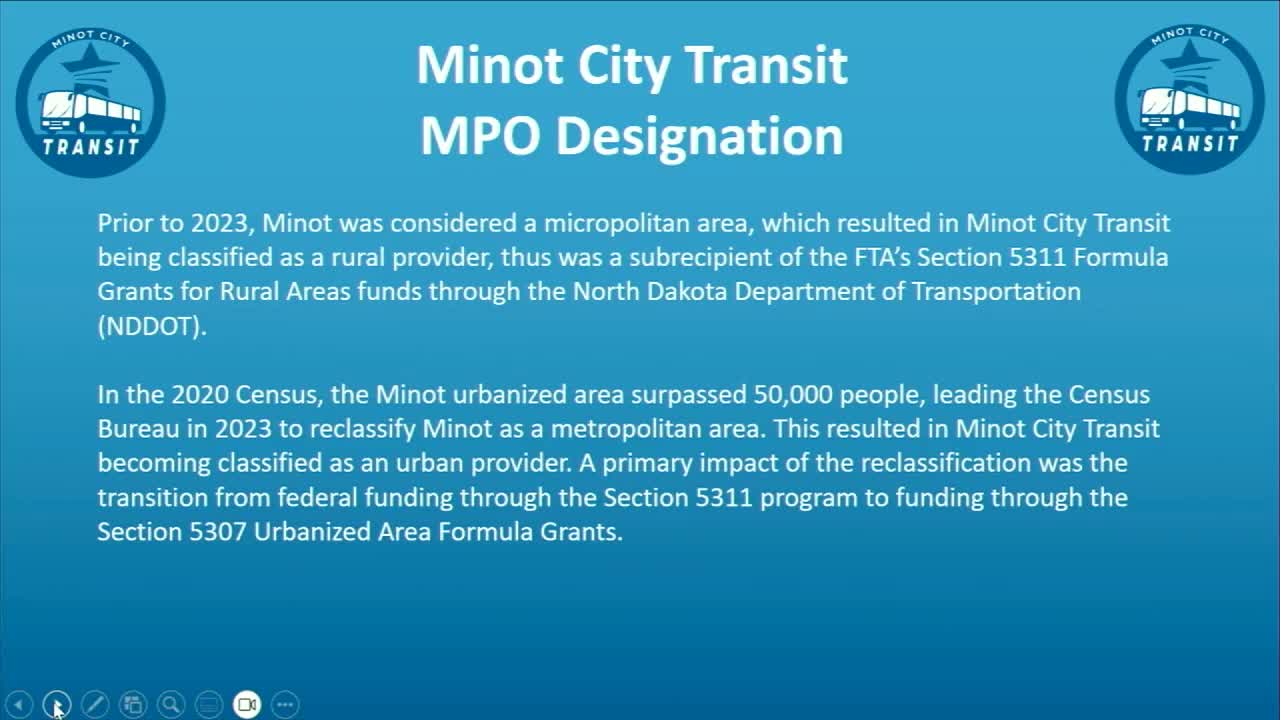
"This change resulted in reduced federal formula funding compared to our rural allocations," Minot Transit Superintendent Brian Horeca said, describing the 2023 reclassification after the 2020 census. Horeca said Minot moved from FTA 5311 rural subrecipient status into the 5307 urban formula program and that the agency now faces unpredictability: "We don't know if that $500,000 is going to be there" when planning budgets.
Horeca outlined operational statistics and finances. Minot expects about 89,380 rides this year, a 9–10% increase over the prior year, while its budget increased roughly 4.7%. He estimated a 2025 cost per ride of about $19.29. On a projected 2025 budget breakdown he presented, "53.73% of our funding will come from our federal grants, 38.6% from local sources, 4.35% from fares, and 3.29% from state aid." Horeca emphasized that fare revenue cannot be used as federal match, whereas state aid can help leverage additional federal funds.
Horeca described pressing capital and fleet concerns: Minot operates 11 fixed-route buses and 4 ADA-accessible minivans; eight buses are beyond useful life and another will reach that threshold within six months. He said maintenance spending rose substantially (he cited roughly $136,700 in parts and commercial repair in 2024 versus $184,737 year-to-date as of the presentation) and that bus replacement lead times under Buy America requirements can be two to three years.
To shorten delivery time and control cost, Minot has purchased a fully refurbished bus from Complete Coachworks for $454,000 with an anticipated spring delivery (Horeca: "We're gonna get this bus in the spring, not in 3 years, in less than 6 months"). He said refurbished vehicles can provide 10–12 years of dependable service and cost substantially less than new buses, which he cited near $702,000 in the figures presented.
Horeca asked the subcommittee to consider targeted state support to secure reliable local-match funding and to avoid service reductions. He noted the volatility of the small transit intensive cities (STIC) stick funding — "there are 6 metrics...the current year was about $512,000 for each one" — and warned that small service cuts could jeopardize eligibility and that losing one metric could cost hundreds of thousands of dollars.
Members asked for detail on the STIC metrics and possible state policy ideas (for example, conditional state funding that supplements but does not displace performance incentives). Horeca said he will provide exact metrics and levels and expressed willingness to work with the subcommittee on potential state-based matching or bridge funding options that do not harm rural providers.