Get Full Government Meeting Transcripts, Videos, & Alerts Forever!
Get email alerts on the School Behavioral Health topic
No spam. Unsubscribe anytime.
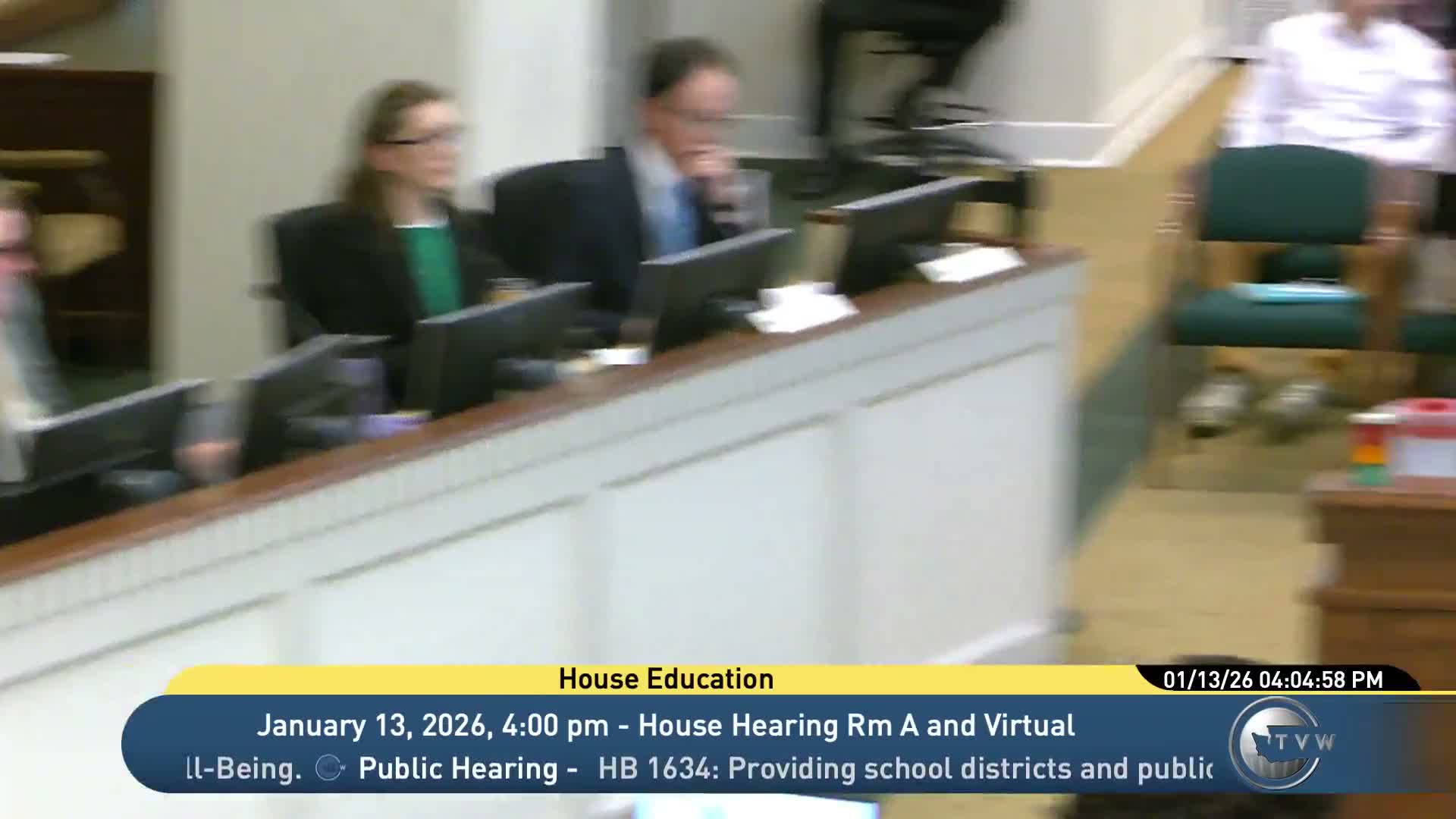
House Education Committee hears testimony on bill to coordinate school behavioral-health supports
Summary
Lawmakers and stakeholders told the House Education Committee that House Bill 16-34 (proposed second substitute) would create a statewide technical assistance and training framework so schools can connect to prevention, early identification, and crisis services; supporters stressed coordination, opponents warned of medicalization.
At a House Education Committee work session and subsequent public hearing, lawmakers heard from the Children and Youth Behavioral Health Work Group, OSPI staff and dozens of witnesses about House Bill 16-34 (proposed second substitute), a measure that would direct the Office of the Superintendent of Public Instruction and Educational Service Districts to develop a statewide technical assistance and training framework for school behavioral health.
Rep. Lisa Callan, co-chair of the Children and Youth Behavioral Health Work Group, opened the work session by describing the group's goal to "focus in on the K-twelve elements" of a broader system for children and youth behavioral health. Tisha Kirschbaum, director of the Division of Behavioral Health and Recovery at the Health Care Authority, framed the proposal within the Washington Thriving strategic plan and argued the state needs "a system of care" to reduce fragmentation and shorten delays in service for young people and families.
The school-based subgroup, co-chaired by Rep. Mai Lin Tai and Christian Stark of the Office of the Superintendent of Public Instruction, presented three priorities the subgroup advanced for the 2026 legislative session: maintaining current state investments in school behavioral health (including the behavioral health navigator program, AESD's Student Assistance Program, and the Department of Health's School Based Health Center grant program), strengthening statewide guidance and strategic planning to reduce fragmentation, and creating a training and technical assistance network to provide coordinated supports for districts.
Stark told the committee the School Based Health Center grant program currently funds 15 health-care sponsors and 32 school-based health center sites and described prior legislation that raised staffing ratios and supported regional tiered supports. He said the technical assistance network would provide a single, coordinated access point so school staff "know that, I see certain needs in my student population, what how do I get access to training and technical assistance that I know is going to be effective and accessible to me?"
During the public hearing, staff described key elements of the proposed second substitute: OSPI and the ESDs would be required to conduct a systems-level needs assessment with resource mapping to identify prevention, early-identification, early-intervention and crisis resources statewide and regionally; the framework must align with the Washington Thriving Strategic Plan, establish roles and processes for participating agencies and community partners, include mechanisms for continuous improvement, and be posted on OSPI and each ESD public website by Aug. 1, 2027.
Supporters at the hearing—including school psychologists, district mental-health specialists, university researchers and student advocates—urged passage. Erin Wick of Washington Thriving cited Healthy Youth Survey findings showing elevated rates of depression and anxiety among adolescents and said coordinated, evidence-based frameworks reduce duplication and improve timely access to care. Student witnesses described delays in access and the impact of stretched counselors.
Opponents raised concerns about scope and parental involvement. Kathleen Wiedemeyer of the Citizens Commission on Human Rights argued the measure could increase psychiatric labeling and the use of medication; she said parts of a draft bill appeared to allow "services that may be provided to children without parental consent." The chair responded that the committee was reviewing a proposed second substitute and that the language Wiedemeyer cited did not appear in the version the committee was currently considering.
No committee vote was taken during the work session or the hearing. The committee closed the public hearing on HB 16-34 after receiving more than 70 proponent and a slate of opponent comments and sign-ins; staff will be available for follow-up on technical questions as the bill moves through the legislative process.
The next procedural step is for members to consider the proposed second substitute in a later business or executive session; no final action was recorded in today's portion of the committee's calendar.