Get Full Government Meeting Transcripts, Videos, & Alerts Forever!
Get email alerts on the Public Hearing topic
No spam. Unsubscribe anytime.
Public hearing on SB 6,005 draws broad support for ferry, preservation and dredging investments
Summary
During a public hearing on Senate Bill 6,005, ferry communities, cities, contractors, ports, labor and environmental groups urged the Senate Transportation Committee to approve supplemental funding for preservation, dredging, ferries and local programs.
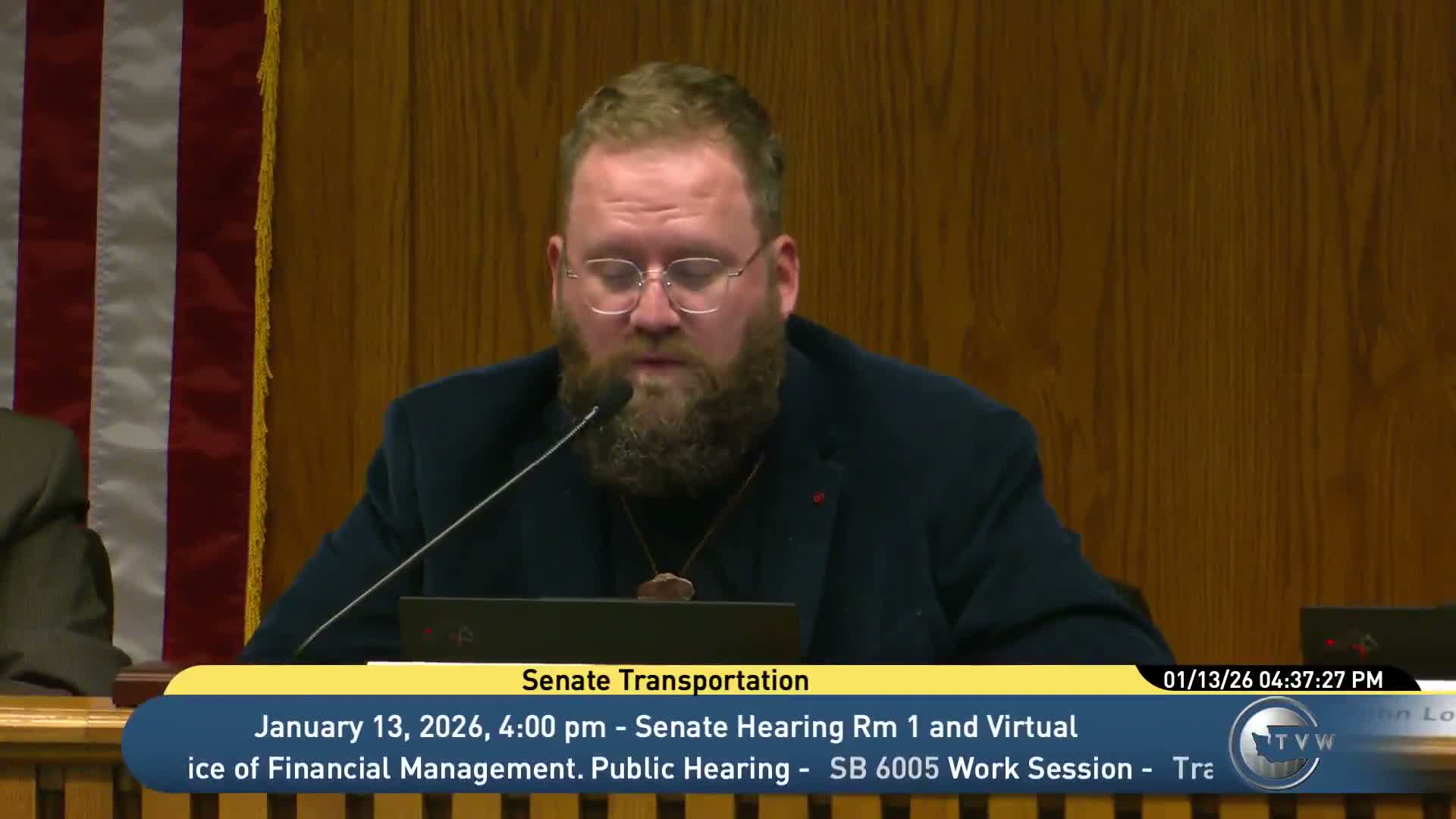
The Senate Transportation Committee opened public testimony on Senate Bill 6,005 on Jan. 13, receiving statements from a wide range of stakeholders urging approval of supplemental transportation appropriations focused on preservation, ferries and dredging.
Laura Lant, a Bainbridge Island council member, said unpredictable ferry service has real effects on residents’ medical access, employment and local businesses and urged continued investment in Washington State Ferries and support for line‑management resources. "When ferries are broken and service is reduced, residents miss medical appointments," she said.
Industry groups and local governments broadly supported preservation investments. Steven Ellis of the Association of Washington Cities praised the governor’s proposal as a step toward preventing a “catastrophic failure” of the transportation system and urged flexibility to unlock federal funds. Gerry Bandwood of the Associated General Contractors said SB 6,005 “helps maintain stability in the state's transportation program,” emphasizing that funding continuity keeps projects on track and controls costs.
Technical and economic testimony highlighted two recurring items: dredging and ferry life‑cycle costs. Eric Fitch of the Washington Public Ports Association endorsed the $15 million Lower Columbia River dredging appropriation to preserve the federally authorized 43‑foot channel, noting Oregon’s matching commitment and the channel’s statewide trade importance. Pete Brady, a Bainbridge resident, presented the results of a public records request he said showed hybrid‑electric ferry propulsion has substantially higher life‑cycle preservation costs than diesel; he described battery replacement costs and asserted a 1,200% increase in certain life‑cycle items. The committee did not record an on‑the‑spot technical rebuttal during his testimony.
Labor and workforce testimony cautioned that money for paving and preservation will not be effective unless WSDOT has adequate staff, equipment and safe facilities. Katie Durkin of the Washington Federation of State Employees said crews face tool shortages and facility issues that slow maintenance work.
Other speakers pressed for broader climate and rail investment eligibility, support for tribal and COFA communities’ Real ID assistance, and continued funding for projects such as Wenatchee’s Confluence Parkway, which city engineer Jake Lewing said is under construction and leveraging $92 million in prior funds.
The hearing concluded with the committee taking no vote that day. The chair closed testimony and adjourned the committee. Several members requested follow‑up information on technical claims and on the methodology for restoring the state self‑insurance account. No formal action on SB 6,005 occurred during the meeting.