Get Full Government Meeting Transcripts, Videos, & Alerts Forever!
Get email alerts on the Military And Overseas Voting topic
No spam. Unsubscribe anytime.
Committee reconsiders uniform military and overseas voting bill that expands eligible overseas voters
Summary
House Bill 2,206 would adopt the Uniform Military and Overseas Voters Act into state law to expand protections for military and overseas voters for state and local elections; witnesses raised concerns about 'never residents' (people born abroad who never resided in Washington) and potential conflicts with state residency requirements.
OPR staff reminded the committee that HB 2,206 incorporates the Uniform Military and Overseas Voters Act model language into state elections code, extending and aligning protections for service members and overseas voters, and making a few state-specific changes such as expanded definitions for certain overseas voters and permitting equitable relief to enforce compliance.
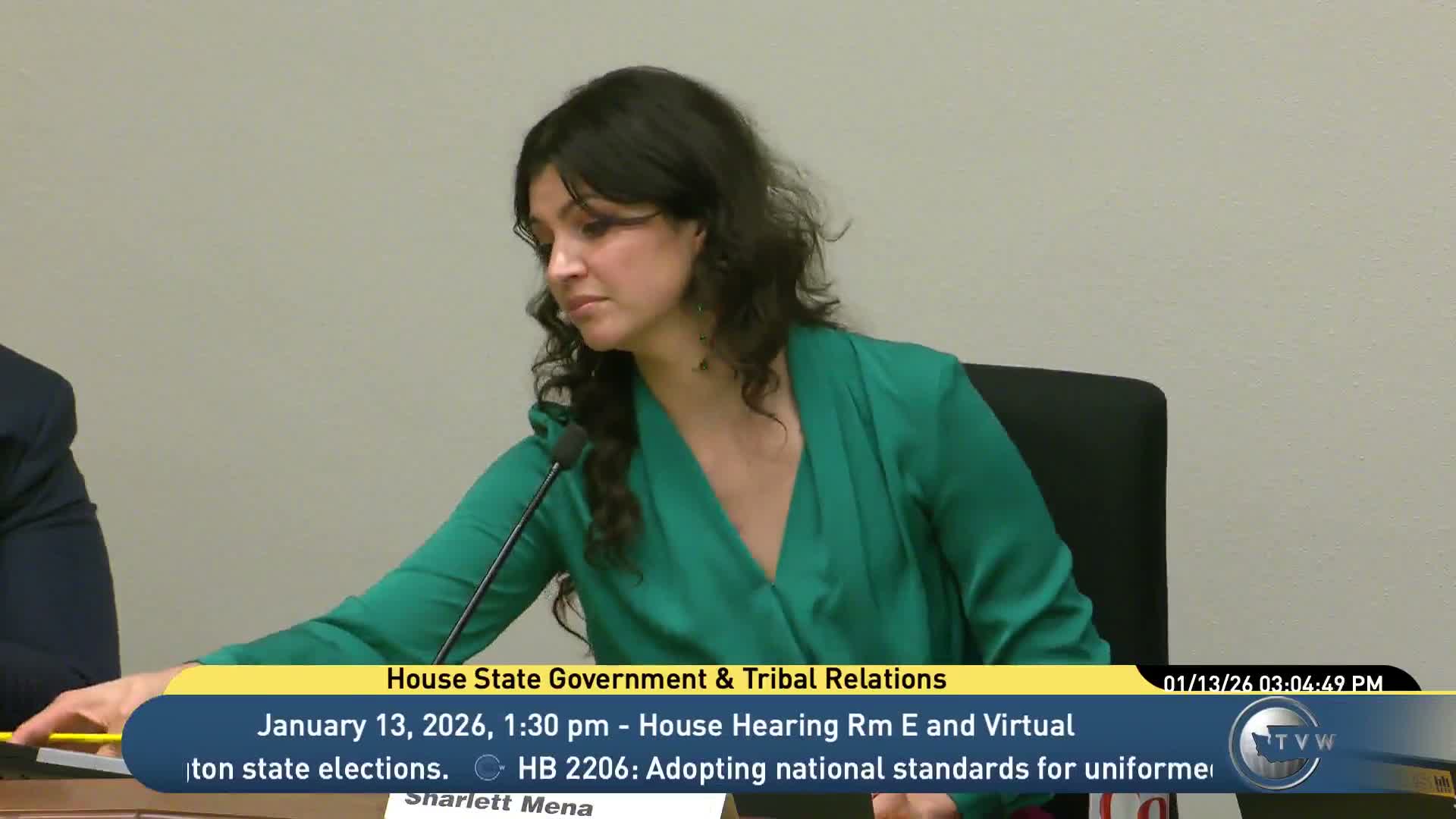
Chair Charlotte Mena and Secretary of State Steve Hobbs both spoke in favor of adopting national standards to streamline absentee and overseas voting for state and local races. Witness Sharon Hanick described a personal example of being eligible as an overseas voter because of a parent’s military service and urged the committee to refine residency checks. Remote witnesses and others raised constitutional concerns about permitting 'never residents' (born outside the U.S. and never a resident of Washington) to register under some provisions of the modeled act; North Carolina case law was cited as analogous.
Testimony included a technical proposal to remove an electronic-portal reference from last year’s language (a change supported by Verified Voting's representative) and calls for cross-state registration checks. The committee discussed ERIC and other inter-state checks and heard that there is no universal cross-reference to prevent multiple registrations across states.
Committee closed the hearing on HB 2,206 after the scheduled testimony and planned to move forward with anticipated technical amendments to address residency and portal language concerns.