Get Full Government Meeting Transcripts, Videos, & Alerts Forever!
Get email alerts on the HB1795 Substitute topic
No spam. Unsubscribe anytime.
House Education Committee hears substitute to HB 1795 to restrict isolation and certain restraints; broad public support, provider cautions on implementation
Summary
Committee counsel briefed members on a proposed substitute to House Bill 1795 that would prohibit mechanical/chemical/life‑threatening restraints and ban planned isolation as a behavior intervention; public testimony was largely pro, while some specialized providers warned about implementation risks without resources or narrow exemptions.
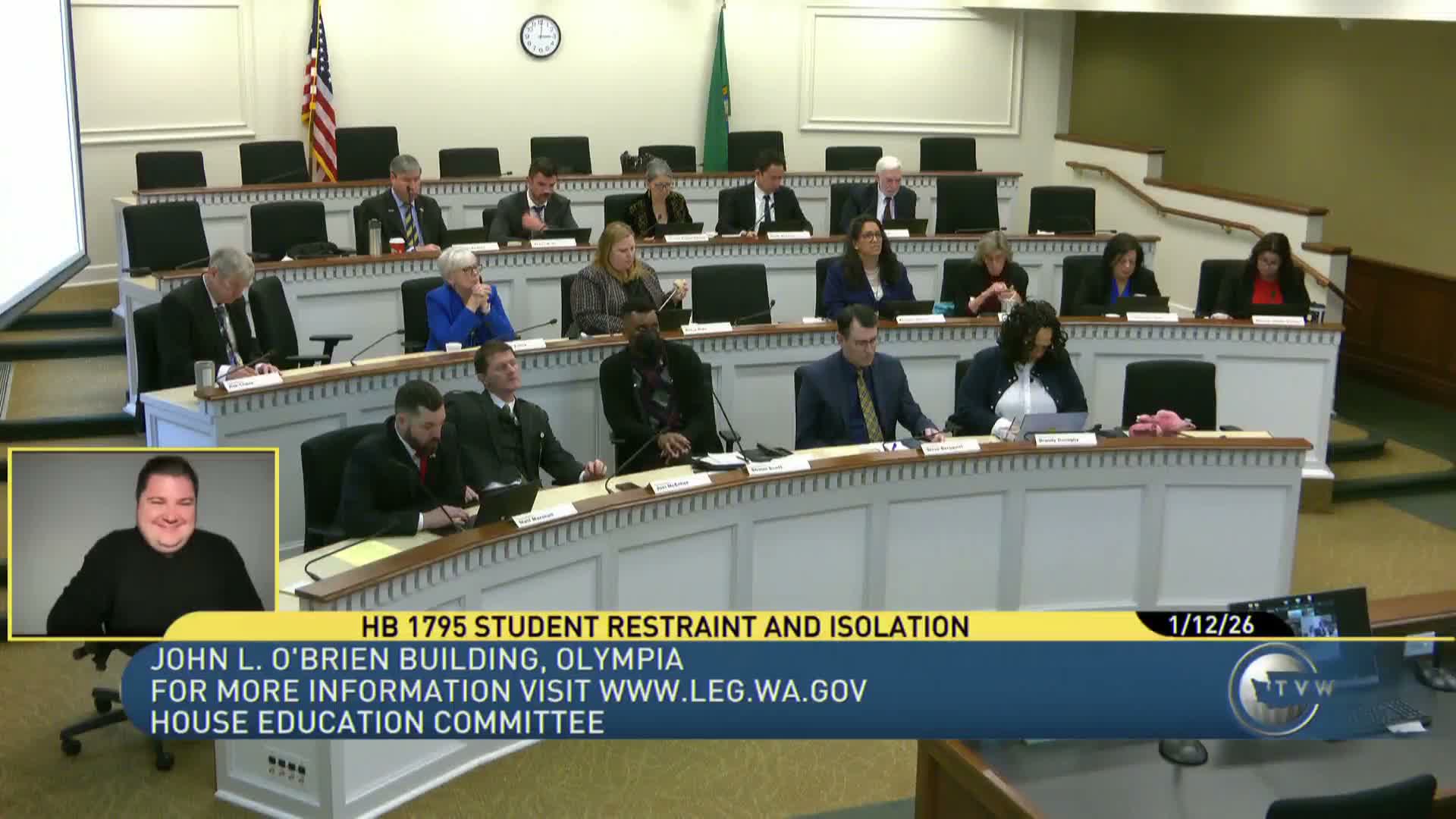
The House Education Committee moved from a work session into a public hearing on a proposed substitute to House Bill 1795 (substitute referenced as H‑2871). Committee counsel Megan Wargack summarized key changes the substitute would make to state practice and law.
Wargack told the committee the substitute prohibits mechanical and chemical restraints and any physical restraint that is life‑threatening or restricts breathing or blood flow. It also prohibits isolation as a planned behavior intervention and modifies the statutory definition of "imminent likelihood of serious harm" so that it applies to the student actor (not property), does not require physical harm and is not triggered merely by threat plus past violence. Planned restraints would remain allowed only with more specific advanced educational planning, documented medical necessity by a licensed health care provider, and informed voluntary consent from a parent or guardian. The substitute also extends district policy, use limitations, and follow‑up protocols to other publicly funded educational providers, leaving a carve‑out for commissioned law‑enforcement officers carrying out lawful duties.
Members asked about SROs and whether commissioned law‑enforcement acting as SROs fall within the bill’s prohibitions. Staff said SROs are commissioned officers required to take SRO‑specific training and that the bill does not prohibit law‑enforcement from carrying out lawful duties; other categories of safety/security staff are required to take student‑focused training but may not take identical trainings required of all school staff.
Public testimony was predominantly in support. Ramona Hattendorf of The Arc of King County and disability advocates said isolation and restraint cause trauma and undermine long‑term outcomes for children; Catherine Davis described a personal family injury from involuntary confinement; Washington Education Association and Washington State PTA testified in favor of the substitute and stressed professional development and system supports. "Restraint and isolation does not resolve behavior," Hattendorf said; "safe relationship, co‑regulation, and skill building do."
Some providers and specialized programs asked the committee to proceed carefully. Megan Graber, site director at Lilac Learning Center, testified in opposition, arguing the substitute’s removal of isolation for pre‑K through 5 and limited exemptions could jeopardize safety for certain severely affected students and that access to medical authorizers could be limited. Several union and professional groups urged careful attention to implementation timelines, resources, training and staffing shortages.
The committee received 176 pro sign‑ins, 35 con sign‑ins and several who registered but did not testify. The hearing closed with the committee adjourned; no final vote on the substitute was taken during the session. Committee staff said members would continue to refine language and implementation details in follow‑up work.