Get Full Government Meeting Transcripts, Videos, & Alerts Forever!
Get email alerts on the Jlarc Workplan topic
No spam. Unsubscribe anytime.
JLARC adopts amended work plan, begins internal performance measures and pilots tax preference fiscal-note rubric
Summary
The Joint Legislative Audit and Review Committee adopted amendments to its work plan, approved a set of internal performance measures to track JLARC effectiveness and launched a 2026 pilot to include standardized evaluation tables for tax preference performance statements in fiscal notes.
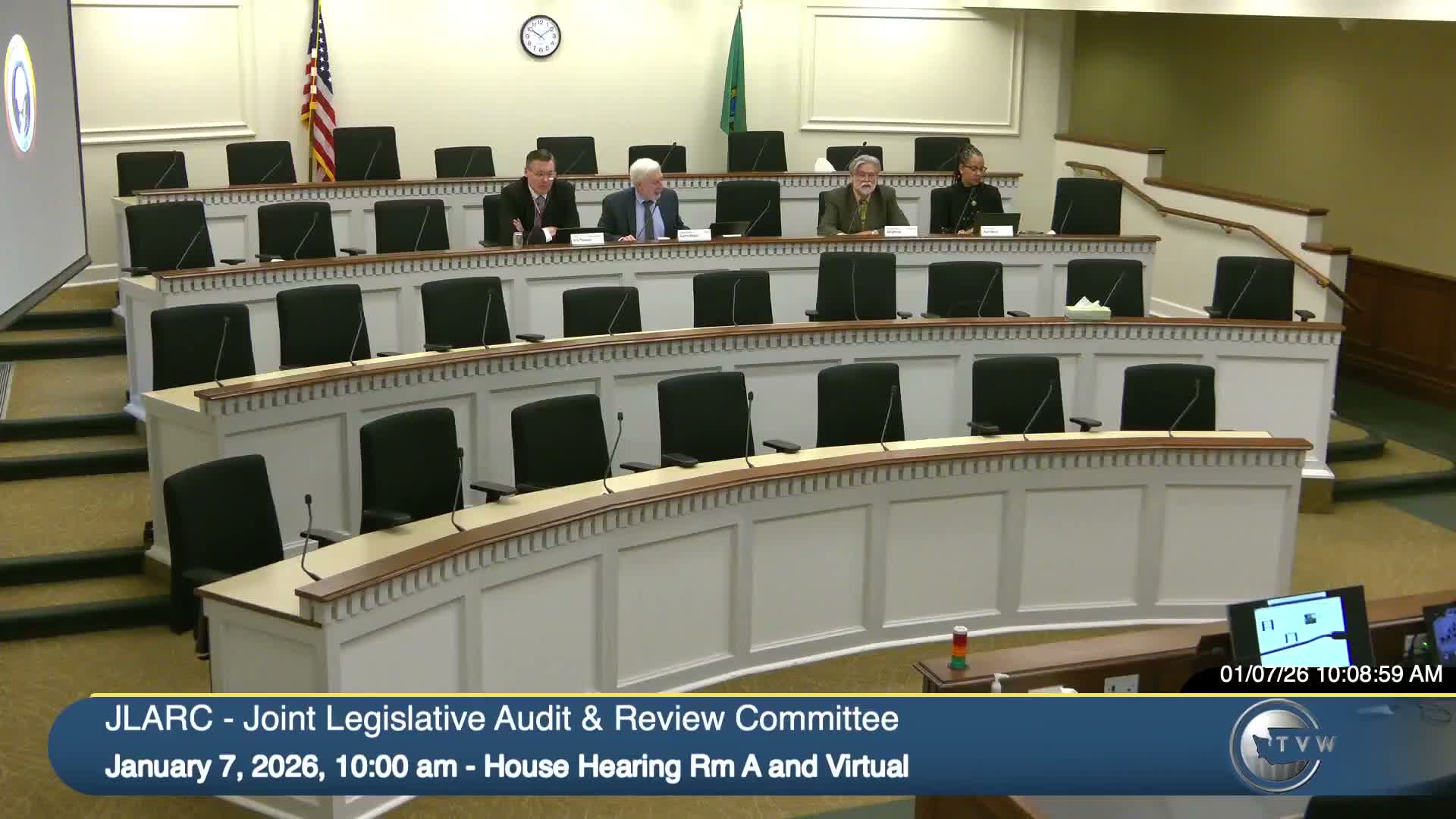
The Joint Legislative Audit and Review Committee on Jan. 7 adopted an amended work plan that re-scheduled two reviews and authorized staff initiatives to measure JLARC’s own performance.
Legislative Auditor Eric Thomas told members the executive committee recommended moving the Department of Health sunset review to 2026 and delaying a thermal energy network pilot report to July 2028 so staff can evaluate more implementation data. The committee adopted the amended work plan by voice vote.
Separately, JLARC staff presented eight proposed internal performance measures focused on effectiveness, efficiency and quality. The measures include member satisfaction surveys after meetings, annual surveys of legislative awareness of JLARC work, tracking presentations to other policy and fiscal committees, percent of recommendations resolved within four years, staff retention and turnover analysis, percent of reports delivered by deadline, triennial peer-review rating goals and recognition from the National Legislative Program Evaluation Society.
JLARC staff also outlined a 2026 pilot to include a standardized table in fiscal notes that evaluates tax preference performance statements against four criteria: whether metrics measure progress toward the policy objective, whether metrics are measurable with quantifiable targets, whether identified data sources will be available and reliable, and whether sufficient time will elapse before JLARC’s future review. Pete Van Moorsel (JLARC staff) said the pilot will be informational and is intended to improve the drafting and evaluation of tax preferences during the legislative session.
Committee members welcomed the initiatives and thanked staff; the chair said the measures are a "living process" and that members will have future opportunities to refine them.
Next steps: Staff will implement the measures on a trial basis after session, report results annually, and run the tax preference performance statement pilot during the 2026 session as part of JLARC’s fiscal-note work.