Get Full Government Meeting Transcripts, Videos, & Alerts Forever!
Get email alerts on the Workforce topic
No spam. Unsubscribe anytime.
Governor’s Behavioral Health Talent Council proposes centralized credentialing and supervision reforms
Summary
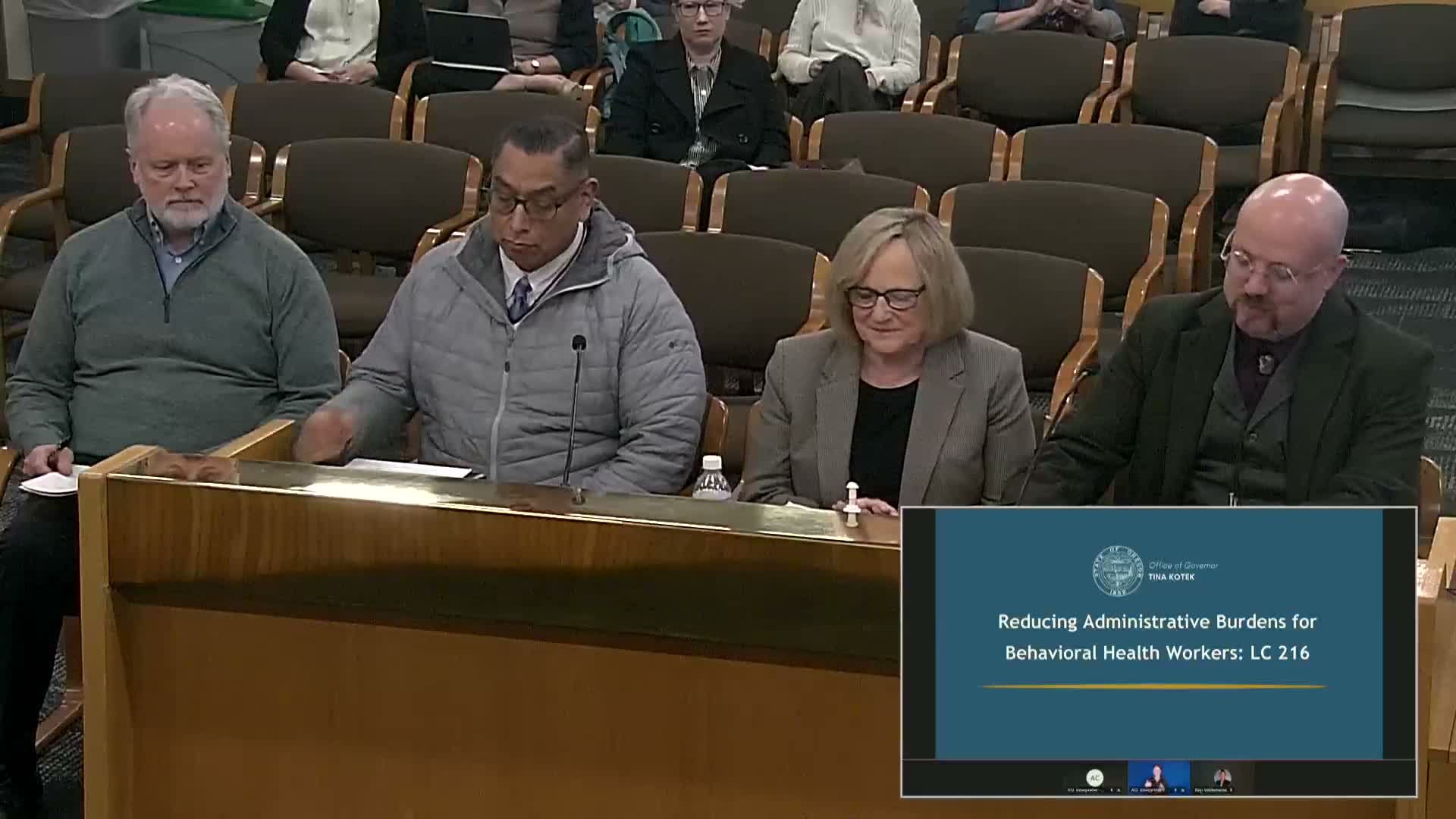
The governor’s office and Talent Council members asked the committee to advance LC 216, a package to centralize credentialing, codify administrative-burden reduction into OHA’s mission, consolidate licensing boards, and expand cross-license clinical supervision to ease workforce entry and retention.
Representatives of the governor’s office and members of the Behavioral Health Talent Council urged the House Interim Committee on Behavioral Health to consider LC 216, a legislative concept aimed at shrinking administrative burden on behavioral health workers and expanding the workforce pipeline.
Casey Liddell, senior behavioral health policy adviser to Governor Tina Kotek, said LC 216 would require the Oregon Health Authority to establish a centralized credentialing process that CCOs must accept rather than running separate panels, and would codify administrative-burden reduction into OHA’s mission. The proposal also envisions consolidating licensing boards (bringing the Board of Licensed Social Workers under the mental-health regulatory agency) and allowing cross-license clinical supervision to expand the pool of supervisors for master's-level clinicians.
Provider representatives emphasized practical effects: clinicians and agencies described duplicated credentialing with many CCOs, numerous background checks and intake paperwork burdens. Julie Ibrahim (New Narrative) said a new clinician’s intake can involve dozens of documents and lengthy forms that harm therapeutic alliance and clinician morale; Eli Kinsley and other Talent Council members added that centralized credentialing portals used in other states offered promising models. Several rural providers asked the committee to ensure centralized tools are accessible to small counties and asked that background-check and licensing streamlining be part of the effort.
Speakers requested the committee consider LC 216 as a first step and to review the Talent Council’s full report when published later this month.