Get Full Government Meeting Transcripts, Videos, & Alerts Forever!
Get email alerts on the Education Training topic
No spam. Unsubscribe anytime.
Commission calls for standardized, accessible xylazine training for first responders, clinicians and community providers
Summary
The commission recommended standardized, practical training on xylazine for first responders, clinicians, substance-use treatment staff and people who use drugs — including case-based clinical guidance, test-strip technique, CEU availability, and translations for nonclinical audiences.
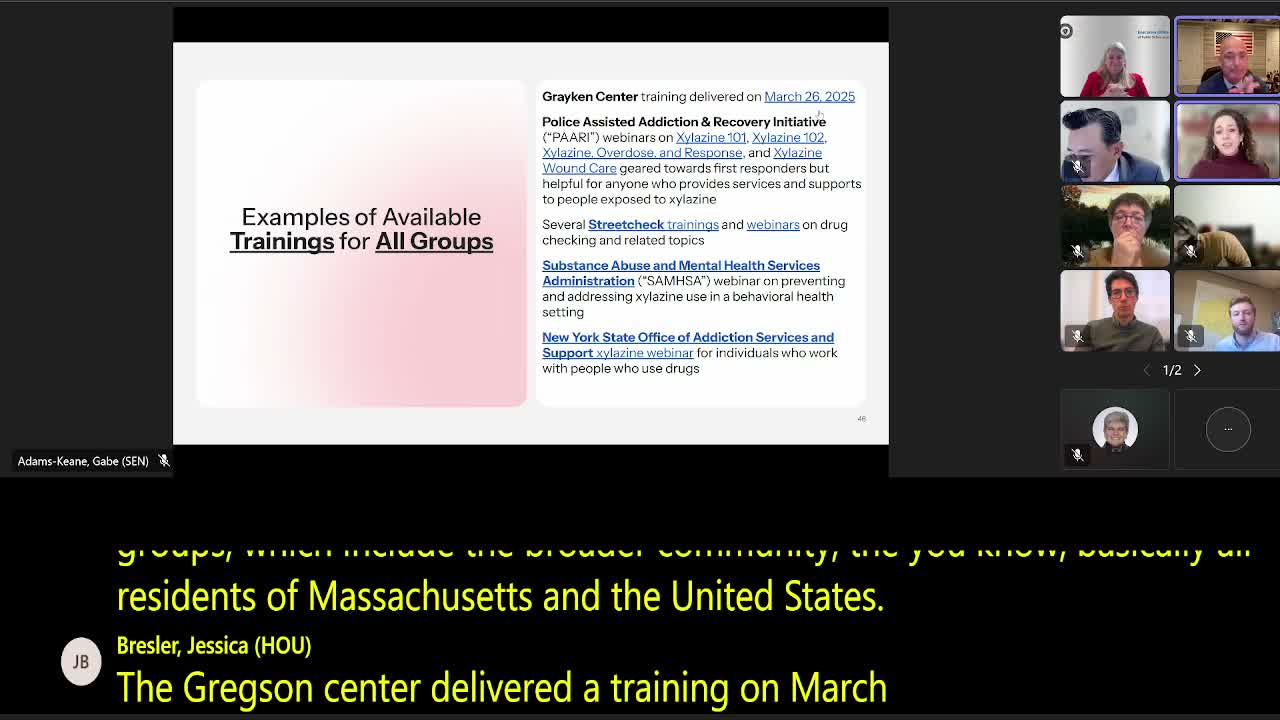
The education and training working group presented consensus recommendations to make evidence-based xylazine guidance practical, findable and uniformly available across Massachusetts. Presenters noted a patchwork of existing resources — university guidance, SAMHSA toolkits, state DPH materials and regional trainings — but said access is uneven and content must be adapted to each audience.
Dr. Kevin Simon recommended practical, case-based clinical materials that answer frontline questions: how xylazine alters overdose presentation and duration of sedation, signs that warrant outpatient management versus escalation, and recognition and management of xylazine-associated wounds. He urged embedding training into continuing medical education and licensing channels to reach clinicians statewide.
Senator John Keenan reported variable awareness among first responders: EMS and paramedics generally have higher awareness than many police or fire personnel. He and others recommended more frequent data feedback from DPH to responders, wider rollout of in‑service trainings, and making wound- and breathing‑kits available to nonmedical responders in the field.
For nonclinical substance-use treatment staff and harm-reduction providers, Chair Mindy Dom and others recommended materials in plain language, risk-assessment questions that staff can use directly with clients, and CEU credit to incentivize uptake. Millie Bhatia stressed materials for people who use drugs should be accessible, trauma-informed and distributed by local DPH, BSAS, harm-reduction programs and treatment providers.
Deputy Director Sarah Ruiz highlighted practical training on correct use of drug‑checking test strips (proper sample volumes and technique) and a need to situate xylazine guidance inside broader toxic-supply education because adulterants change over time. The group recommended that state agencies and licensing boards develop, standardize and host training content in consultation with clinicians, experts and people with lived experience.
Next steps: draft training guidance and a recommended state delivery plan will be incorporated into the commission’s report and circulated to commissioners for review.