Get Full Government Meeting Transcripts, Videos, & Alerts Forever!
Get email alerts on the Bvcp Major Update topic
No spam. Unsubscribe anytime.
Planning Commission reviews Boulder Valley Comprehensive Plan major update, presses staff on annexation and 'new urban development' thresholds
Summary
At a Dec. 17 working session, county staff and city planners discussed proposed BVCP changes including clearer definitions for 'new urban development,' over‑intensive rural development, Neighborhood 1/2 land‑use categories, and when annexation should be required; commissioners requested clearer criteria on community benefit, sound, multimodal access and follow‑up on annexation referrals.
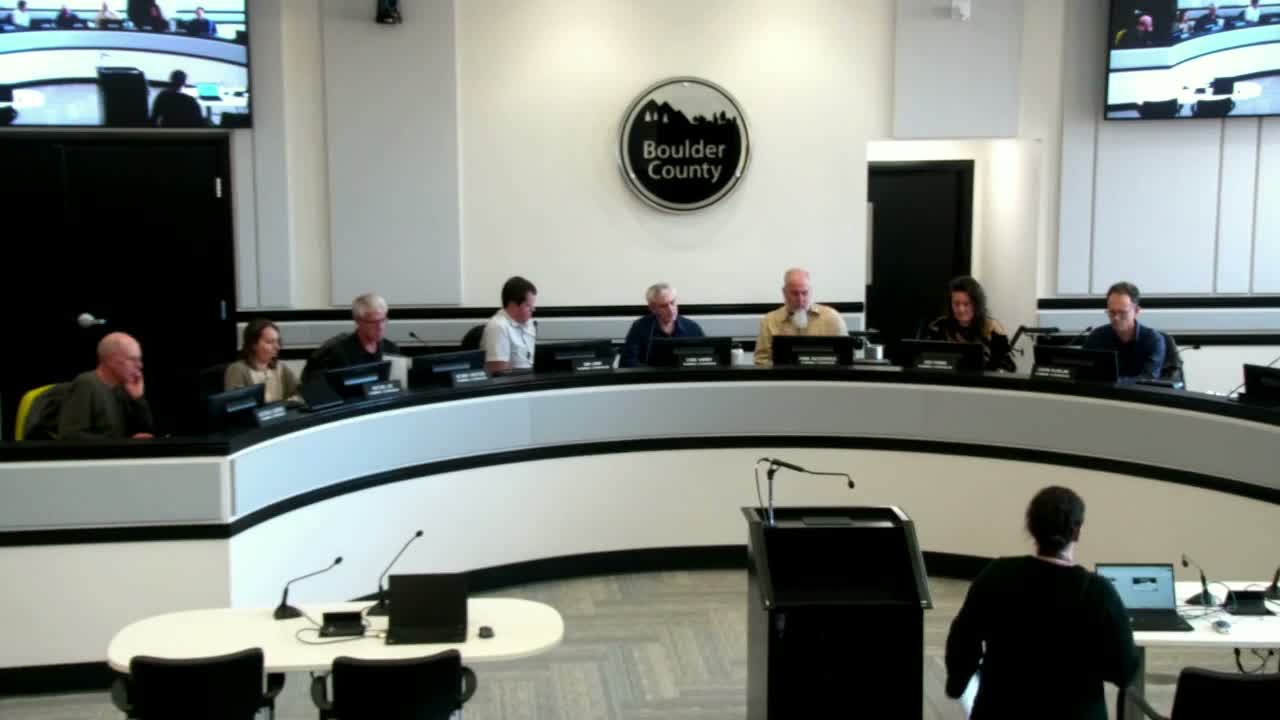
Boulder County planning staff and city officials reviewed a major update to the Boulder Valley Comprehensive Plan (BVCP) during a Dec. 17 working session focused on how the plan draws the boundary between urban and rural development and when annexation should be required.
Hannah Hippley, Long Range Planning Division Manager, said staff are proposing cleanup and clarification to planning‑area maps and annexation policies (policies 1.13 and 1.17) and suggested simplifying language so it is more usable for the public and staff. "We don't expect substantive changes here," Hippley said, while noting the need to clarify what 'new urban development' means and how it should be treated in Area 2 properties where annexation may or may not be feasible.
Staff presented two illustrative Gunbarrel parcels: one adjacent to the city and therefore eligible for annexation, and another that is not contiguous and thus cannot be annexed. Hippley said the plan needs clearer direction on thresholds — such as changes in height, bulk, lot coverage or whether a project requires additional city utilities — that would trigger annexation or different county review.
Commissioners repeatedly asked how to evaluate "community benefit" and whether the county should retain a clearer role in deciding whether annexations or redevelopment proposals deliver benefits to the larger county population. Commissioner George Gerstel urged the commission to ensure the unincorporated county is not left to absorb urban impacts created by city decisions. "We need to make sure that the unincorporated county's interests are well represented in that conversation," Gerstel said.
The working session also addressed "over‑intensive rural development," defined in the BVCP as an otherwise permitted use that would have urban‑level impacts. Hippley asked whether the plan should expand the list of criteria (for example, sound, smell, transportation/multimodal access and availability of more appropriate sites) and clarify who makes the determination (Planning Commission/Board) and the role of city referrals in that determination.
To illustrate the range of outcomes in Area 3, staff cited a recent conversion of agricultural land to a Dharma Chan monastery and a former junkyard converted to an automobile repair operation. Those examples underscored commissioners’ concerns that neighborhood context, transportation access and utility needs should inform decisions about whether a proposal is appropriate.
City officials participated by phone. Brad Mueller, Director of Planning and Development Services for the City of Boulder, and Christopher Johnson, the city's comprehensive planning manager, said the city values collaboration and noted annexation requests include a referral process that allows county input. "There always is a referral process associated with the annexations, and so there certainly is an opportunity to receive input and feedback from county staff," Johnson said.
Commissioners recommended staff consider adding community‑benefit language to the BVCP, expand over‑intensive criteria to include sound and multimodal transportation, and clarify the difference between 'primary' and 'supporting' uses in neighborhood designations. Several commissioners also suggested staff track why the city declines annexation requests to improve the plan’s predictive value.
Staff said these topics will inform further revisions to maps, land‑use designations (Neighborhood 1 and Neighborhood 2) and implementation language, and that additional discussion would follow once land‑use designations and map edits are more developed.
The working session concluded with direction for staff to refine definitions, consider community‑benefit and sound/multimodal criteria for over‑intensive development, and return with more detailed implementation language and mapping.