Get Full Government Meeting Transcripts, Videos, & Alerts Forever!
Get email alerts on the Land Use Subdivision topic
No spam. Unsubscribe anytime.
Board of Adjustment continues Walker appeal over legal building-lot status to March 4
Summary
The board continued AP22-0001, an appeal by Deward and Alice Walker that seeks to overturn a Dec. 17, 2021 determination that five Salina-area parcels are not legal building lots. The continuation was set for March 4 to allow appellants to submit additional legal argument and documents.
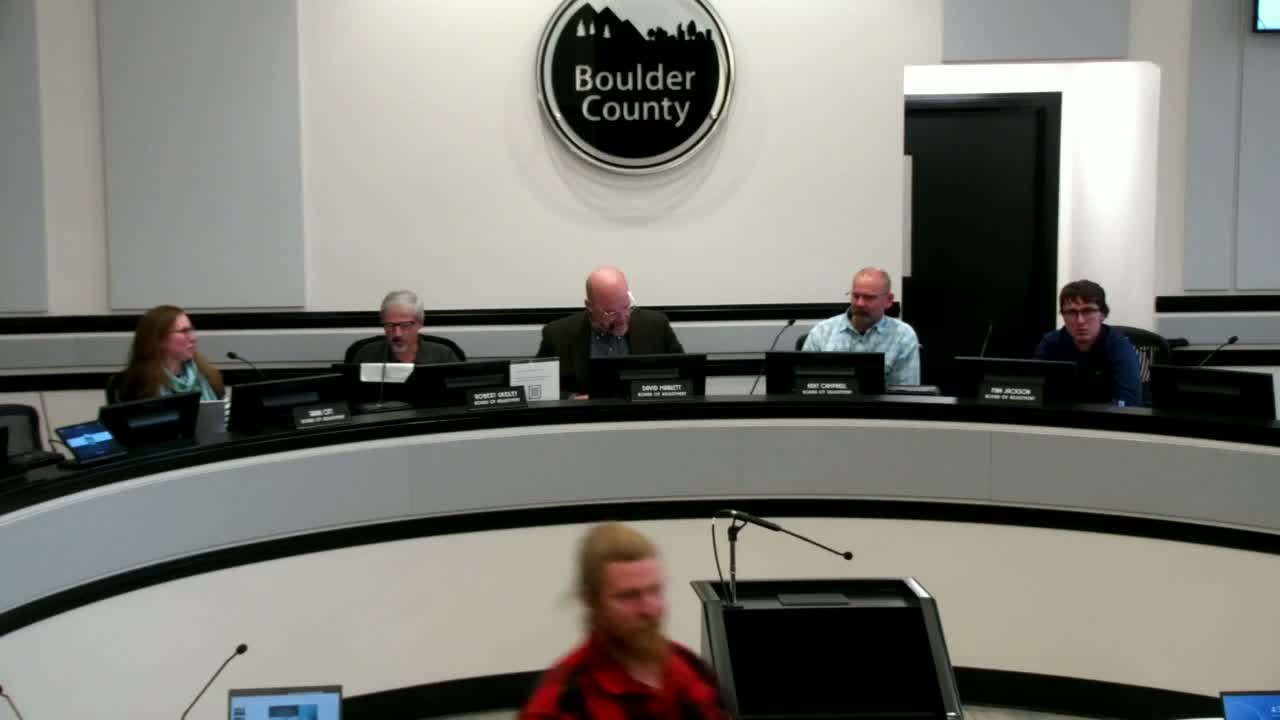
The Boulder County Board of Adjustment on Jan. 7 continued the Walker appeal (AP22-0001) to March 4 to allow the appellants to submit additional documentation and legal argument about whether certain parcels along Gold Run Road in the Salina area qualify as legal building lots.
Dale Case of Community Planning and Permitting summarized staff’s 2021 determination that the parcels in question are not legal building lots because they did not meet minimum lot-size requirements at the time they were created and did not qualify under subdivision-exemption processes. Staff highlighted a 1983 transaction — a foreclosure on what the parties called the "bankrupt load" — that it treated as a post-creation transfer leaving the remaining parcels below the minimum lot-size threshold.
"The determination of the property does not constitute a legal building lot," Case told the board, explaining that deeds and subsequent transfers left the parcels out of compliance with subdivision regulations.
Appellants’ counsel John Henderson and appellant Alice Walker contested staff’s reading of the deed history. Henderson—an attorney with decades of local practice—argued federal mining-claim surveys and patenting conveyances create distinct meets-and-bounds descriptions that cannot be treated as merged by a single deed. Walker described decades of reliance on a 2001 county determination that she said recognized the combined holdings as a building site, and she said the family made substantial investments based on that understanding, including work tied to a county- and FEMA-funded bridge project.
"For 2 decades, I relied on that 2001 decision," Walker said, describing bridge work and other expenditures made after the county’s earlier letter. Walker asked that the Board reject the Dec. 17, 2021 determination.
Board members probed the legal basis for the 2021 finding, asking whether a foreclosure-generated transfer requires subdivision approval and whether the Board has equitable authority to address estoppel-type claims. County counsel and staff responded that the County Planning Act’s exemptions (for liens, deeds of trust, mortgages) do not extend to transfers by foreclosure and that the county’s practice is to assess lot creation history and legal descriptions. Counsel noted that equitable-estoppel claims are typically judicial matters but are part of the record if raised.
Joseph "Joe Ben" Walker, an in-person commenter and family member, urged the board to consider the practical building envelope on the ground and said county actions on flood recovery and bridge repair signaled prior recognition of the site’s buildability.
Given the applicant’s request for time to assemble legal arguments and additional documentation to address staff’s 2021 rationale, Member Robert Yukali moved to continue the hearing. The board amended the tabling motion to set the continuation for March 4, and the motion passed by roll call. Staff and the county attorney’s office noted that Board rules permit tabling to a date specified in the motion without further public notice.
The continuation will give the appellants an opportunity to submit additional deeds, title documents and focused legal memoranda addressing the county’s concerns about the 1983 transactions and the proper interpretation of the statutory and policy criteria for recognizing a legal building lot. The board did not make a final determination on the merits at the Jan. 7 meeting.