Get Full Government Meeting Transcripts, Videos, & Alerts Forever!
Get email alerts on the Municipal Finance.bond topic
No spam. Unsubscribe anytime.
Texarkana officials outline 2.5‑mill increase to fund roughly $28M in street repairs, $3–4M for drainage ahead of Nov. vote
Summary
City Manager Tyler Richards told a town hall that voters will see three ballot questions to refund prior bonds and levy an additional 2.5 mills to finance a prioritized list of 58 streets and drainage work (ballot shows larger, inflated amounts; real collection expected at about $28M for streets and $3–4M for drainage).
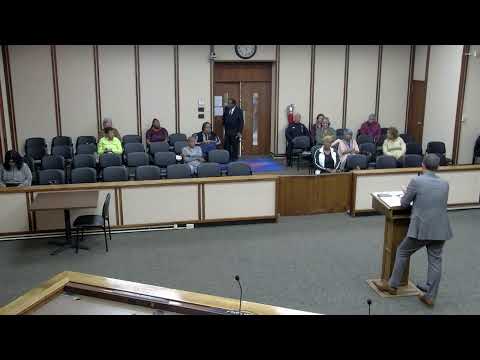
Tyler Richards, Texarkana’s city manager, told a public town‑hall that the city will ask voters in November to approve three ballot questions that together would allow the city to refund earlier debt and levy an additional 2.5 mills for street and drainage projects.
“This bond will provide up front funding that normally would take us approximately 20 years to complete all these projects on the list,” Richards said, outlining a data‑driven priority list of 58 streets and drainage work designed to address a long maintenance backlog.
Why it matters: Richards said the city faces constrained, largely fixed annual revenues and is behind on road maintenance because only a small share of property tax is designated for streets. He described sales tax as the city’s largest revenue source (about 39%, roughly $13.5 million annually) and said the city currently collects roughly $4.0 million in property tax, of which about $780,000 is designated for streets under 2024 allocations.
Tax impact and ballot amounts: Richards said the measure would amount to a 2.5‑mill increase on real estate — “so your property tax bill would go up $50 for every $100,000 value of your property” — and gave personal‑property examples (about $2.50 per $1,000 of personal property value). He noted the ballot will show higher, “inflated” maximum amounts approved for future flexibility: Question 2 lists $41,925,000 for street improvements but Richards said the city expects to collect about $28,000,000 in practice; Question 3 lists $5,350,000 for drainage while Richards estimated realistic receipts of $3–4 million. Question 1, he said, is a refunding question (ballot lists $2,375,000) and must pass to allow the full levy.
Scope and priorities: Richards said a third‑party consultant used an ASTM pavement assessment and a priority score that weights street condition (56%), street classification/traffic (22%), and cost‑benefit/life‑extension (22%) to rank small segments of road. That methodology, he said, avoids staff bias and allows targeted repairs rather than repaving whole lengthy corridors.
Drainage: Richards said the drainage allocation would prioritize clearing and dredging of Nick’s Creek — the city’s primary drainage outlet — before moving to tributaries such as Jones Creek. He cautioned drainage costs are volatile and that $5 million on the ballot likely represents a maximum; “how much that’s gonna cost … we’ll have to see once the projects are bid out,” he said.
Alternatives considered: The city manager explained other options were limited: a local fuel tax is prohibited by state law, expanding sales tax is constrained by cross‑border competitiveness with Texarkana, Texas, and franchise‑fee bonds are capped and volatile. Richards said the state caps some franchise fee charges at 4.25% and that the city is already near that level, making franchise‑fee bonding impractical for the scale needed.
Community examples and timing: Richards provided sample calculations to illustrate the resident impact and described a multi‑year schedule: without the bond the 58‑street list would take roughly 21 years to complete with current revenues; the bond would free some operating funds to be redirected to other roads. He also said prior 2012 bonds are projected to be paid off in about seven years and that any extra collections typically go to retire bonds earlier rather than to the city’s general fund.
Next steps: Richards urged residents to attend remaining town halls, listed early‑voting dates (Nov. 12–14 and Nov. 17) and Election Day (Nov. 18), and encouraged voters to review the published priority list (available online or on request). He closed by inviting questions and offering staff contact options for follow‑ups.
The city will post the full presentation and the street priority list online and continue neighborhood town halls through the start of early voting.