Get Full Government Meeting Transcripts, Videos, & Alerts Forever!
Get email alerts on the All In Mile High Expenditures topic
No spam. Unsubscribe anytime.
Mayor’s office details All In Mile High expenditures and forecasts — council asks about sustainability
Summary
The mayor’s office presented a multi‑year accounting of one‑time and recurring costs for the All In Mile High shelter initiative, reporting large one‑time federal investments and forecasts of lower recurring costs for 2026; council members pressed for clarity on indirect costs, ARPA versus general fund splits and whether closures produce durable savings.
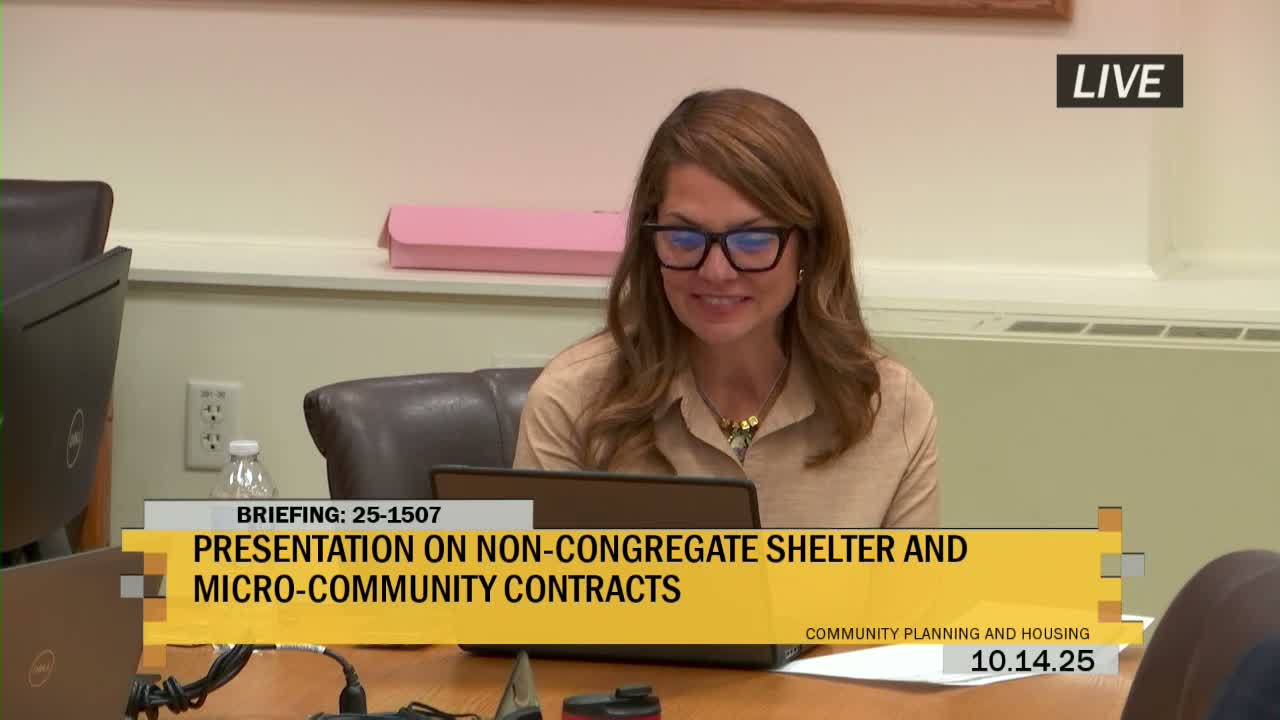
Colt Chandler, senior adviser on homelessness in the mayor’s office, briefed the Community Planning and Housing Committee on expenditures tied to the All In Mile High initiative and forecasted 2026 budgets.
Chandler said the initiative — which brought multiple hotel and micro‑community sites online as part of a multi‑agency effort — helped move more than 7,500 people indoors and, by his account, more than 6,200 into permanent or stable housing. He cited an Urban Institute evaluation that found a 98% reduction in large encampments citywide since the initiative began.
Chandler provided a year‑by‑year account. For 2023 he reported site preparation and construction spending for hotels and micro‑communities and smaller operational costs as sites came online. For 2024 he said one‑time federal funds (ARPA and other federal sources) paid the bulk of acquisition and capital outlays (~$63.9M cited for one‑time dollars to bring sites forward), while recurring host contract costs for operations were reported around $41.2M in 2024. Chandler said general services spent roughly $5.7M on maintenance/repairs/security for city‑owned hotels in that period.
For mid‑2025 Chandler reported expenditures as of June/July: DDPHE behavioral health services at about $235,000 and HOST operations/supportive services at about $17.2M year‑to‑date. He said 2026 budgeted figures reduce recurring expenditures in part because some leased sites are closing (Radisson closed March 2025; Comfort Inn scheduled to close March 2026) and because one‑time acquisitions and construction have already occurred.
Council members questioned whether the planned mid‑year site closures would deliver sufficient long‑term savings, noting that closures that occur mid‑year will not immediately appear as full‑year reductions. Chandler agreed closures are phased and that some increases (cost‑of‑living adjustments, security added into contracts) offset savings, but said the city is forecasting an overall reduction in recurring spend for 2026 compared with peak years.
Several members asked for a more complete accounting that includes indirect costs (legal, HR, finance, housing command staffing and IT) and for a clearer breakdown of one‑time ARPA and other federal funds versus ongoing general fund obligations. Chandler acknowledged the presentation focused on direct operating and one‑time capital costs and said broader system integration work will continue into 2026, including strengthened street outreach and increased behavioral health capacity for people who remain unsheltered.
No committee action was taken at the briefing. Council members requested follow‑up material including closed FY2025 books, a detailed split of funding sources and an update on the social impact bond program for consideration in a future committee meeting.