Get Full Government Meeting Transcripts, Videos, & Alerts Forever!
Get email alerts on the Parking Enforcement topic
No spam. Unsubscribe anytime.
Denver committee debates allowing mailed parking citations, citing staff safety and notice concerns
Summary
Committee considered a proposal to let right‑of‑way enforcement mail many stationary parking citations rather than affixing them to vehicles, citing staff safety and operational efficiency. Councilmembers sought cost estimates, data on citation distribution, effects of the parking magistrate office dissolution and equity concerns for residents with limited mail access.
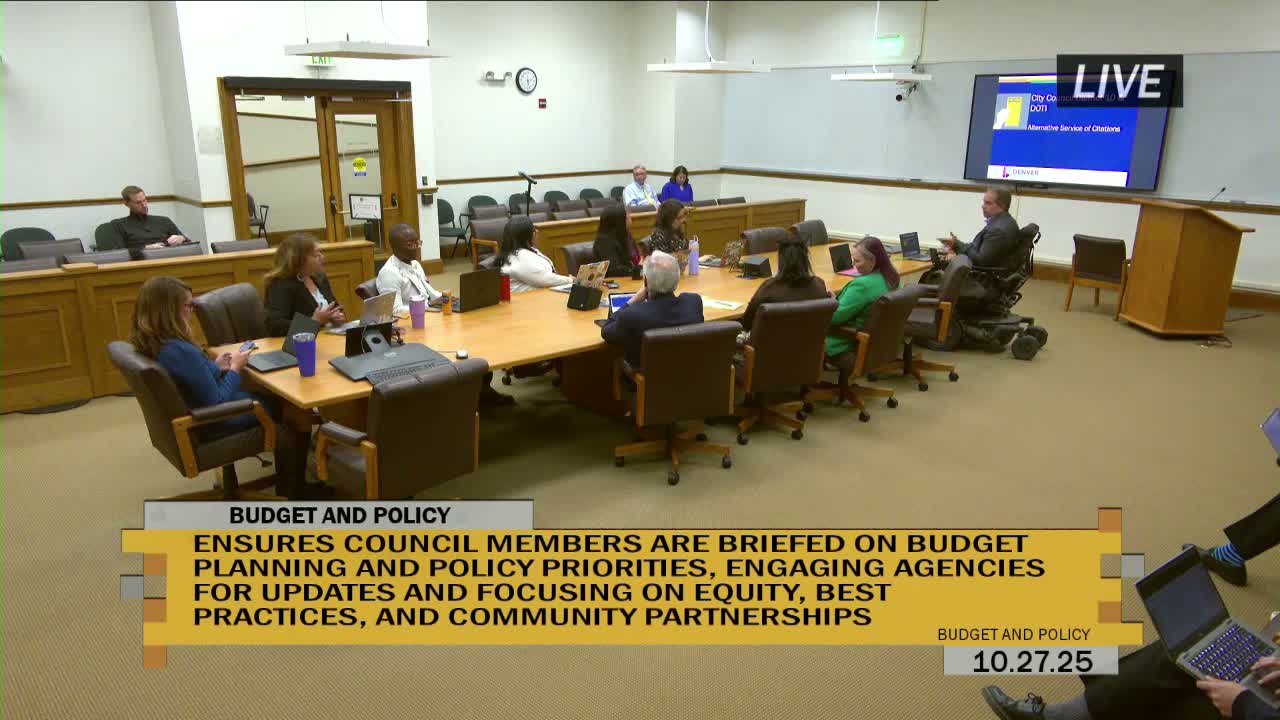
The Budget & Policy Committee shifted from a civic assembly briefing to debate a proposal to permit mailing of stationary parking citations rather than requiring enforcement agents to affix printed citations to vehicles.
Councilmember Hines (presenter) told the committee the city currently requires parking citations be conspicuously affixed to vehicles under DRMC 54 7 88, while moving‑vehicle and photo enforcement citations may be mailed. He and staff argued mailing would reduce confrontations and staff exposure: enforcement agents average about 50 citations a day and the presenter said that as of a month earlier right‑of‑way enforcement had issued nearly a quarter‑million citations for 2025. The presentation also cited field safety data: since 2023 there were 87 negative field interactions with enforcement staff and 14 incidents that required police response.
Adam Petrow, interim director for right‑of‑way enforcement, told the committee mailing would not be universal. He said mailing is most appropriate for high‑volume situations such as street sweeping where operational efficiency matters and where complex violations that require photographic evidence would remain on‑vehicle citations.
Councilmembers pressed about practical impacts. Members asked how much it would cost to mail citations, how many mailed tickets are ultimately paid, and whether mailing would increase disputes because recipients receive notice days later. Several members flagged that the city recently dissolved the parking magistrate's office, leaving adjudication and dispute logistics unclear; one councilmember said the new process for contesting will not be fully spelled out until January, and that the magistrate gap increases risk if mailed citations arrive and residents cannot readily contest them.
Councilmembers also raised equity concerns: residents who collect mail infrequently or who lack regular mailboxes (for example, some Jefferson Park residents) could face escalations before seeing mailed notice; members asked for spatial data to assess whether enforcement has been disproportionately targeted at specific neighborhoods. On ADA enforcement, presenters noted state law sets graduated fines (transcript referenced first citation $350, second $500, third $1,000 and subsequent penalties and community service tiers) and that peace officers — not right‑of‑way enforcement agents — have authority on private lots unless property owners allow peace officers on site.
No vote was taken. Committee members asked staff and the presenter to return with comparative data from other municipalities, cost estimates for mailing and processing, clarification on how contesting will work without the magistrate office, and a breakdown of where citations have been issued in the past year to evaluate equity impacts. Several members said the proposal is premature until those details are provided.
The meeting adjourned with the item left for further analysis and follow‑up.