Get Full Government Meeting Transcripts, Videos, & Alerts Forever!
Get email alerts on the Property Tax Rebate topic
No spam. Unsubscribe anytime.
Denver committee considers narrowing property tax rebate to prioritize homeowners and increase outreach
Summary
Councilmembers reviewed proposed Phase 2 changes to Denver's property tax rebate program, including lowering the age threshold to 62, raising certain AMI limits for homeowners, adding a surviving-spouse category, a FY26 budget proposal of $4.9 million, and the possibility of phasing renters out by 2030.
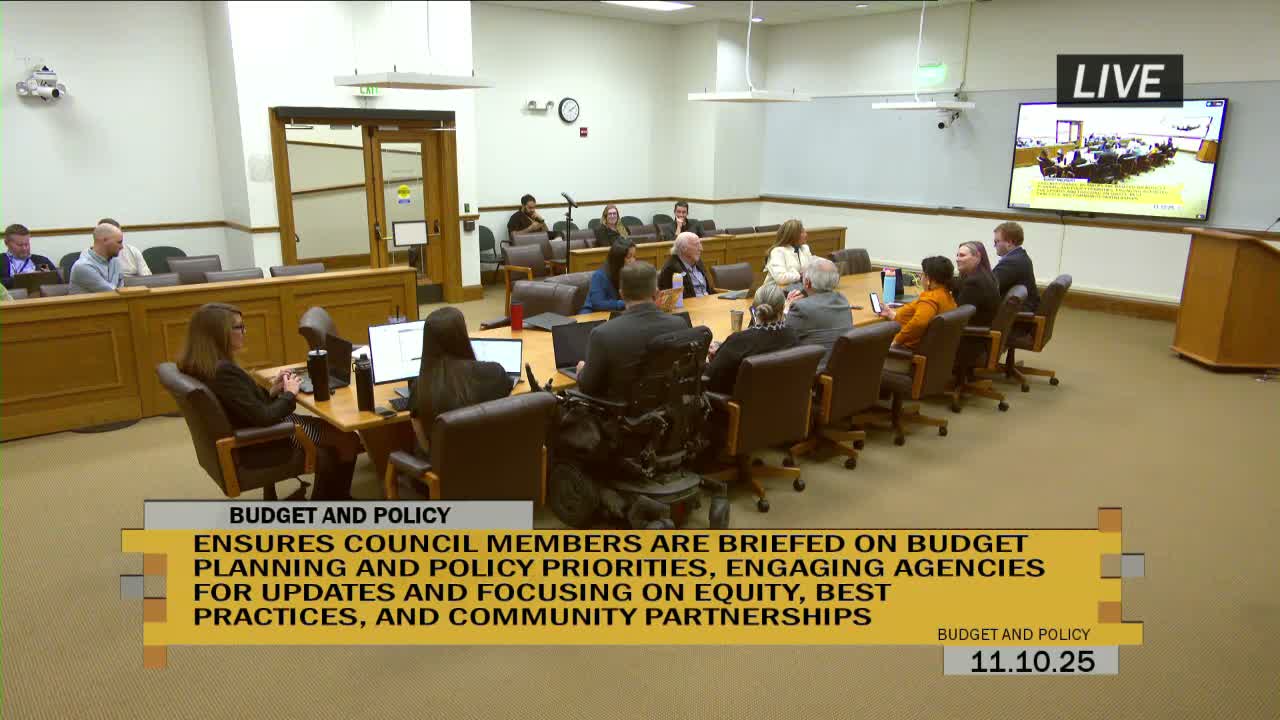
DENVER ' The Denver City Council's Budget & Policy Committee on Nov. 10 reviewed proposed changes to the city's property tax rebate program intended to expand access for homeowners and better target the program as a displacement-prevention tool.
Matt Walters, senior council lead for District 5, told the committee the rebate provides a partial refund of property taxes or the equivalent in rent to qualifying Denver residents and said eligible applicants receive at least $372. "Eligible applicants receive a payment of at least $372," Walters said while summarizing the program.
Host, which assumed administration of the program from DHS this year, launched a new online application May 1. Walters said Host received 3,018 applications between May and October and has processed and approved 1,047 to date. He reported the 2024'1025 program-year average rebate was $1,148 and current-year averages are close to $1,200.
Walters presented proposed ordinance changes: lower the homeowner age threshold from 65 to 62 to align with federal and state definitions of older adults; raise homeowner AMI eligibility from 60% to 80%; add a "surviving spouse, non-remarried" homeowner category; and simplify renter thresholds to a single 30% AMI cutoff. The presentation also flagged a policy question under discussion: whether renters should be phased out of the program over time (a hypothetical date of 2030 was mentioned) so dollars concentrate on homeowner displacement prevention.
On budget, Walters said the FY26 program was budgeted at $4,900,000 based on Host projections and program uptake. He and other presenters noted that the program's prior budget had been larger before a $1.5 million reallocation during the migrant crisis; Host staff said the current projection should meet next-year needs but emphasized limited historical data because Host only recently assumed administration.
Host staff described outreach steps taken since May: two locally contracted nonprofits to assist applicants, in-person outreach events, and a call center. Melissa Tati, Host's director of Stability & Prevention, said the program is listed in the My Friend Ben app and that applicants can apply online through DenverGov.org; she said applications can be submitted without file uploads and supporting documents can be mailed, dropped off, or picked up.
Councilmembers pressed staff on several unresolved issues. Members asked whether renters who previously benefited from the rebate would have alternative programs available if the city phases renters out; Host staff said increased funding for temporary rental assistance (TRUWA) may provide alternatives. Members also asked about caps: staff said current payout caps are $1,800 for homeowners and $1,000 for renters and that payments are limited to what applicants actually paid in taxes or annualized rent.
Several councilmembers raised concerns about landlord passthrough risk if owners apply for rebates on units that are rented: could landlords capture benefits rather than tenants? Staff said rebates are tied to dwelling units and that legal review would be needed to determine whether an ordinance could require landlords to share rebates with tenants; presenters said their current recommendation leans toward refocusing the program on homeowners.
Next steps: Walters said the proposal will proceed through the council process with a targeted committee date on Feb. 3 for formal consideration; staff will prepare ordinance language, legal review on landlord/tenant passthrough questions, and more detailed budget projections and outreach plans prior to that date.