Get Full Government Meeting Transcripts, Videos, & Alerts Forever!
Get email alerts on the Homelessness All In Mile High topic
No spam. Unsubscribe anytime.
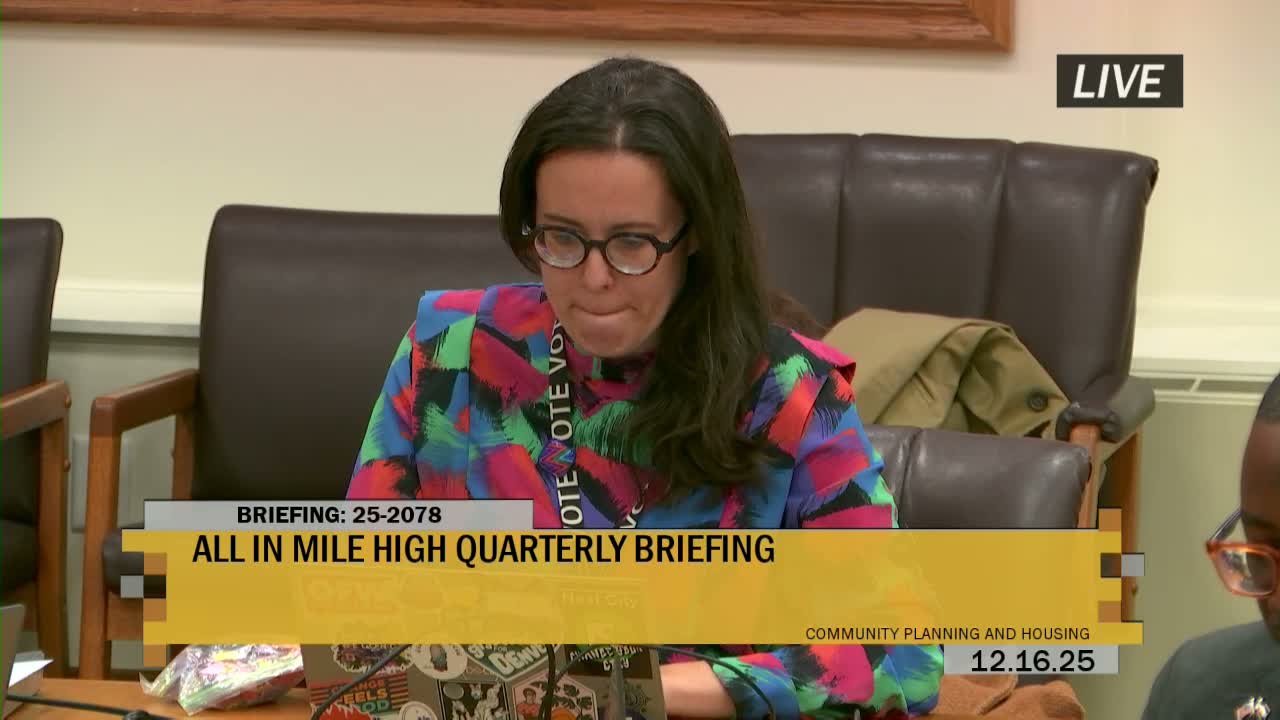
City reports progress and data questions in All in Mile High homelessness briefing
Summary
City staff told the Community Planning and Housing Committee they sheltered 2,006 people and have housed 1,630 year‑to‑date as part of the All in Mile High initiative, highlighted health‑service engagement (9 encounters per patient) and flagged data discrepancies on deaths that councilmembers asked the Office of the Medical Examiner to clarify.
Denver officials presented a quarterly All in Mile High homelessness briefing on Dec. 16 that combined program outcomes, contracts on the horizon and operational challenges including mortality data and funding risks.
Cole Chandler, senior advisor on homelessness in the mayor’s office, said the city had sheltered 2,006 people toward its 2,000 sheltering goal and “we have actually housed 1,630 people at this point in the year,” projecting roughly 1,650 by year‑end. Chandler cited Metro Denver Homelessness Initiative point‑in‑time data showing a 45% reduction in unsheltered homelessness since the 2023 high watermark and said Office of the Medical Examiner figures show deaths among people experiencing homelessness peaked in 2023, declined in 2024 and were below that high watermark in 2025; he added that “around 75 percent” of those deaths were related to overdoses.
City staff described program changes and near‑term procurements: the Radisson non‑congregate shelter closed in March; Roads to Recovery is maintaining roughly 71% of service connections for its clients; housing‑central command has continued to improve placements; and the planned integrated street‑engagement platform was moved to a January 2026 launch. Jeff Kositzky, deputy director, said service utilization at non‑congregate sites is about 71% and average length of stay is 205 days (staff said the target is under 180 days). Kositzky also explained the move toward performance‑based contracting tied to service utilization metrics.
Tristan Sanders, director of community behavioral health at DDPHE, briefed on health services and a CCH contract amendment staff expect to submit: the amendment would align referrals and response‑time metrics, fund an additional mobile medical vehicle and increase nurse care coordinators and medical assistants. Sanders highlighted clinical engagement data that “tells us” the system is producing an average of “9 to 1 encounters per patient,” meaning clients receive multiple substantive services across time.
Emily Berger summarized a rapid‑rehousing workforce pilot: of a universe of just over 300 people referred to rapid rehousing in 2025, about 200 were referred to workforce services, 86 elected to engage, 52 gained employment (about 60% of those engaged), and 36 started or completed training. Job placements included city positions, parks and rec, airport roles and airline contractors.
Councilmembers pressed staff on data quality and program details. Councilmember Ramirez sought clarity on the deaths data and pointed out a discrepancy between two slides; Chandler said the death figures come from the City’s Office of the Medical Examiner and recommended the committee consult that office for a technical explanation because staff could not reconcile slide differences in the meeting. Members also requested more regular monthly reporting from CCH on encounters and outcome types and asked staff to track program exits, returns to street, and the mix of housing outcomes (rapid rehousing, permanent supportive housing, reunification).
On vehicular homelessness, Chandler said the outreach pilot had “resolved vehicular homelessness for 75 total people” as of Dec. 2 through a mix of shelter, family reunification and direct moves to housing, and that nine people had voluntarily surrendered vehicles to the city’s vehicle disposal program. Staff said outreach remains the primary operational response and that the program’s scale for 2026 will be considered in the budget process.
Staff acknowledged risks tied to Medicaid billing changes for reimbursable services but said the CCH contract contains capacity to shift city funding to cover staffing if reimbursements decline; nurses and enrollment staff are also positioned to help people maintain Medicaid eligibility. The committee asked for follow‑up briefings on street engagement, storage trends required under the 2019 Lyle settlement, and the vehicular homelessness program.
The briefing did not include formal committee votes on the contracts discussed; staff said some contract amendments and leases will come forward on future consent calendars. The committee consented to two unspecified consent items at the close of the meeting and adjourned.