Lifetime Citizen Portal Access — AI Briefings, Alerts & Unlimited Follows
Council committee advances ordinance to expand uses of Denver's disposable bag fee, clearing budget transfer
Loading...
Summary
The Transportation & Infrastructure Committee voted 4-1 to advance a code change that would expand allowable uses for Denver's disposable bag fee special revenue fund and authorize up to a $4.7 million transfer to the city's volume-based pricing (composting/recycling) program; members pressed staff for tighter language and options to limit the transfer.
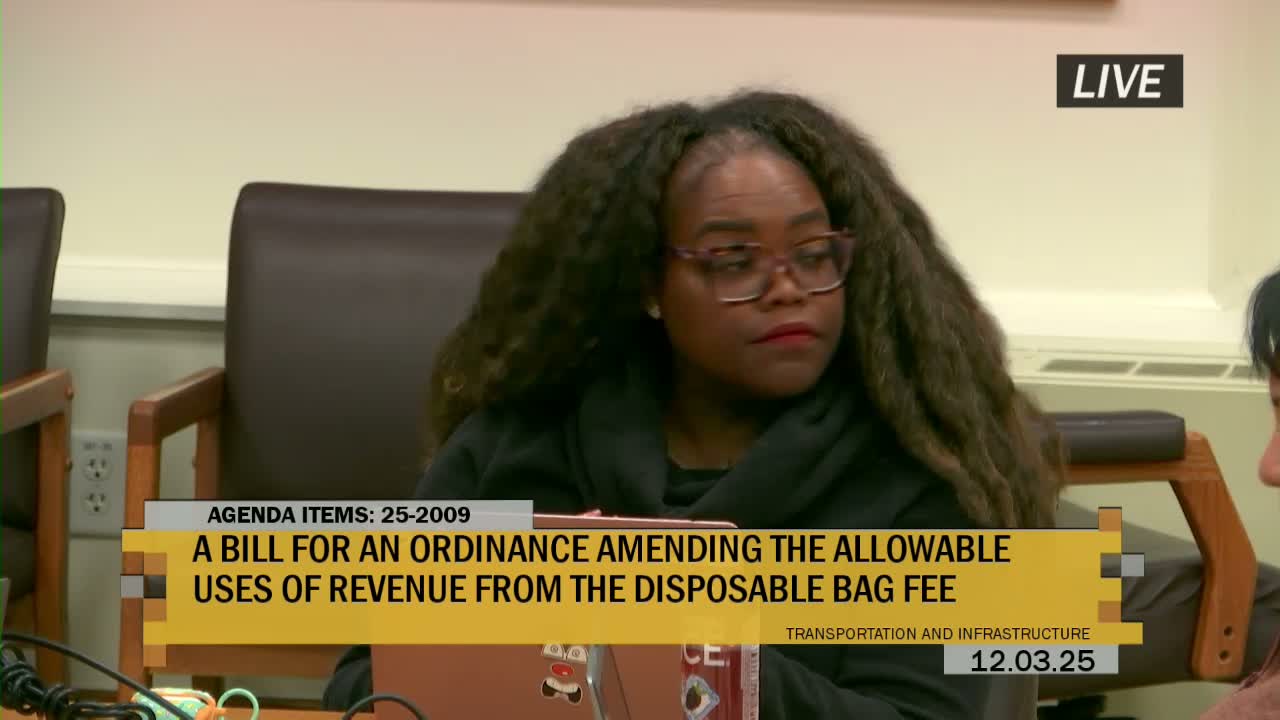
Denver ' The Transportation & Infrastructure Committee advanced an ordinance on Dec. 3 to broaden how the city may spend revenue from the disposable bag fee, and to enable a budgeted transfer of up to $4.7 million to the volume-based pricing fund that supports citywide composting and recycling.
The measure passed a committee roll call, 4-1, after roughly two hours of questions focused on whether the proposed language'particularly the phrase "and related activities" followed by "which may include"'was too broad and risked diverting funds from the program's original administration, education and reusable-bag work. Chair Chantal M. Lewis cast the lone no vote; the motion to advance was made by Councilmember Paul Cashman and carried.
Jonathan Wachtell, deputy executive director for the Office of Climate Action, Sustainability and Resiliency (CASR), told the committee the bag fee was created in 2021 as a 10-cent charge at retail checkout, with 60 percent remitted to the city and 40 percent retained by businesses to defray administrative costs. "We've seen a 50% reduction in the total disposable bags being used in the city of County, Denver," Wachtell said, adding the program has achieved "99% compliance" and that the city estimates "over 50,000,000 plastic bags" have been avoided through the policy.
Why it matters: The council previously budgeted a transfer from the bag-fee fund to the city's volume-based pricing program in the 2025 long bill, but that transfer was contingent on a code change clarifying allowable uses. Without the change, city finance staff warned, the authority to make the transfer could lapse on Dec. 31 and the volume-based pricing fund could show a negative balance for the 2025 fiscal year.
Money and mechanics: Justin Sykes, director of the Budget Management Office, said the bag-fee fund balance is currently "a little over $6,000,000," and that the 2025 budget authorized a transfer of up to $4,700,000 to support composting and recycling implementation. CASR staff said the remainder would leave the bag-fee fund with roughly $1.6 million and that ongoing administration, outreach and reusable-bag giveaways would remain the priority uses. CASR's program administrator, Natalie, described past outreach including community giveaways of about 2,000 reusable bags at events and a prior campaign distributing roughly 40,000 reusable bags.
Council concerns and proposed limits: Multiple members raised two consistent concerns: (1) the draft text'which uses "may include" when listing specific allowable activities'could allow unanticipated spending beyond the listed items; and (2) using bag-fee revenue to offset general operational needs for the volume-based pricing program could turn a narrowly intended program into a broader revenue source. Council President Sandoval put the point bluntly: "this is no longer the disposable bag fee fund," she said, urging either clearer naming or tighter limits so council and the public understand the fund's purpose.
Timing and compromise: Several council members urged a narrow approach to avoid budget risk: pass only the code change necessary to authorize the already-budgeted transfer and postpone debate about the wider expansion until January. Administration and CASR leadership expressed willingness to work with council: Liz Babcock, executive director of CASR, said she would "work with you all" but warned that implementation timelines for the Universal Recycling and Composting Ordinance are aggressive and that some flexibility in funding would help meet the September 2026 rulemaking and rollout schedule.
Outcome and next steps: The committee voted to advance the ordinance as drafted, with the understanding that council and administration will continue negotiations on tightening language and on how much of the authorized transfer to use. Because the ordinance was advanced out of committee, it will next appear on the council floor where members said additional amendments are possible.
Vote at a glance: Committee advanced the ordinance 4-1 on a roll call. (Recorded aye votes during committee: Councilmember Splendid; Council President Sandoval; Councilmember Hines; Councilmember Paul Cashman. Chair Chantal M. Lewis recorded a no.)
What remains unresolved: Council and administration still need to agree on specific statutory language to constrain "related activities," whether to reduce the transfer amount (a proposal to move $1.5 million rather than the full $4.7 million was discussed), and how CASR will document and report the impacts of any expanded uses. CASR committed to continuing briefings and to coordinating with the city attorney to clarify the ordinance text before final council action.