Get Full Government Meeting Transcripts, Videos, & Alerts Forever!
Get email alerts on the GAIN topic
No spam. Unsubscribe anytime.
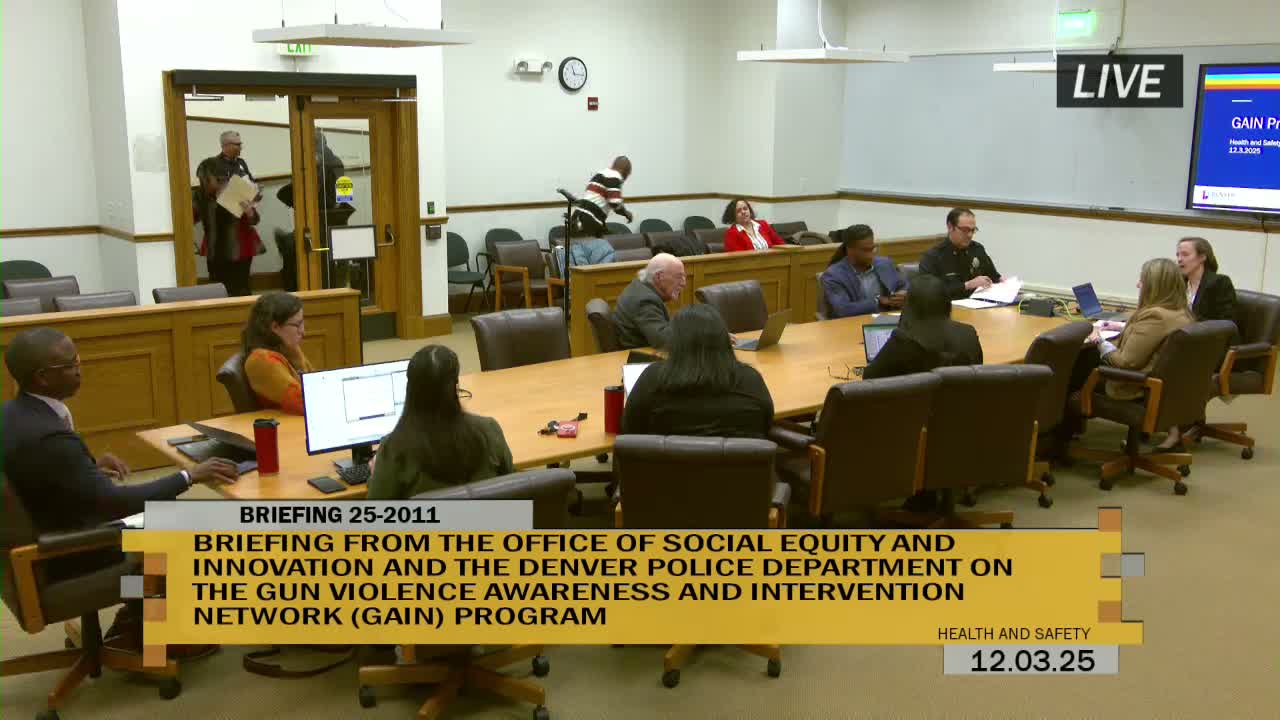
Committee hears GAIN pilot review; officials say redesign needed after limited conversions
Summary
City staff told the Health and Safety Committee that the GAIN (Gun Awareness and Intervention Network) year‑long pilot screened 222 people, reached 30 by contact and provided services to nine; briefers said the pilot was resource intensive and plan a 2026 redesign with stronger community partnership and clearer outreach protocols.
Denver — City officials presented findings Dec. 3 from a year‑long GAIN pilot that used a focused deterrence approach to identify and offer services to people at elevated risk of involvement in gun violence. Presenters said the pilot was wound down in October and staff plan to redesign the effort for 2026.
Megan Rohrer, director of mayoral initiatives, said the pilot screened 222 individuals over the year and that the program "served both adults and youth." She added that, during screening and follow‑up, the team contacted 30 people and "9 accepted and received services." Rohrer and data staff stressed that GAIN’s pilot was not credited as the cause of citywide reductions in shootings and homicides reported in 2024, and that other citywide strategies contributed to declines.
Kristen Jacoby of DPD’s data analysis bureau described the GAIN identification model: it combines offense points, role points and a time‑decay factor to produce a 0–100 score. Jacoby emphasized the model does not use demographic fields (race, ethnicity, gender or age) and that criminal justice information systems access is limited to a small, CJIS‑certified analytic team.
Presenters and councilmembers discussed the pilot’s operational limits. Staff said the model is resource intensive (roughly two hours of analyst work per workup) and that the program experienced a large attrition of possible candidates: the team screened 222 people from a much larger rolling data pool but could locate and contact only a subset. Officials also addressed community concerns that a much larger number of people had been "scored" in city databases; staff said the broader analytic pool contains roughly 7,500 people with any gun‑crime score across a three‑year rolling window, but that only 222 people were screened into the program workup during the pilot.
Councilmembers voiced strong concern about community outreach and trust. Several asked why council and neighborhood partners were not more involved and urged that the redesign include community‑led organizations, clearer communication channels, and a council liaison. Some members raised questions about the content and tone of outreach letters sent to individuals — including letters from law enforcement and references to prosecutors — and requested legal and procedural clarity on data sharing with federal partners.
Next steps: Staff said they completed an after‑action review and intend to use the pilot’s findings to redesign GAIN in 2026, with particular attention to partnership with community organizations, reducing reputational risk to community providers, and improving contact and conversion rates to services.