Get Full Government Meeting Transcripts, Videos, & Alerts Forever!
Get email alerts on the Axon Contract topic
No spam. Unsubscribe anytime.
Denver briefing details proposed $27 million Axon contract and raises data, taser and docking‑station questions
Summary
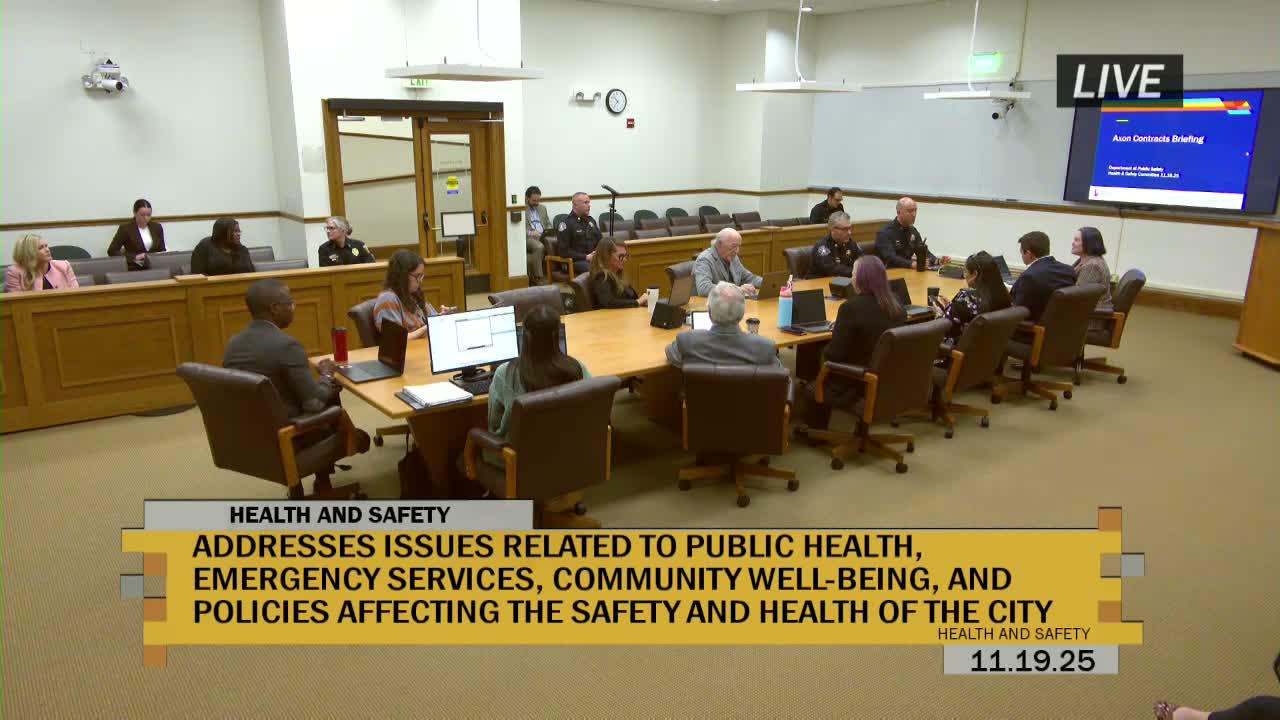
The Department of Public Safety briefed the Health & Safety Committee on Nov. 19 about (1) a $450,000 amendment to the current Axon contract and (2) a proposed Jan. 1, 2026–Dec. 31, 2030 contract with an approximate $27 million maximum spend; council members requested the draft contract, historical spending data back to 2015 where available, and clarifications on evidence.com, Ring integration, docking‑station costs and TASER use metrics before a Dec. 3 vote.
Department of Public Safety staff briefed the Health & Safety Committee on two Axon‑related items: an administrative amendment to the current contract (a requested $450,000 increase to allow the department to pay 2025 invoices, bringing the current max spend to roughly $22.5 million) and a proposed five‑year replacement contract (Jan. 1, 2026–Dec. 31, 2030) with a maximum spend of about $27 million.
Emily Lough, legislation and policy director for the Department of Public Safety, said the current contract (originally executed in 2015 and amended in 2020/2021) needed the amendment because actual spending on hardware, licences and accessories for policing and sheriff functions exceeded prior forecasts. The proposed new contract covers body‑worn cameras, TASER devices and cartridges, interview‑room audio/video upgrades, professional services and centralized unlimited digital evidence storage (evidence.com). Lough said the administration used a NASPO cooperative procurement to leverage a national competitive process and cited Denver Revised Municipal Code § 20‑64.5 as authorizing that approach.
Axon representative Ben Rupi described primary cost drivers: modest increases in camera counts (DPD from ~1,670 to ~1,725; sheriff up to ~730), a recommendation to add single‑bay docking stations (a 1:1 ratio requested by DPD), and substantial increases in TASER devices (police requests rose to ~1,450 TASERs and sheriff requested ~400 TASERs for facility use). Rupi and department staff said docking stations reduce overtime for officers who previously had to travel to multi‑bay upload stations and that unlimited third‑party storage would consolidate evidence holdings and reduce discovery risk because the Denver District Attorney’s Office has standardized on the evidence.com platform.
Council members used the briefing to probe operational and policy implications. Questions and requests from council included:
- A year‑by‑year cost and scope chart (council asked for data back to 2015; CFO Shanae Cummings said Workday financial data is available starting in 2018 and that PeopleSoft records before that period require manual retrieval).
- Details on docking‑station costs versus overtime savings, and whether 1:1 single‑bay docks are necessary instead of shift‑based or shared approaches.
- TASER use metrics and safety data. Staff said the TASER 10 includes telemetry that records withdrawals even when not fired; the sheriff reported 20 probe discharges since 2021 and 81 instances where a taser was shown but not fired in the department’s preliminary data (a 75% de‑escalation success rate was cited for that sample).
- Data‑sharing, Ring integration and privacy: Axon said community uploads and a Ring opt‑in pipeline are possible; Axon and DPD emphasized those features are opt‑in from community members and that evidence.com access is role‑based and audited. Councilmembers raised concerns about facial recognition metadata and asked for explicit contract language blocking unapproved surveillance features.
- Artificial intelligence: commanders and Axon representatives said AI‑generated draft police reports are not part of the current contract scope, though council asked for policy guardrails before adopting any future AI features.
Council President Amanda Sandoval and others asked that the draft contract be delivered as deliberative work product to council attorneys and members this week (before Dec. 3) so committee members can review. Department staff agreed to provide the contract and follow‑up materials (cost breakdowns, DIA contribution estimates, TASER deployment data and other requested documentation) ahead of the Dec. 3 action item.