Get Full Government Meeting Transcripts, Videos, & Alerts Forever!
Get email alerts on the Water Conservation topic
No spam. Unsubscribe anytime.
Denver Parks outlines near-complete smart-irrigation build-out, cites water and staff savings
Summary
Denver Parks and Recreation told the City Council Parks, Arts & Culture Committee it has nearly completed a citywide central control (smart irrigation) network tied to a new weather-station system, estimating routine savings, faster repairs and operational benefits while flagging aging infrastructure and vandalism as ongoing challenges.
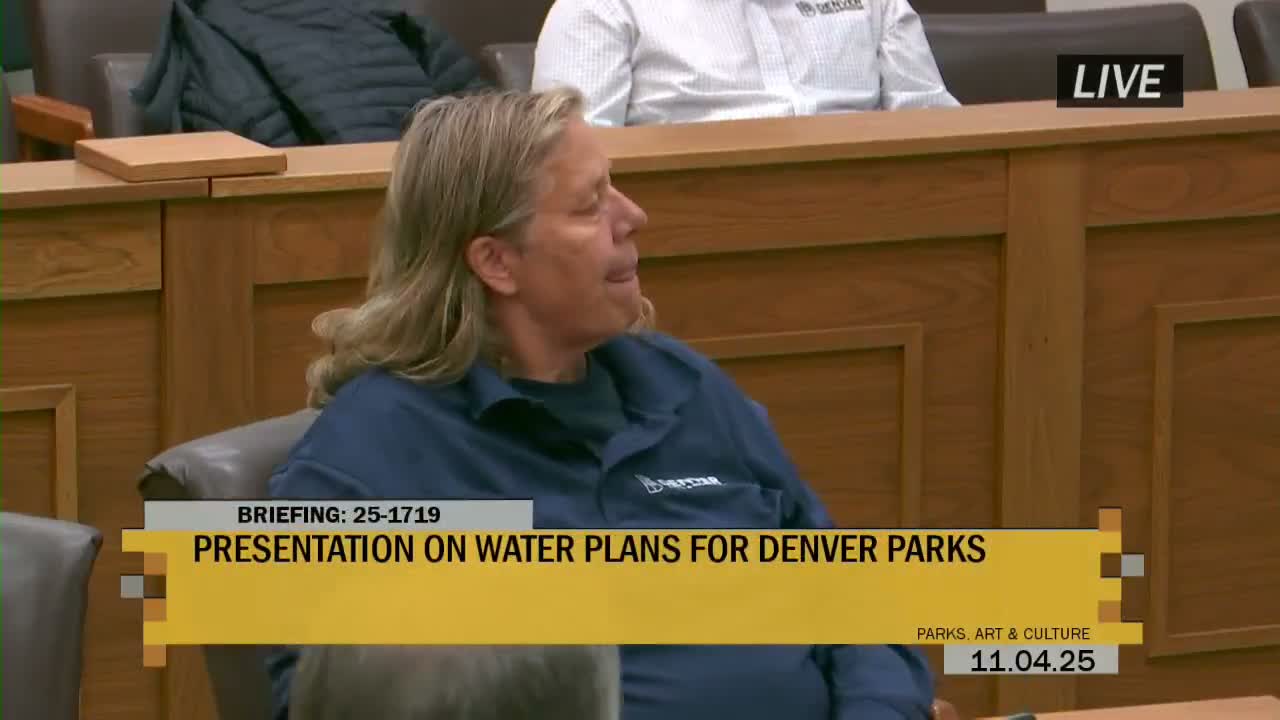
Denver Parks and Recreation told the City Council Parks, Arts & Culture Committee on Jan. 21 that a citywide rollout of networked irrigation controllers — known as central control or smart irrigation — is about 95% complete and is already helping the department conserve water, speed repairs and reduce reliance on vendors.
Damian Wetzel, Water Conservation Manager for Denver Parks, said the department uses more than 2,000,000,000 gallons of water a year and pays roughly $5,000,000 annually for irrigation water, making Parks Denver Water’s largest customer by volume. "Central control is what you commonly refer to as smart irrigation," Wetzel said, adding that controllers communicate over radios or cellular service and that Parks now has "over 700 individual central control units." He described the system as a tool to program by park and landscape type and to detect leaks or theft through flow and master-valve sensors.
The program’s nut is tighter, data-driven watering, officials said. The department tracks evapotranspiration (ET) and maintains irrigation water budgets by district; through September this year Parks had used about 70% of its irrigation budget. "We track that through ET…so that's how we create our adjusted irrigation requirement," Wetzel said, describing monthly consumption reports distributed to park operations managers.
Lynn Fulton, a water-conservation crew lead, described a weather-station network (eight full stations and 12 rain cups) that triggers automatic rain shutdowns across controllers. Fulton said a full shutdown at peak season can save an estimated 30,000,000 gallons and about $70,000; in 2024 the system recorded 31 shutdown events, four of them full shutdowns. "We want to be proactive when programming, with weather as a big factor," Fulton said.
Committee members pressed staff on several operational details. Councilmember Daryl Watson asked how the system handles older infrastructure; Wetzel said Parks installs a master valve and flow sensor at each connection so controllers learn normal gallons-per-minute ranges and shut down automatically after repeated high-flow alarms that indicate a broken head or main break. "The controller’s intelligent enough to calibrate based on the old and new system," Wetzel said.
On recycled water, staff said Parks partners with Denver Water and that roughly 25% of irrigated parks receive recycled ("purple pipe") water where that infrastructure exists — primarily in the Northeast and Northwest and parts of the East District. Park conversions depend on Denver Water’s expansion of recycled-water mains.
Officials also described nontechnical gains: an in-house build-out and service program that has handled more than 1,200 service calls since 2018 with an approximately 90% one-day success rate, and an OpenGov (Cartograph) work-order rollout intended to speed responses and replace slower email/manual dispatch systems.
But Parks cautioned about constraints. Wetzel highlighted vandalism and theft — including backflow devices targeted for metal value — and noted that many park irrigation mains and laterals remain decades old. He said about 85 parks have irrigation infrastructure older than 40 years (about 120 parks older than 35 years) and that full park replacements are costly; City Park was cited as a project with widely increasing cost estimates. To respond, Parks has started an in-house irrigation construction crew to replace smaller systems (roughly 5 acres and under) and uses modern materials and designs (mechanical fittings, MP Rotator nozzles, plastic valves, shallower mains) when feasible.
Committee members also discussed outreach and planning: staff said Parks is incorporating "hybrid" designs in new parks (mixing smaller irrigated bluegrass with larger native areas) and running community-facing communications under an "In Denver's Nature" project to explain conversions and water-smart plantings. Council members asked Parks to share CIP project lists and consumption data with council offices; staff agreed to provide follow-ups.
Chair Flora Alvidrez closed the discussion after members praised the presentation and requested additional follow-up materials. The committee adjourned without votes on the topic.