Get Full Government Meeting Transcripts, Videos, & Alerts Forever!
Get email alerts on the Building Code Single Stair topic
No spam. Unsubscribe anytime.
Denver committee advances building and fire code changes to allow single‑stair apartment buildings
Summary
The Community Planning and Housing Committee voted to move a package of building‑ and fire‑code updates to the full City Council, including a new allowance for single‑stair multiunit residential buildings (up to five stories), state‑sourced wildland‑urban interface map adoption and several administrative permitting clarifications.
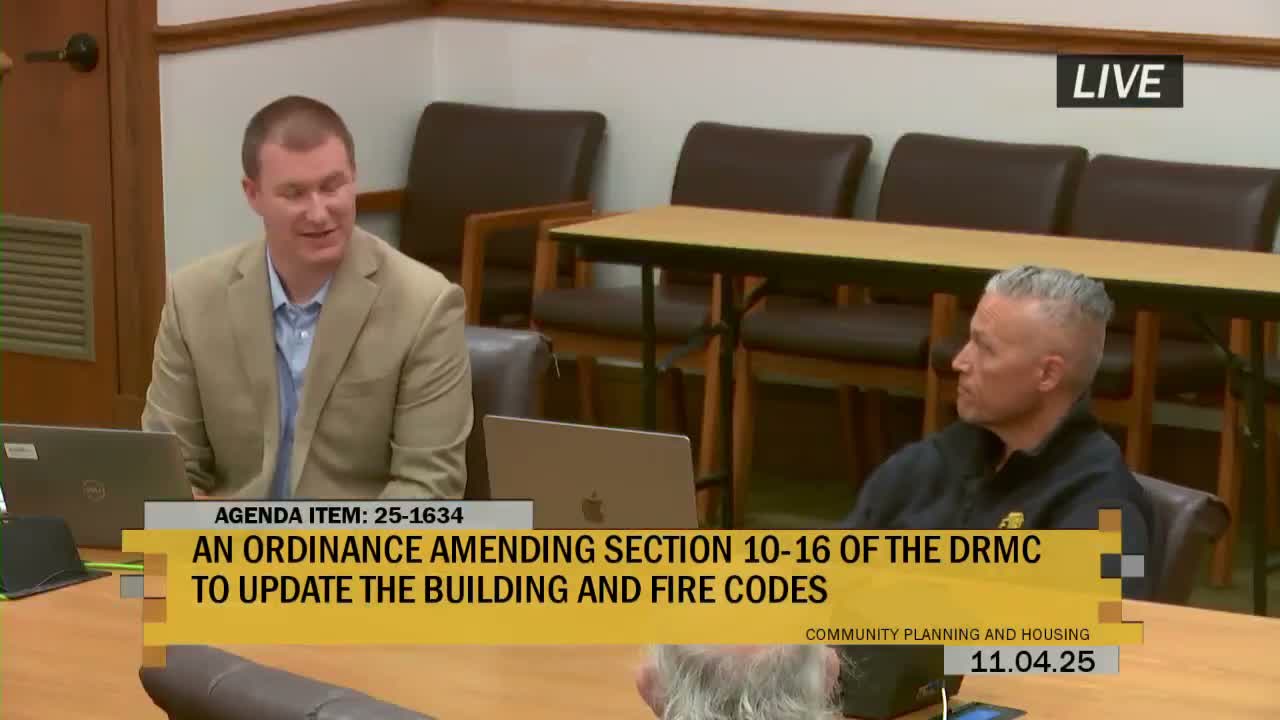
Denver’s Community Planning and Housing Committee on Nov. 4 voted to advance a set of building‑ and fire‑code updates to the full City Council that would let certain multistory apartment buildings use a single stair, adopt state wildland‑urban interface maps, and streamline several permitting requirements.
Eric Browning, chief building official for Community Planning and Development, told the committee the package reflects more than a year of research and coordination with Denver Fire and follows recent state and model‑code developments. “What we have, be presenting this afternoon is a culmination of all of the research,” Browning said, noting the local language “primarily matches that of the state” while adding some Denver‑specific allowances.
Under the proposed rule, single‑stair residential buildings could be built up to five stories (or four stories with an occupied rooftop deck) provided they meet life‑safety criteria Browning described. The package sets a 6,000‑square‑foot maximum per story and allows up to four units per story. All residential spaces in these buildings would be fully sprinkler‑protected; permitted construction types would include Types 1, 2, 3 and 4, with staff saying Type 3 (wood‑frame) was evaluated and recommended locally because of added redundancies and fire‑safety features.
Browning and Denver Fire officials also identified operational and design safeguards. Chief DeBaer said suppression and smoke control will be required and emphasized the department’s “defend‑in‑place” and ladder‑backup strategies for rescue if a stair becomes compromised. Browning added that the code requires emergency escape and rescue openings facing the right‑of‑way and limitations on electrical outlets in stairs and common corridors to reduce risks from lithium batteries.
Public commenters, including housing advocates and architects, urged the committee to adopt the changes and consider allowing taller buildings. Max Nardo of the Southwest Energy Efficiency Project told the committee the reform “will expand housing diversity in areas that are connected to public transit and jobs” and urged council to “remain open minded to increasing it to 7 stories.” Rob Greer, an eviction‑defense attorney, said Denver’s housing shortage and permit shortfalls make the change urgent and also urged consideration of seven‑story options tied to density bonuses.
Council members asked for operational detail and for CPD to provide memos documenting safety differences between single‑stair and double‑stair buildings, pressurization requirements, fire‑pump and water‑supply provisions, and any likely effects on plan‑review timing. Browning said staff will provide trainings, update external guidance materials and track how many single‑stair buildings are permitted and built if the code moves forward.
Other items in the package included a nonretroactivity clause for the wildland‑urban interface regulations (they apply only when qualifying exterior work is performed), an alternate neighbor‑notification option using posted signs instead of certified mail, exemptions or streamlined review for modifications to existing wireless and broadband facilities, SolarAPP+ permitting for residential rooftop solar and clarifications to energy‑code compliance for small commercial changes of occupancy. Browning said the wildland‑interface maps affect a very small number of parcels in Denver and that adoption would not force owners to make immediate changes.
Chair Amanda Sawyer moved to advance the package to the full City Council for public hearing and subsequent readings; the committee indicated unanimous thumbs‑up and set the item to go to the council floor. Browning told the committee he expected the item to be in full council for a first reading on the 17th and for a later vote shortly before Thanksgiving.