Get Full Government Meeting Transcripts, Videos, & Alerts Forever!
Get email alerts on the Revenue Forecast Sales Tax topic
No spam. Unsubscribe anytime.
City's revenue forecasting team outlines neural-network sales-tax model and warns one-time funds won't close 2026 gap
Summary
Denver budget office presented its sales-tax forecasting approach using a custom neural-network model, reported 2024 collections were 98.8% of budgeted estimates, and said one-time revenues that helped stabilize 2025 (about $36M) are largely absent from the 2026 outlook, leaving the city to rely on expenditure reductions and reserve strategies.
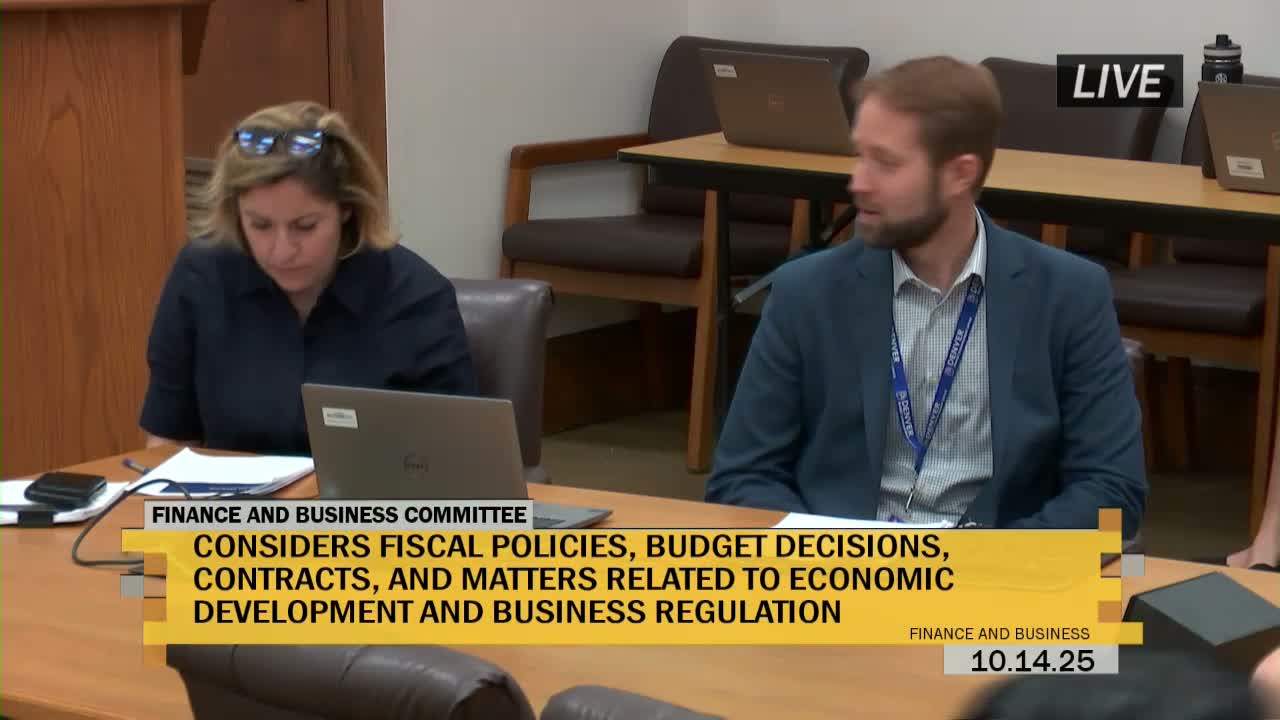
Denver's Budget Management Office briefed the Finance & Business Committee on Oct. 14 about the city's revenue outlook for 2026, explaining modeling methods, one-time revenue uses in 2025 and the five-year forecast and reserve strategy.
Chief economist Lisa Martinez Templeton described the city's consumption-based sales-tax model, a custom program written in Python that uses monthly tax collections at six-digit industry detail, local foot-traffic indicators, tourism and hotel occupancy data, macroeconomic variables and special-event adjustments. Templeton said the model is paired with judgmental adjustments and scenario analysis to produce a baseline and optimistic/pessimistic scenarios.
Budget Management Office Director Justin Sykes said the city maximized one-time revenues in 2025 (just over $36 million), including $22 million transferred from the border crisis response fund and $6 million from the Stapleton Reserve Special Revenue Fund, but projects only about $5 million in one-time sources for 2026. He warned the city cannot rely on one-time transfers to the same degree next year and described proposed structural expenditure reductions to bring the operating budget closer to balance.
Sykes also walked the committee through the five-year operating forecast and the city's reserve policy. He said the city anticipates roughly $1.664 billion in 2026 general fund revenues, with more than two-thirds coming from sales and use tax and property tax. The presentation explained the reserve policy bands: amounts above 15% of expenditures can be used for one-time items, 10—15% allows stabilization during below-average growth, and below 10% is reserved for severe emergencies. Staff currently project 2025 year-end reserves around 10.3% and a proposed 2026 target of about 11%.
Council members questioned modeling accuracy and vendor provenance. Templeton said she developed and runs the Python-based neural network in-house and noted that the city collected 98.8% of budgeted core sales-and-use-tax estimates for 2024, meaning model errors were around 1.2% in that comparison.
Council members also raised aging fees (for example, the right-of-way vacation fee set at $1,000 in prior years) and requested a holistic review of fee schedules to determine where adjustments could be made, with sensitivity to equity impacts. Finance staff agreed to pursue an off-season review of top revenue sources and fees and to provide a breakdown of what funded the border crisis response fund and where those dollars were reallocated.
The committee closed with follow-up requests for additional detail on one-time transfers, fee-update proposals and clarifying assumptions in the five-year forecast ahead of the budget vote next month.