Contra Costa Fire District to deploy high-pressure tool to attack EV battery fires; chief reports EMS improvements
Loading...
Summary
Fire Chief Burchard told the Contra Costa County Fire Protection District board the department plans to put a European-made Cold Cut Cobra on response vehicles to target EV battery fires and reported improved ambulance transport metrics, including 94.7% compliance and nearly 86,000 transports in 2025; the board approved the consent calendar unanimously.
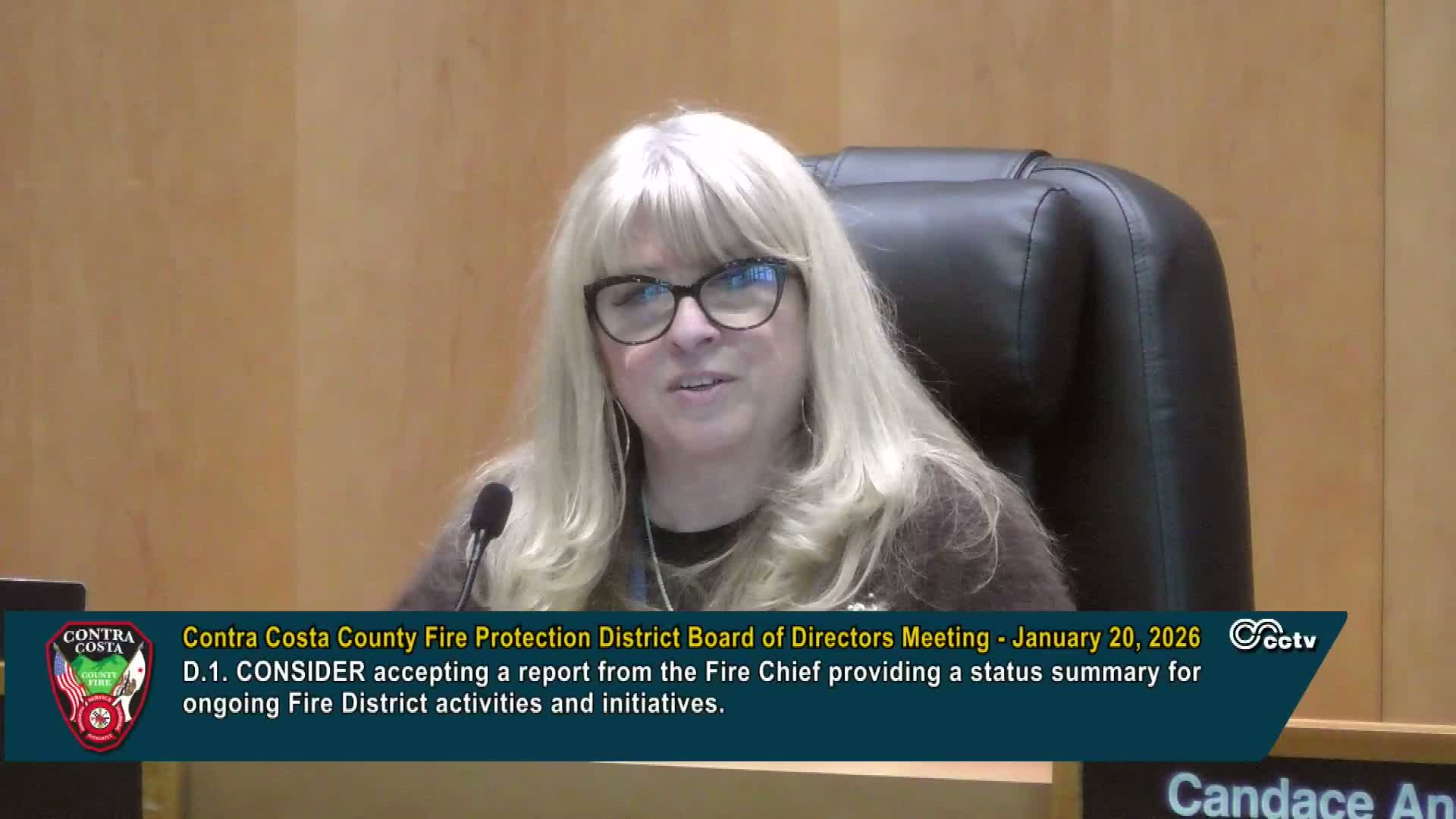
Contra Costa County Fire Protection District plans to add a high-pressure cutting-and-injection tool to its arsenal to attack electric-vehicle battery fires, Fire Chief Burchard told the board on Jan. 20, and he also reported measurable improvements in ambulance transport performance.
Burchard described a recent demonstration of a device called the Cold Cut Cobra, saying the tool "would significantly increase our ability to control EV fires." He said the European-made unit uses a very small, high-pressure jet — the nozzle opening is "about the size of the opening of a ballpoint pen" — to pierce metal or plastic and inject a small amount of water directly into a burning battery compartment. "So instead of using thousands upon thousands of gallons of water over many, many minutes, if not over an hour, we can get to the actual heart of the fire, put the fire out, quickly, and mitigate the incident, much more efficiently," he said.
Burchard told the board procurement approval for the equipment appeared on the meeting's consent calendar. The device is compact, designed to mount on a pickup with a small tank and hose reel so crews can drive into parking garages and reach battery compartments more quickly.
The chief also gave an update on the district's emergency medical services. He said the transport system "performed at a rate of 94% 94.7% compliance with the contracted requirements" across geography from Richmond to Discovery Bay and reported "just under 86,000 transports" in 2025. He said the district has expanded calls routed to its nurse navigation program from roughly five per day to about 20 per day since June, and that expansion is still new.
On ambulance patient offload times (APOT), Burchard said 12-month data attached to his report show a downward trend at most facilities. He highlighted a targeted Kaizen process in early November involving district EMS staff, the subcontractor AMR and several hospital systems that, he said, produced a notable improvement at John Muir Walnut Creek: the 90th-percentile offload time fell from about 1 hour 11 minutes in January to about 22 minutes in December 2025.
Burchard also briefed the board on staffing and training. He said a fire academy of 15 lateral firefighters began Jan. 5 and the class is intended to provide replacements expected in March; the class is due to graduate in February. He reported the district has logged roughly 110,000 hours of training (transcript phrasing unclear on exact metric) and referenced an annual prevention-bureau figure near 7,000.
In discussion that followed, board members and staff touched on consumer battery-brand quality, storage options and the limits of some mitigation products. Burchard warned that vehicle fire blankets previously marketed to departments can trap byproducts such as hydrogen and pose an explosion risk. Participants suggested fireproof lithium battery boxes and steel storage cabinets as possible mitigations, but Burchard cautioned standards and definitive solutions remain under development.
Procedural action: the board approved the consent calendar (items C1–C10) on a motion by Supervisor Scales Preston and a second from Supervisor Anderson; Chair Gioia announced the motion "passes unanimously." The chief said the new EV tool procurement was included on that consent calendar. The board took no other formal votes during the public portion of the meeting.
Next steps and timing in Burchard’s report included putting the Cold Cut Cobra units into service "over the next few months," the February graduation of the academy class and continued monitoring of nurse navigation and APOT metrics. The meeting record shows no public commenters during the public comment period.