Get Full Government Meeting Transcripts, Videos, & Alerts Forever!
Get email alerts on the Parks And Recreation topic
No spam. Unsubscribe anytime.
Grand Junction council sends parks impact fee study back for review after builders question land‑price inputs
Summary
Council asked staff and consultant Tischler Weiss to revisit parts of the parks and recreation impact fee methodology after the Home Builders Association argued the use of an average land‑price sample inflates acquisition cost assumptions; staff will return with defensible options tied to PROS plan priorities.
The Grand Junction City Council on Nov. 3 directed staff to work with consultants and stakeholders to revisit parts of the newly adopted parks and recreation impact fee study after builders raised concerns about how land prices were sampled to calculate the land‑acquisition component.
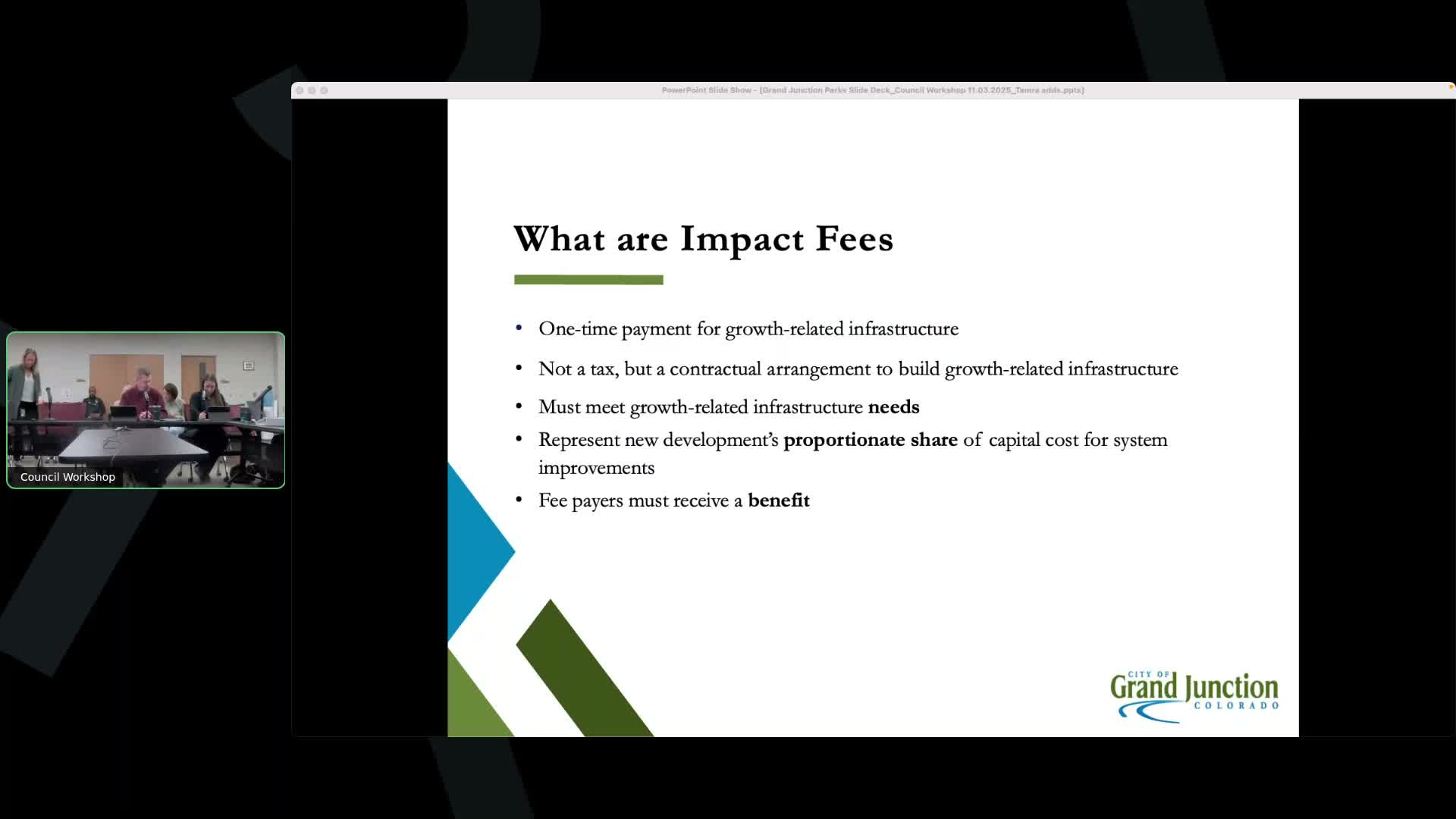
Julie Herlins of Tischler Weiss reviewed the methodology the firm used: a consumption‑based (incremental expansion) approach that derives current levels of service for parkland, open space and park improvements and applies weighted average acquisition costs from sampled past purchases to calculate a cost‑per‑person. Herlins said the city inventory used in the analysis includes roughly 545 acres of parkland and about 303 acres of open space, producing a level‑of‑service baseline (about 4.7 acres per 1,000 residents) used in the fee calculation.
Diane Schwenke, representing the Home Builders Association, urged a re‑examination of the land‑cost inputs, arguing that the consultant’s average acquisition price (presented in the packet) understates the distribution of values and that outskirts acquisitions typically run much lower than the citywide average. "147,000 is an average. It's not the median," Schwenke said, and she offered BBC research and an alternative scenario showing lower projected acquisition costs and correspondingly lower fee revenue impacts.
Staff and the consultant said the study used actual acquisition prices and followed defensible methodology required by statute (the packet cites Senate Bill 15 as enabling impact fees in Colorado), but acknowledged council can ask for scenario testing. After council discussion about whether to remove high‑value downtown park acquisitions from the sample, or to test a median or location‑adjusted approach tied to the city’s PROS plan and identified future park sites, staff said they would return options for council consideration.
Council did not change the ordinance during the workshop; instead staff was asked to develop alternative methodology scenarios and analyses — for example, removing downtown outliers, testing median versus mean land costs, and aligning inputs with the PROS plan’s identified future park locations — and to return with defensible comparisons for council action.