Get Full Government Meeting Transcripts, Videos, & Alerts Forever!
Get email alerts on the Automated License Plate Readers topic
No spam. Unsubscribe anytime.
Larimer County approves Homeland Security grant application to maintain ALPR camera system after sheriff's briefing
Summary
After a presentation by Sheriff John Fan, the Larimer County Board approved a consent-item Homeland Security grant application to maintain automated license-plate reader (ALPR) capabilities for roughly three years; commissioners pressed the sheriff on data sharing, retention and privacy safeguards.
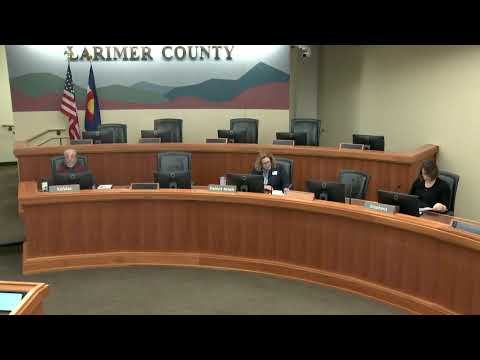
The Larimer County Board of County Commissioners on Jan. 26 approved a consent-item Homeland Security grant application to help fund the county's automated license-plate reader (ALPR) camera system, after Larimer County Sheriff John Fan briefed the board and answered commissioners' questions about privacy and data use.
Sheriff John Fan said the grant request would help maintain the county's existing ALPR capabilities for about three years. "It's about $130,000 a year," he said, adding that the three-year cost would be roughly $320,000—$360,000 depending on final budgeting. Fan described the system as still-image cameras that "do not record audio," and said, "We own the data. Flock does not have access to the data." He said the county generally deletes un-downloaded data after 30 days, noting state law sets a maximum one-year retention.
The presentation and follow-up questions focused on how the technology works, how the county manages access, and whether the system could be misused. Fan described ALPRs as an investigative tool that provides leads, not a standalone basis for arrest: "It just gives us a direction to go," he said, adding that deputies still need to develop probable cause through conventional investigation. He also told the board the county shares ALPR information with regional partners and that, nationally, many agencies use similar systems.
Commissioner John Kefalas, who asked that the grant item be pulled briefly from the consent agenda for discussion, pressed the sheriff on legal and civil-rights implications. Kefalas asked for case law and cautioned about profiling risks, noting constituent concern that data could be used inappropriately. "Could the camera system be used for racial profiling?" he asked. Fan acknowledged the risk of misuse and described supervisor review and audit trails: "Every keystroke that accesses our system ... there's a digital trail," he said.
Commissioner Kristen Stevens raised retention and capability questions: she confirmed the sheriff's office uses still images rather than continuous video and reiterated community worries that data sharing could extend beyond local control. Fan said the county's contracts allow it to determine which agencies may access its shared data and that while he had not seen federal partners in the list he reviewed, the state patrol is among local partners.
Board members also asked why the county had adopted the Flock system rather than alternatives. Fan said the per-camera cost with other vendors could be substantially higher (he cited roughly $2,500 per camera per year for Flock) and that a critical mass of private partners and shared deployments in the region made the system practical for cross-jurisdictional investigative work.
Fan cited several investigative outcomes the county attributes in part to ALPR hits, including locating vehicles tied to burglaries and assisting with Amber Alert recoveries and homicide leads. He described a series of examples where plate reads produced investigative leads that helped deputies narrow suspects or find missing children, and cited endorsements from national organizations that have supported use of ALPRs in specific projects.
After the presentation and extended questions from commissioners, Commissioner Kefalas moved to approve the consent agenda, "including this item for today." The board voted aye, and the consent agenda passed. The sheriff and staff will proceed with the grant-submission pathway and continue public engagement about policy and oversight.
The board then moved to other routine items, received a brief county-manager update about a ranch master-plan meeting with school-district representatives, and heard commissioners' reports. Commissioners later voted to enter an executive session to receive legal advice on Taft Hill Road condemnation cases; no decision was expected from that executive session.
What the board approved and what remains to be decided
- Action taken: The board approved a consent agenda that includes the county's application to the FEMA Homeland Security grant program to fund eligible technology and to maintain the county's ALPR system for the near term. - Next steps: Staff will finalize grant paperwork and continue public communication about policies governing data access, retention and oversight. Any change to retention policy, interagency sharing or vendor contracts would require further action by the board or by staff under board direction.
Key quotations
"It does not record audio," Sheriff John Fan said, explaining the cameras capture still images of vehicles rather than video or sound. "We own the data. Flock does not have access to the data," he added, describing CJIS-compliant cloud storage and monthly supervisory audits of access logs.
"I want us to be really cautious in this space because ... there are cases across the U.S. where it has been used to harass residents," Commissioner Kristen Stevens said during questioning, calling for continued transparency and safeguards.
Context and why it matters
ALPR systems are used by many law-enforcement agencies to generate investigative leads from license-plate reads; advocates point to recoveries of missing children and theft investigations, while critics caution about privacy, data sharing and potential misuse. The Larimer County board's approval to pursue federal Homeland Security grant funding preserves the county's current system pending further public discussion of access, retention and oversight.
The meeting record shows the board approved the administrative minutes and consent agenda and voted to enter executive session on litigation matters; no final policy changes about ALPR retention or interagency access were adopted at this meeting.