Get Full Government Meeting Transcripts, Videos, & Alerts Forever!
Get email alerts on the Water Supply Safety topic
No spam. Unsubscribe anytime.
Oxnard City staff seek committee recommendation to adopt new cross-connection, backflow ordinance
Summary
Water division staff asked the Public Works and Transportation Committee to recommend that the City Council introduce and waive first reading of an ordinance aligning Oxnard City’s cross-connection and backflow rules with the California Cross Connection Control Policy Handbook; staff said the changes add hazard-assessment requirements, require digital test uploads, and include compliance fees with no direct fiscal impact to the city.
Chris Peyton, water division manager, asked the Public Works and Transportation Committee to recommend that the City Council introduce and waive first reading of a proposed ordinance that would amend Article 4 of Chapter 22 to regulate cross connections and backflow prevention in Oxnard City.
Peyton said the ordinance is intended to bring the city into compliance with the California Cross Connection Control Policy Handbook (CCCPH), which the state adopted on Dec. 19, 2023. "Effective on 07/01/2024, the CCCPH is the primary enforcement and regulatory authority for cross connection control and backflow prevention of public water systems," Peyton said.
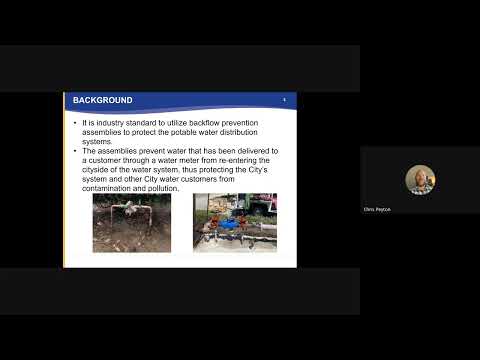
According to Peyton, a cross connection is "an interconnection between a potable water supply and a nonpotable source via any connection or structural arrangement" that could allow contamination of the public water system. He described backflow prevention assemblies as the industry standard device to stop water delivered to a customer from reentering the city distribution system and contaminating other customers.
Peyton summarized the substantive changes from the existing ordinance 2661, which previously relied on California Department of Health Services rules and California Code of Regulations Title 17. The proposed ordinance makes the CCCPH the core governing standard and specifies that the most current version of the handbook "as adopted or amended" must be used.
Key substantive updates Peyton identified include new statewide-mandated elements for public outreach, incident response, and local entity coordination; clearer hazard-assessment procedures; and a requirement that a customer or property owner provide access within five business days for a hazard assessment. Peyton said the ordinance allows for installation of an air gap or a reduced-pressure-principle backflow prevention assembly, or termination of service, if required access is not granted.
The proposal would also move inspection and testing records from paper to digital submission. "Per the CCCPH guidelines, this ordinance requires digital inspection and testing forms that must be uploaded to the Water Division backflow portal," Peyton said.
Peyton told the committee there would be "no direct fiscal impact to approving this ordinance," and that the ordinance includes fines and fees similar to the existing ordinance to encourage customer compliance and to support costs associated with operating the Cross Connection Program.
The committee did not record a final vote during Peyton’s presentation; Peyton asked the committee to review the proposal and recommend the City Council introduce the ordinance and waive first reading. Next steps would be a committee recommendation to the City Council and a potential council first reading if members move forward.