Get Full Government Meeting Transcripts, Videos, & Alerts Forever!
Get email alerts on the Resilience Action Plan topic
No spam. Unsubscribe anytime.
Erie reviews draft Resilience Action Plan; students detail air quality, heat, flooding and equity priorities
Summary
CU Boulder students and town sustainability staff presented Erie's draft Resilience Action Plan, highlighting air‑quality exceedances, heat and drought projections, flood and wildfire risk, social vulnerability in Central Erie, and plans for community engagement and next steps toward implementation.
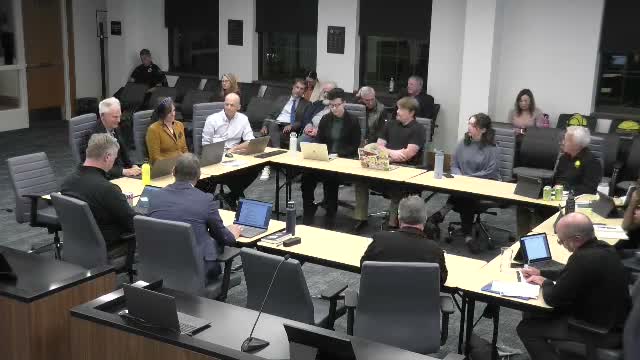
Erie’s sustainability team and a CU Boulder Masters of the Environment capstone team presented the town’s first draft Resilience Action Plan on Oct. 7, outlining hazards, vulnerabilities and draft strategies for implementation.
Erica Thorley, sustainability manager, and the student team summarized a vulnerability assessment that identified ground‑level ozone and particulate matter as the region’s major air pollutants, indoor radon as a local health concern, increasing drought risk, rising numbers of extreme‑heat days and residual flood and wildfire risks from past events such as the Front Range floods of 2013. The team noted Erie already runs monitoring and programs — including air‑quality monitors, radon mitigation rebates, tree‑planting and heat‑reduction incentives — and recommended building on those efforts.
The assessment highlighted social vulnerabilities concentrated in Central Erie: the team reported that census blocks in that corridor contain the town’s highest shares of low‑income residents (about 15 percent), housing‑cost‑burdened households (about 34 percent) and people of color (about 33 percent), and rank high for potential economic and life loss in hazards mapping. The plan groups strategies into three chapters — resilient infrastructure, land management and community supports — and links many actions to co‑benefits such as cooling, air‑quality improvements and habitat protection.
The students said they conducted broad community engagement, attending eight town events and interacting with more than 900 participants to collect priorities; the top hazards identified by residents were drought, wildfire and extreme heat, while priorities for action included ecosystems and trees, land use, transportation and water conservation.
On funding and implementation, the team said specific cost estimates were outside the scope of the capstone project but offered a list of potential funding sources and urged iterative implementation; staff indicated they will request additional resilience funding in the 2025 budget and planned to return with a final draft in early November. The student team will present the project at CU Boulder’s capstone symposium on Oct. 31 and the town asked to receive an updated draft before its Nov. 4 packet.
Council members praised the work, asked for clearer prioritization for budgeting, and requested an editable draft to provide comments prior to the next packet. Staff and the student team agreed to share updated drafts and continue community engagement.