Get Full Government Meeting Transcripts, Videos, & Alerts Forever!
Get email alerts on the Land Use topic
No spam. Unsubscribe anytime.
Erie council approves Northwesterly planned development, clearing path for 2,146 homes and village commercial
Summary
The Erie Town Council approved a planned development rezoning for the Northwesterly property on July 22, allowing about 2,146 dwelling units, roughly 150,000 square feet of commercial space, a 12‑acre neighborhood park funded in part by a $4.7 million fee and a 10% attainable housing commitment. Council and residents debated drainage, traffic design (signals vs. roundabouts), open‑space crediting and affordability verification before a unanimous voice vote.
Erie — The Erie Town Council voted July 22 to approve a planned development (PD) rezoning for the Northwesterly property, a roughly 391‑acre addition envisioned as an expansion of the Westerly community that would include 2,146 dwelling units, about 150,000 square feet of commercial space and new parks and infrastructure.
Senior planner Ali Burkhalter told the council the PD is intended to produce a mixed‑use neighborhood with a mix of single‑family, townhome and multifamily types and that the PD yields fewer units than would be allowed under the original zoning. "They're proposing 2,146 dwelling units," Burkhalter said in the staff presentation and recommended council approval, noting staff had reviewed utilities, transportation and environmental impacts and found the PD consistent with approval criteria.
Developer Southern Land Company and consultant PCS Group described design and commitments that staff and the applicant said provide public benefits in exchange for modifications from standard code. Jim Henry of Southern Land Company highlighted amenity and park commitments and a long‑term investment approach: "We're invested for the long term," he said. The applicant pledged a 12‑acre neighborhood park site plus a $4,700,000 construction commitment (with a 3% escalator), a 10‑acre private community amenity, a deeded 4.6‑acre water‑tank site and substantial trail and road improvements.
On affordability, the PD includes an attainable housing requirement equal to 10% of units; the applicant said half of those units would be restricted to 80% of area median income (AMI) and half to 120% AMI. Burkhalter and the applicant said the units are intended to be rental product and that town staff is working with regional partners on income verification and auditing.
The proposal drew both support and concern during public comment and council questioning. Resident Dwayne Drummond urged the town to "replace the planned signals on Erie Parkway with roundabouts, in keeping with the town's vision for safety and effective transportation," arguing roundabouts better support safety and traffic flow. Town transportation engineer Nick Wagner responded that roundabouts must be applied selectively and said, for a corridor with existing signals, continuing with signalized intersections can be the more appropriate option.
Several residents raised drainage concerns. Richard Shaloski, identifying himself as a local drainage specialist, warned that added impervious surfaces would increase runoff and urged the council to reject the proposal without a clear downstream mitigation plan. The applicant and civil engineer Ken Tolan said the plan includes oversized detention ponds that capture the 100‑year storm and release at a lower (approximately 5‑year) rate to reduce peak downstream flows; Tolan said the project is "overdetained" and is following the town's outfall planning guidance, with more detailed studies to follow at the plat and site‑plan stage.
Environmental staff told the council that existing oil and gas wells on the property have been plugged and abandoned and that follow‑up testing found no methane in soil samples. "There was absolutely no methane detected in any of the soil samples after those wells were plugged," said David Frank, Director of Environmental Services, reporting a state "no further action" determination.
Council members pressed for additional detail on the commercial market study (the applicant provided a market analysis supporting 150,000 square feet of commercial rather than an earlier 220,000 figure), park timing and funding flow, drainage contingencies, geotechnical controls for historic mine undermining and how attainable housing units would be monitored.
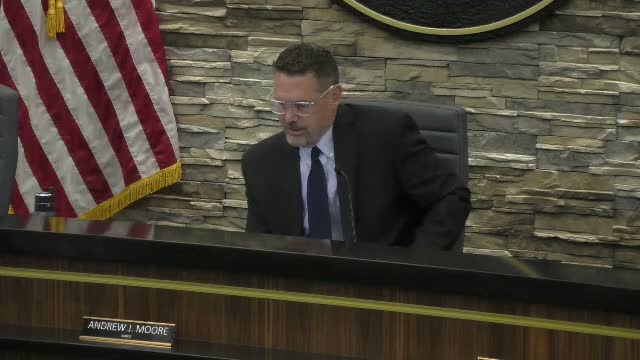
After extended questions and discussion, a council member moved to approve the PD and the motion was seconded. By voice vote, all council members present said "Aye," and Mayor Moore announced the motion carried. "Motion carries," the mayor said; the council authorized staff to continue the entitlement sequence, including preliminary plat and subsequent site‑plan and engineering review.
What happens next: Council approval of the PD rezoning establishes the concept and zoning rules for Northwesterly but does not authorize construction. Future approvals — preliminary plat, engineering plans, site plans and building permits — are required before infrastructure and homes are built. Council members and staff repeatedly noted that detailed drainage, geotechnical, traffic and school‑impact studies will be completed at those subsequent steps.
The council then moved into an executive session to receive legal advice and discuss negotiation strategy and real property matters under Colorado statutes; the meeting adjourned to closed session and did not return to open session.