Get Full Government Meeting Transcripts, Videos, & Alerts Forever!
Get email alerts on the Transportation topic
No spam. Unsubscribe anytime.
Erie transportation staff outline 25-year TMP, prioritize pavement preservation and Vision Zero safety work
Summary
Town transportation staff presented the Transportation Mobility Plan, said technology-driven street scans show the town’s pavement condition index at about 80%, and recommended preserving pavement life with targeted maintenance rather than large reconstructions. Staff also highlighted Vision Zero safety work and regional coordination on US 287 and Highway 52.
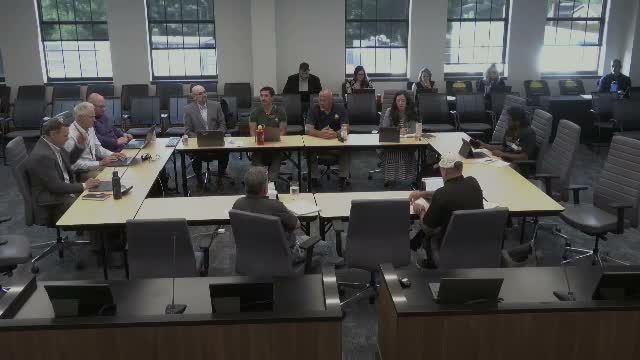
Town transportation staff on July 15 outlined a data-driven, 25-year Transportation Mobility Plan and urged council to maintain a long-term, preventive approach to pavement and safety. At a special meeting, Transportation Manager John Ferruzzi and his team described how the plan guides local projects, capital budgeting and regional coordination.
"The TMP is a high level document...it sets the vision and the focus for the next several decades," Ferruzzi said, explaining that the plan groups work into four systems — pedestrian, bike/wheels, transit and vehicle networks — and feeds capital improvement projects. Staff said the TMP was developed from traffic data and repeated public outreach events and will be updated as the community grows.
Staff highlighted tools they use to manage assets and safety. Isaac Lopez, the streets and traffic superintendent, described a new street-scan program that uses camera, lidar and AI to create a digital inventory of pavement, markings and signs. Ferruzzi said the town conducts scans roughly every three years and compares results over time to measure degradation rates and prioritize treatments.
The presentation noted Erie’s pavement condition index (PCI) is about 80 percent and that the town’s pavement-management system estimates a cumulative backlog of roughly $20.2 million to bring all paved surfaces to a theoretical 100 percent. Ferruzzi framed that figure as a planning guide and recommended staged treatments — mill-and-overlay, chip seals and targeted full-depth repairs — to extend pavement life and avoid much higher reconstruction costs later.
Safety work was presented as a complementary priority. Ferruzzi described a Vision Zero approach aimed at reducing deaths and serious injuries, and staff demonstrated a crash-analysis tool (Dyaxis) that benchmarks intersections regionally to find high-risk corridors. He said identified 'red' intersections will be investigated for engineering, enforcement and education countermeasures.
Council members pressed staff on specifics: how the backlog number is calculated, how frequently scans run, and how the town partners with regional agencies. Staff listed outside partners — CDOT, DRCOG, Boulder and Weld counties — and described ongoing coordination on corridor projects, including Boulder County’s safety study for US 287 and planned roundabout and lighting work on Highway 52.
Staff also reported progress on acquiring streetlights from a utility and said a proposal from United Power appears cost-competitive pending that utility’s board approval and final rates in October.
The presentation closed with staff asking council to affirm the TMP’s maintenance-oriented funding philosophy and to continue investing in both near-term and long-term CIP buckets so maintenance keeps pace with growth.