Get Full Government Meeting Transcripts, Videos, & Alerts Forever!
Get email alerts on the Land Use Zoning topic
No spam. Unsubscribe anytime.
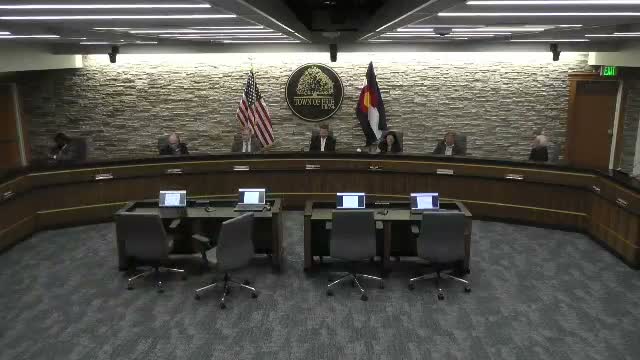
Erie council adopts code changes to allow ADUs and lift certain parking minimums near transit
Summary
Council adopted amendments to Title 10 of the Unified Development Code to align assembly‑use rules with federal law, implement state ADU requirements and remove minimum parking requirements for qualifying multifamily and adaptive‑reuse projects within quarter‑mile transit buffers; one councilor voted no and members noted pending legal challenges to the state law.
Erie — The Town of Erie Council voted 5–1 on June 10 to amend the municipal code to (1) align treatment of religious assemblies with the federal Religious Land Use and Institutionalized Persons Act (RLUIPA); (2) adopt state requirements for accessory dwelling units (ADUs) where single‑family detached homes are allowed; and (3) prohibit local minimum parking requirements for qualifying multifamily, adaptive reuse and mixed‑use projects located within a quarter‑mile of identified transit stops.
Planning and Development Director Sarah Narmela and Principal Planner Chris Lulu said the changes are required to bring local code into compliance with recent state legislation. Lulu noted that the ADU changes require jurisdictions to permit one ADU per single‑family lot with administrative approval, subordinate size and appearance requirements, and limited parking exceptions where off‑street or on‑street parking exists.
On parking, staff explained that the statute applies to areas located within a quarter‑mile of qualifying transit service areas shown on state/DOLA maps and that the town will update maps as transit routes and frequencies change. Staff also cautioned the council that some local transit routes have hourly frequency and may not meet the statute’s 30‑minute service threshold; the town will continue coordinating with DOLA to ensure accurate map boundaries.
Council discussion covered HOA authority (staff said state ADU law supersedes HOA bans on ADUs though HOAs may regulate design), the financial and market pressures that typically influence developers to include parking, and the risk of state enforcement: one staff member noted that six other Colorado communities had already filed lawsuits challenging the state law.
Mayor Moore said he opposed the state law but would follow the rule of law: "I am totally against the state law that's driving us to where we're at," he said, before voting in favor of the ordinance to comply with state requirements and protect local funding channels. Council adopted Ordinance 18‑20‑25 by a 5–1 vote.
Staff indicated the council could revisit and repeal local changes if the pending lawsuits or subsequent state action make that appropriate.