Get Full Government Meeting Transcripts, Videos, & Alerts Forever!
Get email alerts on the Police Facility topic
No spam. Unsubscribe anytime.
Erie council weighs financing options for new police facility as design nears completion
Summary
Town staff and council examined several financing paths for a proposed police facility — certificates of participation, bonds, higher impact fees or ballot measures — and directed staff to advance a community survey and impact‑fee study while continuing design work to avoid losing momentum.
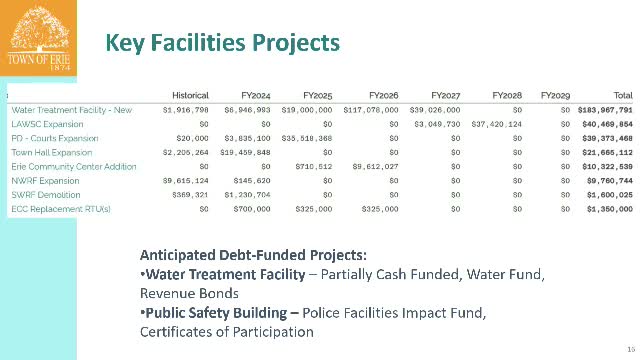
Erie — As design for a proposed police facility nears completion, Erie town staff urged the town council on March 13 to weigh financing choices now to avoid higher costs later. Sarah Hancock, the town’s director of finance, said the police project is budgeted within the town’s capital program and that the town has structured preliminary debt assumptions for a Certificates of Participation (COPs) issuance of roughly $33–35 million.
Why it matters: The council must balance urgency — the police building responds to capacity and operational needs — with the long‑term fiscal tradeoffs of choosing COPs (no voter approval required but higher investor risk) versus voter‑backed bonds or revenue pledges. Hancock cautioned that delaying construction could raise costs through construction‑cost inflation and interest‑rate movements.
Council members pressed staff on alternatives. Mayor Andrew Moore and several councilors asked whether impact fees, a sales‑tax ballot measure or other revenues could reduce reliance on COPs. Staff noted the police facilities impact fund currently receives about $454,000 per year and that the current impact fee is $686 per unit; an upper‑bound example circulated during the meeting indicated a theoretical fee near $3,850 would be required to produce $2.5 million a year without other revenue. "We are asking how to proceed at this point," Hancock told the council as she summarized the town’s choices.
Risk and reward: Hancock and the council’s bond counsel explained the distinction between funding vehicles. General obligation or sales‑tax bonds require voter approval but typically yield lower interest costs and dedicated revenue pledge language; COPs do not require voter approval but are structured as a lease/lease‑purchase and are treated differently under Colorado law. Hancock warned COPs are best suited to mission‑critical projects and said, "COPs are riskier on other types of projects," urging caution when applying COPs to revenue‑dependent facilities.
Community input and timing: Council members asked staff to accelerate two pieces of work: a comprehensive impact‑fee study and a community survey to test willingness to pay and rank priorities. Gabby (staff) had already solicited a price quote from a pollster and staff estimated a full household survey could cost in the mid‑$60,000 range. Councilors generally agreed to pursue competitive written quotes or an RFP and to attempt to get survey results in time to inform a late‑Q3 decision about debt issuance. Council repeatedly emphasized avoiding the perception of abandoning the police project while seeking broader funding options.
Next steps: Council directed staff to solicit multiple bids for a community survey, start an impact‑fee study and return with scenario comparisons (including a lower‑inflation and recessionary scenario) and legal analysis on mixed financing. Staff will continue advancing design work so that contract and procurement timing can remain options in 2025 while the town gathers more fiscal input.
The council took no formal vote at the study session; staff will return with procurement documents, refined impact‑fee estimates and scenario modeling later this year.