Get Full Government Meeting Transcripts, Videos, & Alerts Forever!
Get email alerts on the Facilities Master Plan topic
No spam. Unsubscribe anytime.
Kalamazoo County reviews Facilities Master Plan, flags multimillion-dollar needs and phased jail expansion
Summary
County officials reviewed a facilities master plan that recommends a new administration building, a larger household hazardous waste site, emergency operations options and phased sheriff’s office/jail work. Consultants estimated near-term escalation and prioritized projects for years 0–5.
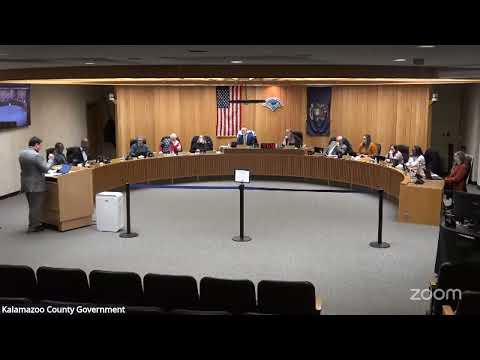
Kalamazoo County commissioners on Tuesday heard a Facilities Master Plan 2025 presentation that recommends a new administration building, investment in an emergency operations capability, a larger household hazardous waste facility and phased expansion and modernization of the sheriff’s office and jail.
Consultant Jared (Eckert Wardle) told the board the study used department questionnaires, facility tours and interviews to quantify current and projected space needs. "We kick this off by sending out a questionnaire to all of your department heads," he said, outlining a prioritization process based on need timing, the potential to enable other departments and clarity of purpose.
Why it matters: the plan groups projects into near-term (0–5 years), mid-term (5–10) and longer-term tiers. Near-term recommendations include a new administration building driven by an estimated roughly 50% growth in administrative space needs; a household hazardous waste facility (consultant recommended 10–12 acres to avoid taking park land); and phased renovations and additions to the sheriff’s office and jail.
Commissioners pressed staff on cost, scope and phasing. Jared said level-1 cost estimates include land acquisition and a 10% escalation allowance, with larger escalations applied for later years: about 30% for 5–10 year projects and 60% for projects farther out. On the sheriff’s office, he said a phased approach would allow new space to be occupied while older portions are demolished and rebuilt, and that temporary on-site facilities might be needed during reconstruction.
Board members asked about operational savings from consolidating off-site file storage into a new building; the consultant said that study was separate and not included in the master-plan cost modeling. Commissioners also discussed co-locating emergency-management functions in the new administration building versus building a stand-alone Emergency Operations Center, and the tradeoffs involved.
Next steps: staff said the master plan will inform capital investment and CIP committee recommendations; commissioners signaled support for further study, value engineering, and careful budget alignment before any project proceeds.