
Superintendent proposes $119 million operating increase and $231.6 million capital program for FY2027
Get AI-powered insights, summaries, and transcripts
Subscribe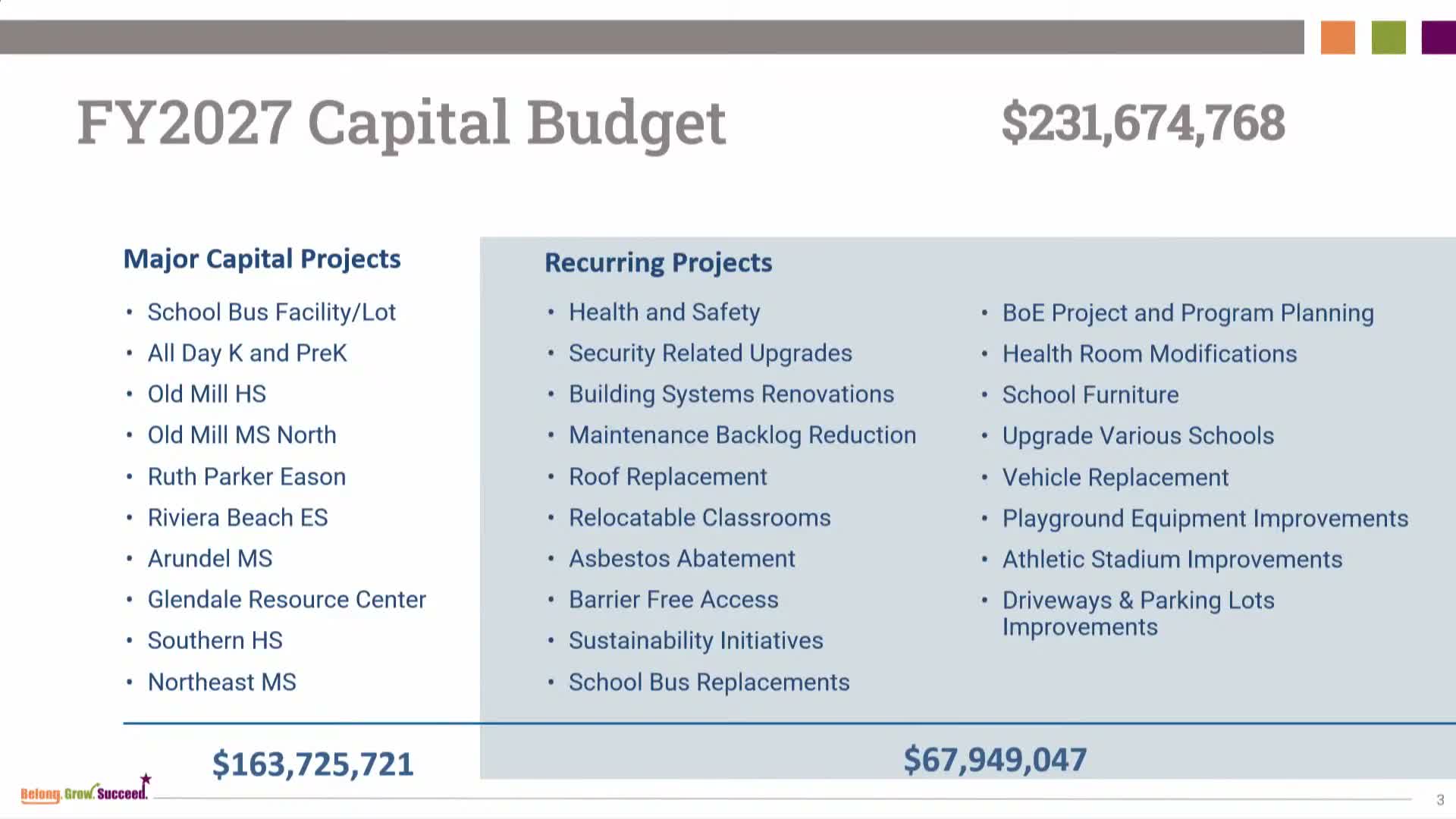
Summary
AACPS presented a superintendent's request that seeks roughly $231.6 million in capital and a $119.2 million operating increase for FY2027, emphasizing compensation, special‑education and program needs while warning of potential mitigation steps if county and state funding fall short.
Matt Stanski, chief financial officer for Anne Arundel County Public Schools, presented the superintendent's FY2027 budget proposal at the Jan. 20 workshop, describing both capital and operating priorities and the risks should full funding not materialize.
On capital, Chief Operating Officer Bill Heizer said the superintendent's request totals $231,600,000: $163,700,000 for major capital projects and $67,900,000 for recurring projects. Heizer listed priority projects including completion work at Old Mill High School, Old Mill Middle School North and construction at the Carver Early Education Center. He said the district expects about $79,100,000 in external support for these projects, with $74,900,000 anticipated from the Interagency Commission on School Construction (IAC).
On operating revenue, Stanski said the district is estimating state aid at $612,900,000 (a $19,000,000 increase) and is requesting roughly $1,000,000,000 from the county—about $100,000,000 more than FY26. He noted restricted federal grants remain uncertain and that the superintendent's request assumes full funding of state "blueprint" programs pending the governor's budget release.
Stanski broke down requested increases: roughly $40,400,000 for compensation (a placeholder for step increases and a 2% cost‑of‑living adjustment), $11.7 million for contractual obligations, $12,000,000 for blueprint mandates, and program and departmental requests totaling about $22,700,000. He also listed targeted enhancements—positions for English language development, additional counselors and psychologists, expanded co‑curricular and curriculum adoption funding, and $3,000,000 to expand high‑school laptops.
Stanski warned of rising benefit costs. The district projects a 13% increase in health‑care claims this year for a fund covering more than 35,000 people and said the budget includes a $10,000,000 placeholder that will likely be amended in February to about $20,000,000 to meet obligations. He also cited pension cost increases tied to higher salaries and an aging participant base.
Because of enrollment declines in some categories and rising student needs—special education and multilingual learners have grown—Stanski warned the district faces structural cost pressures and outlined mitigation strategies should the county or state provide less than requested. Those strategies include further central hiring freezes, reassessing department requests, possible delays to curriculum adoptions, and difficult choices about program and staffing allocations. He emphasized the administration will prioritize minimizing impacts to classrooms and student services where possible.
Key calendar dates: the board must vote to transmit its request Feb. 18; the district must send the request to the county by March 1; the county executive releases a budget in May; the charter deadline for county action is June 15 with the board approving the council's final budget by June 17.