Get Full Government Meeting Transcripts, Videos, & Alerts Forever!
Get email alerts on the Environment And Public Health topic
No spam. Unsubscribe anytime.
Select Board hears DPW briefing after DEP flags 1,4‑dioxane and arsenic at Parkerville Road landfill wells
Summary
DPW Superintendent Bill Cundiff told the Select Board that DEP asked for additional analysis after monitoring found 1,4‑dioxane and arsenic exceedances at landfill monitoring wells near Parkerville Road; the town has sampled groundwater and two private wells and will deliver a DEP risk assessment within 60 days.
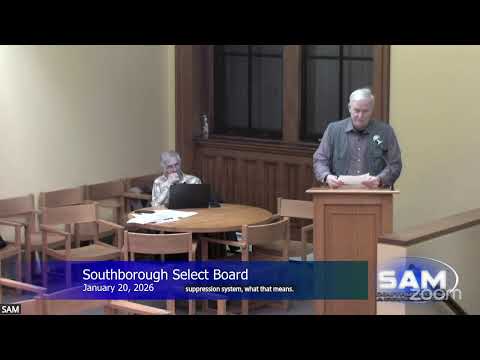
The Select Board on Jan. 20 received a technical briefing from DPW Superintendent Bill Cundiff about a DEP letter requiring additional sampling and a risk assessment after exceedances at monitoring wells near the capped landfill on Parkerville Road.
Cundiff said DEP notified the town on Jan. 7 that monitoring detected two exceedances. He described the monitoring network as three well groupings (MW‑2, MW‑3 and MW‑4) surrounding the landfill and said the DEP asked the town to classify the groundwater, identify down-gradient public-water-supply zones and private wells, and complete a risk assessment.
Regarding chemical results, Cundiff said the town’s monitoring detected 1,4‑dioxane above the DEP threshold (0.3 micrograms per liter). “In this round we detected in the shallow well 0.9 parts per billion and in the deep well 0.5 parts per billion,” he said. He also reported an arsenic result of 0.017 micrograms per liter at MW‑4 against an arsenic threshold of 0.01 micrograms per liter. Cundiff emphasized that the DEP’s request is for information, not that the agency declared a public‑health emergency.
Cundiff said consultants (Parr) promptly collected additional groundwater samples and took samples from two nearby private drinking-water wells; the town is awaiting analytical results. Once analyses are complete, Parr will prepare the DEP‑requested risk assessment and a response within the 60‑day window Cundiff cited.
Residents asked why the DEP raised the matter now when low-level exceedances have been present for years; Cundiff said monitoring in the MW‑3 wells has shown minor exceedances since at least 2015 and that a recent citizen inquiry may have triggered the DEP contact. Cundiff also said gas monitoring (soil‑gas probes) is performed along the landfill property boundary and that the town plans to install additional probes where older ones have been covered or rendered inaccessible.
Cundiff told the board the town has been sampling surface water and collecting stream samples downstream of the landfill and has not observed exceedances in those locations. He committed to provide residents with clarifying material about sample locations and to follow up with the DEP response once the risk assessment is complete.
“DEP basically had a number of things that they wanted us to do as a result of the exceedances,” Cundiff said, adding the response “is not a situation that is a cause for a health emergency” but does require technical follow-up.
The board encouraged residents to read the consultant memo prepared by Tim Tees and Parr for detailed analytical context and asked DPW to continue public communication while the town completes the requested sampling and assessment.